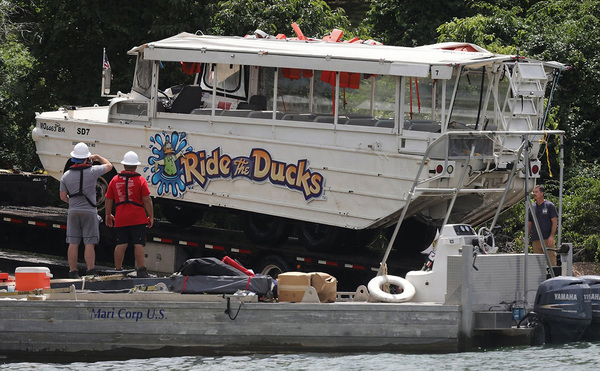
KANSAS CITY, Mo. — A federal judge in Missouri has dismissed criminal indictments against three men charged for their alleged involvement in a 2018 duck boat disaster on Table Rock Lake that killed 17 people.
Doug Harpool, a federal judge in Springfield, on Wednesday adopted the recommendation of magistrate Judge David Rush, who said in September that federal courts did not have jurisdiction in the case because of the nature of Table Rock Lake, where a Ride the Ducks boat owned by Ripley Entertainment carried 31 people into a powerful storm before sinking.
Wednesday's order means Kenneth Scott McKee, the captain of the duck boat, and Ripley Entertainment employees Curtis Lanham and Charles Baltzell currently no longer face criminal charges.
"While the events of July 19, 2018 remain an unfortunate accident and tragedy we're pleased that both Judge Harpool and Magistrate Judge Rush have sustained the admiralty dismissal motion," said Kansas City attorneys J.R. Hobbs and Marilyn Keller, who represented McKee.
Tom Bath and Tricia Bath, who represented Lanham, referred to an earlier statement in which they said they believed the tragedy was caused by a "once in a lifetime storm" and not the actions or failure to act by Lanham or other employees.
Federal prosecutors could seek an appeal of Harpool's dismissal.
"We don't believe it's appropriate to publicly comment on internal discussions of prosecutorial decisions," said Don Ledford, a spokesman for the U.S. attorney for the western district of Missouri, Tim Garrison.
A federal grand jury brought an indictment against the three defendants in 2019, accusing them generally of negligence and being more concerned with profits than passenger safety.
The indictment said McKee was negligent as a boat captain for bringing passengers out on Table Rock Lake as a storm with winds in excess of 70 miles per hour approached and did not prepare passengers as it became apparent the boat would sink.
The indictment also said Lanham, the general manager of Ride the Ducks in Branson, and Baltzell, the supervisor, did not properly monitor the approaching storm and the risks it posed for passengers on the lake.
The federal charges hinged on whether Table Rock Lake was considered a "navigable waterway"; in other words, whether it supported commercial activity like shipping.
Defense attorneys in the case filed a motion to dismiss the indictments, arguing that federal law does not support the criminal charges against their clients because Table Rock Lake was not navigable.
Rush and Harpool agreed with that analysis. Rush said in his recommendation that if the defendants were to be prosecuted, it should happen at a Missouri state court.
Prosecuting attorneys in Stone and Taney counties were not immediately available to discuss whether they were considering a case in state court.
The National Transportation Safety Board investigated the duck boat sinking and issued a final report earlier this year that said lives could have been saved in 2018 had the U.S. Coast Guard followed recommendations from 2002 in the aftermath of a similar duck boat catastrophe in Arkansas.
The NTSB suggested after the 1999 Arkansas tragedy that duck boat operators remove overhead canopies that had the tendency to trap passengers if the boat started sinking.
Neither the Coast Guard nor Congress acted on those recommendations.
Video taken by witnesses aboard the nearby Showboat Branson Belle when the duck boat sank showed the presence of an overhead canopy and side curtains as waves and strong winds battered the vessel.
NTSB investigators and board members were mixed about McKee's handling of the ill-fated duck boat. One investigator noted that camera footage showed the lake was calm when the boat first arrived for a lake tour.
The resulting storm, however, would whip up winds that were more than twice what investigators said a duck boat — a retrofitted World War II-era vessel designed to travel by water and land — was designed to handle.