CIUDAD JUAREZ, Mexico _ The number of asylum-seekers arriving in this troubled city has reached a critical point as renewed drug violence explodes, creating what local leaders say is a pressure cooker for the region with a perilous outcome for both sides of the border.
"This is creating a climate of instability," said Jorge Contreras Fornelli, a member of the Citizens' Council for Public Security and furniture maker.
A group of priests, including a representative of the Vatican, and migrant advocates plan a Tuesday afternoon Mass near an 18-foot high fence to push back against President Donald Trump's Feb. 15 proclamation of a national emergency to build a wall on the U.S.-Mexico border. The House is expected to vote Tuesday on a resolution to block the declaration.
The priests are also calling on the government of Mexico President Andres Manuel Lopez Obrador, popularly known as AMLO, to resist pressure from Trump to implement Migration Protection Protocols, which are already in effect in Tijuana and are expected to be enforced in the coming days in the El Paso-Juarez area, too, said U.S. Rep. Veronica Escobar of El Paso.
The controversial protocols, originally known as Remain in Mexico, require that immigrants headed to the U.S. wait in Mexico until their asylum claims are considered. Critics say the policies are contributing to a "bottleneck crisis" with "catastrophic" effects on the border.
The protocols may lead to the building of tent cities in Juarez, argued Dylan Corbett, executive director of the Hope Institute.
"The criminalization and militarization of the border has lethal, fatal consequences for our border and we've seen that firsthand," said Corbett, noting the death of two young Guatemalans while in U.S. border patrol custody in December.
The flow of migrants has already put a strain on resources on both sides of the border. Casa del Migrante, the leading shelter in Juarez, is filled to capacity and is no longer accepting asylum seekers. Similarly, a gym used as a shelter is no longer taking in migrants. Efforts are under way to create additional space at a factory.
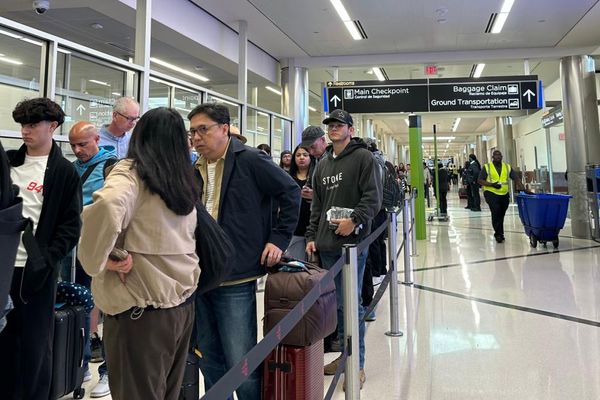
Across the border in El Paso, Annunciation House, a principal nonprofit waystation for asylum seekers, said it took in more than 3,600 migrants from Feb. 16-23, a record for the shelter. Over the weekend, dozens of Central American families, clutching their children, were spotted at the airport, bound for cities that included from Atlanta, Houston and Dallas.
In interviews, many said they were lured to the border by "guias," or smugglers, who charged them to take them to remote areas near Antelope Wells, N.M., where they turned themselves in to border patrol authorities. Because space is limited in holding cells there, many were released with ankle bracelets and given court dates to present their cases for asylum.
The situation is largely a result of Trump's so-called metering system, which limits the number of people allowed to present their asylum claims at legal ports of entry. For instance, in Juarez, as many as 60 people were being processed each day at one point. That number is now down to an average of 20, thus discouraging migrants from seeking asylum at border checkpoints and leading many to attempt to cross in remote, often desert or scrub, areas.
Their only other option is to be added to the U.S. waiting list and wait in Mexico until their names rise to the top of the list for processing. Mexico's tacit cooperation with this controversial policy has put Lopez Obrador in an uncomfortable situation. He's come under fire from a variety of critics, led by U.S. legislators, Catholic leaders and dozens of immigrant rights groups, who accuse him and Trump of sidestepping human rights international law that grants asylum-seekers a hearing.
Lopez Obrador administration officials have said they want to avoid a confrontation with Trump over immigration, something they see as a domestic matter that needs to be resolved by U.S. courts and not the Mexican government. But some analysts say playing along is risky.
"By avoiding a confrontation with Trump and allowing Central American migrants to remain in Mexico while applying for asylum, AMLO is losing credibility with his nationalistic base," said Howard Campbell, an anthropologist at the University of Texas at El Paso and author of "Drug War Zone: Frontline Dispatches from the Streets of El Paso and Juarez." "AMLO needs to resist Trump's policies and rhetoric in order to maintain his popularity in Mexico."
Indeed, given their populist nature, and strong political base, the two leaders face an inevitable explosion, said Guillermo "Jesus" Velasco, a specialist on U.S.-Mexican relations at Tarleton State University.
"The conflict will arrive in any moment, and it will be intense," he predicts. "This is a time bomb."
The situation in Juarez is compounded by Mexican state governments, including in Coahuila, which have opted to pay for buses to push migrants out of their states and into Juarez, angering local officials here. This comes amid renewed drug turf wars in Juarez, pushing homicides rates into the hundreds per month.
Last year, Mexico tallied 33,341 murders, a record.
"Mexico is not safe for Mexicans and therefore not safe for asylum seekers," said Guadalupe Correa. "It seems that Mexico is doing the dirty work for Trump. Mexico continues to be America's backyard."
Across the border in El Paso, meanwhile, one of the safest cities in the country seems to be preparing for battle. Razor wire has gone up on the international bridges, placed by Custom Border Protection authorities to "prevent a rush" of migrants into the city. The Pentagon's top brass also toured the city even as President Donald Trump plans to divert billions of dollars from the military budget for his promised wall. Acting Defense Secretary Patrick Shanahan fired off a couple of border patrol weapons on Saturday as cameras clicked.
Local leaders fired back.
"Our bridges are a symbol of our history with Mexico, our strong binational ties and shared interests, and should not become militarized zones based on a misguided policy rooted in fear," said Escobar.
El Paso Mayor Dee Margo, a Republican, reminded lawmakers in a column for Ripon Forum on Monday, that "115,000 jobs in El Paso and 559,000 jobs in the State of Chihuahua, Mexico, depend on our cross-border commerce. Any rhetoric implying otherwise is false and should immediately be retracted. Mexico is Texas' largest trading partner, and instituting policy that will detrimentally affect that trade is unacceptable."
In Juarez, Sergio Marquez, 59, crosses the border from El Paso daily to work in the gritty streets of his native city in a cab. He said he's concerned about migrants swarming the streets alongside rising violence, and razor wires going up, generating a tense climate.
"Both sides of the border just feel too tense, stressed," he said. "Like we're about to go war, but with who? I don't get it."