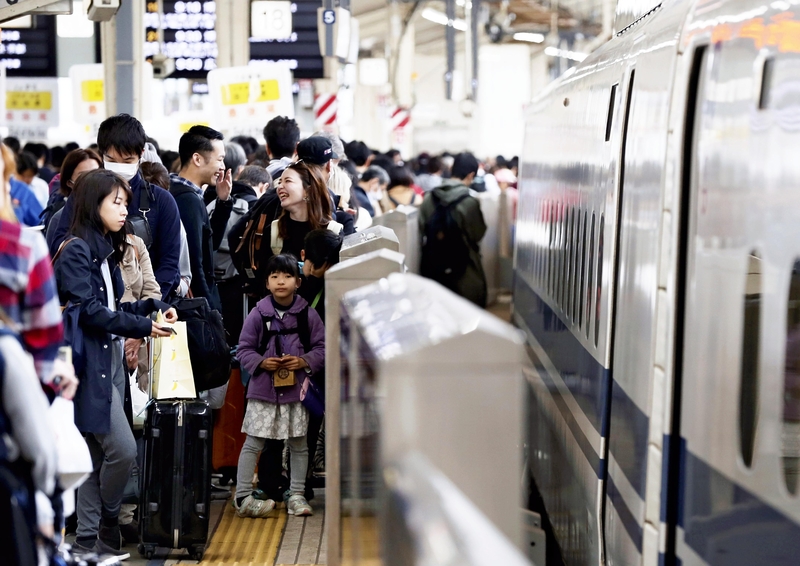
Central Japan Railway Co. (JR Tokai) is hunting for seconds to squeeze out of its already overcrowded timetable in order to increase the number of Nozomi bullet trains on the Tokaido Shinkansen.
With the Tokyo Olympic and Paralympic Games less than a year away, these time-saving measures include introducing high-performance brakes that enable trains to maintain high speeds as long as possible and further streamlining the cleaning process inside the passenger compartments.
Frequent as commuter trains
According to JR Tokai, up to 10 Nozomi trains on one-way services are operated between Tokyo and Shin-Osaka stations per hour. Including Hikari and Kodama trains that stop at more stations than the Nozomi, the average daily number of runs on the Tokaido Shinkansen was 373 in fiscal 2018, up 1.6 times from 231 in fiscal 1987, when Japanese National Railways was privatized. About 480,000 people per day used the service in fiscal 2018, up 1.7 times from fiscal 1987.
Trains are already crowded enough during busy seasons. During past Bon summer holiday periods, the occupancy rate of unreserved seat cars reached up to 180 percent last year and 200 percent in 2017.
A maximum of 1.1 million spectators are expected to visit Japan during the Tokyo Olympics and Paralympics in July-September next year.
JR Tokai has yet to predict the congestion of Shinkansen trains during the event.
"Even now, there are people claiming they couldn't take trains in a desired time period mainly in the busy seasons. Considering the event, it is essential to increase the number of trains," said a JR Tokai official.
The company plans to increase the number of Nozomi trains by two per hour when it revises the timetable next spring. The maximum number of runs between Tokyo and Shin-Osaka stations will be 12 trains per hour. The interval of the trains will be comparable with commuter trains. Including the Hikari and Kodama trains, 17 trains an hour will run on the section.
To maintain speed
Amid the already overcrowded timetable, from where will JR Tokai find the time to fit in additional trains? Presently, the company has focused on improving the brake system and its cleaning routine.
The train's Automatic Train Control (ATC) system is activated when it approaches a station, and the driver manually stops the train when the speed falls to 30 kph or less. JR Tokai has improved the ATC so that the brakes begin operating later than before when approaching Tokyo Station. As a result, trains can maintain high speeds a few seconds longer.
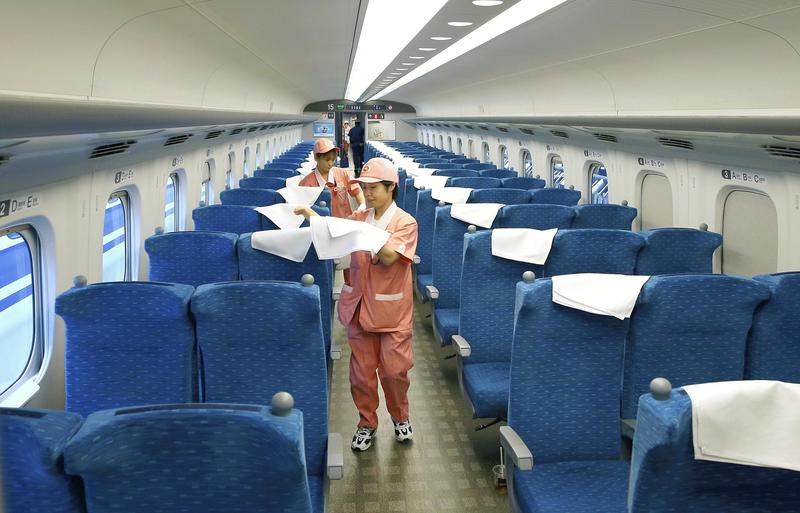
JR Tokai will also further fine-tune the already well-known brisk cleaning procedure inside passenger cars arriving at Tokyo Station. Arm rests will be wiped only when they are dirty. The numbers will be reduced in refilling liquid soap in toilets and washrooms, as well as in changing out the ashtrays in the smoking room. These measures will shave about 2 minutes off the current 12-minute procedure at its fastest.
Furthermore, the company will revise the safety check procedures carried out by station staff on the platform before the train departs, squeezing a few more seconds. When the timetable is revised next spring, all trains will be the N700A type, which have a maximum speed of 285 kph.
Consequently, JR Tokai succeeded in shortening the interval of train departures by a dozen seconds, letting it achieve an increase of two trains per hour.
Safety measures
Further congestion on the train timetable requires additional safety measures. The trains will be equipped with a function to prevent short-circuits even if the voltage from the overhead wire temporarily drops when many trains arrive and depart at the same time.
The total cost for this upgrade is estimated at about 3.2 billion yen, according to a JR official.
Hitoshi Tsunashima, a professor at Nihon University, said, "In addition to the Olympics, the number of passengers is expected to continue increasing as the population is concentrated in major cities along the line, including Tokyo and Osaka."
Tsunashima, a specialist in railway engineering, called on JR Tokai to ensure safe operations, considering the burdens of increasing the number of trains.
Six times more trains than 1964
The Tokaido Shinkansen, once described as a super express of dreams, is widely associated with the previous Tokyo Olympics. The Shinkansen began operating on Oct. 1, 1964, only nine days before the opening of the Games. At that time, Kodama and Hikari bullet trains were running at a maximum speed of 210 kph, and it took at least 4 hours between Tokyo and Shin-Osaka. The average daily number of services was 60, or one-sixth the current number, while about 60,000 people, one-eighth the number today, used the service.
Read more from The Japan News at https://japannews.yomiuri.co.jp/