Construction is moving ahead on a 286-kilometer section of the Chuo Shinkansen between Tokyo and Nagoya that uses the superconducting maglev system by Central Japan Railway Co., also known as JR Tokai.
With an eye toward launching service between Tokyo and Nagoya in 2027, JR Tokai is having its engineers refine the unique, advanced technology by repeating test runs at the Yamanashi Maglev Test Line.
Japan initiated development of the maglev system in 1962, two years before the Tokaido Shinkansen bullet train line launched. Superconductivity is a phenomenon in which the electrical resistance of certain metal elements approaches zero at a very low temperature.
Even though this system generates an electrical current that continues to flow almost indefinitely, the hurdle has been putting it into practical use because a slight increase in heat means superconductivity cannot be maintained.
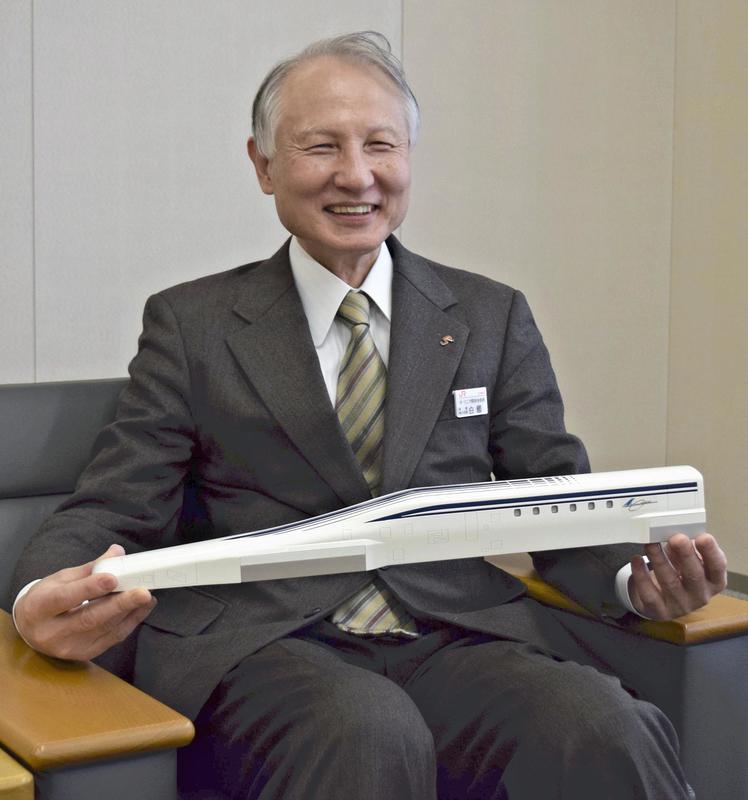
"The most difficult thing was to properly maintain the state of superconductivity," said JR Tokai Senior Corporate Executive Officer Noriyuki Shirakuni, known in-house as "Mr. Linear" for the linear motor used in the maglev system and the developments in recent years to the system.
"A big thing was establishing technology to maintain the state of liquid helium and to reduce the amount of heat emitted by stabilizing the magnet," he said. In the current maglev system, the superconductive state is achieved by cooling to minus 269 C a Niobium-titanium alloy with liquid helium.
Test runs, initially operated in Miyazaki Prefecture, have been held on the Yamanashi Maglev Test Line since 1997. Among other improvements, the reduction of wind resistance -- something borrowed from airplane aerodynamics -- also greatly contributed to the technological innovation of the maglev system.
On the other hand, China adopted a normal conduction maglev system developed by Germany in which the vehicle floats using electromagnets. The Shanghai Maglev Transportation Development Co.'s trains run at a top speed of 430 kph. The vehicles float at a height of about 1 centimeter.
"The Japanese system is strong during earthquakes because [the vehicle] floats 10 centimeters," stressed Shirakuni, who is enthusiastic as he looks toward starting commercial service. "We want to improve our technology to control the amount of shaking and noise of the maglev train, putting it on par with the Shinkansen bullet train," he said.
JR Tokai has proposed the introduction of the superconducting maglev system to the Northeast Corridor project in the United States, connecting New York and Washington. The company initially hopes to realize a maglev section between Baltimore and Washington as a Japan-U.S. collaborative project.
Floating experience
On the Yamanashi Maglev Test Line, riders can board the maglev train and experience what 500 kph feels like. There are also related facilities at the Yamanashi Prefectural Maglev Exhibition Center in Tsuru, Yamanashi Prefecture, to introduce characteristics of the superconducting maglev system in a simple way through demonstrations.
I took a ride on the test train. It began the journey on tires first and shifted to levitation once its speed exceeded 150 kph. I felt the train car floating and the shaking stopped. People in the vehicle cheered when the maximum speed surpassed 500 kph. In 2015, the maglev train broke the record for the world's fastest manned train with a speed of 603 kph.
Since 2014, JR Tokai has held a paid test-ride event about three times a year at the Yamanashi Maglev Center, and more than 80,000 riders have so far taken the train, according to the company.
Those 16 or older living in Japan can apply to take part in the event, but the number of applicants reaches as many as 30 times capacity on weekends.
A 45-year-old company employee from Yokohama rode the train with his 6-year-old son and said, "It was great -- I could feel the speed."
Read more from The Japan News at https://japannews.yomiuri.co.jp/