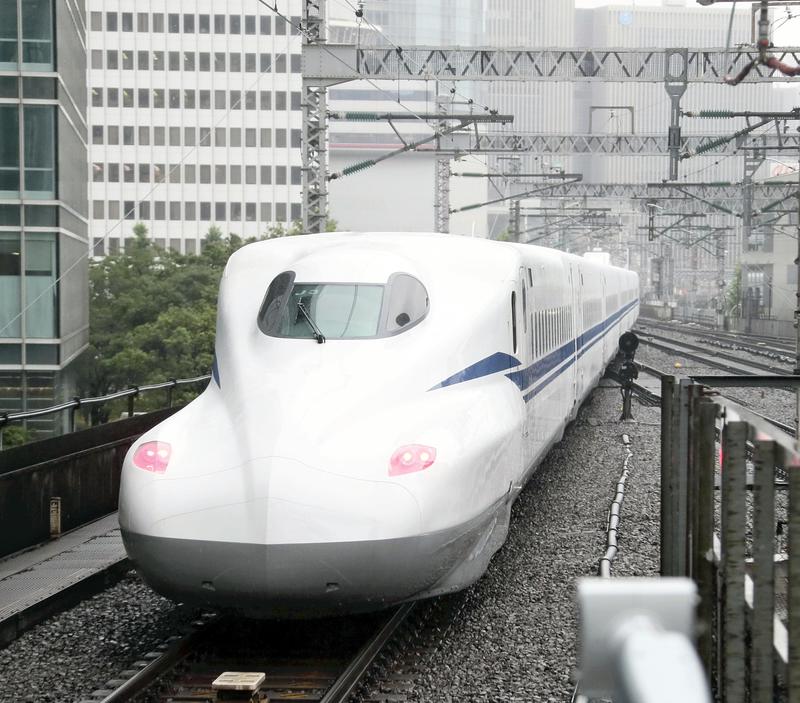
JR companies, organizations backing the disabled and the transport ministry have reached an agreement to expand the number of stalls for wheelchairs on Shinkansen bullet trains with the figure is expected to increase to at least four -- from one or two -- per train.
Tests are expected to be conducted this month along the Tokaido Shinkansen Line, which connects Tokyo and Osaka, as the groups look for more slots to accommodate six wheelchairs.
Under the Barrier-Free Law, railway operators are obligated to set up wheelchair-accessible areas. The Land, Infrastructure, Transport and Tourism Ministry establishes criteria for the number of wheelchairs accommodated per train.
After the revision of the criteria in 2018, it became necessary for Shinkansen to provide a basic standard for stalls at two or more wheelchairs per train. JR companies, four organizations for the disabled and the transport ministry opened discussions in January to expand the capacity in time for the Tokyo Olympics and Paralympics.
The three parties in June agreed the number of spaces for four wheelchairs per train will be set on the Hokkaido, Tohoku, Joetsu, Hokuriku and Sanyo Shinkansen lines, which can accommodate from 500 to 1,000 passengers per train.
According to sources, including the transport ministry, Central Japan Railway Co. (JR Tokai) has proposed that the number of wheelchair stalls on the Tokaido Shinkansen Line, which has the largest capacity among Shinkansen lines at 1,323 passengers, be set at four for the time being, and increased to six according to demand.
However, some groups called on the company to up the number of slots to about six. As a result, an agreement on the number of slots wasn't reached during talks between JR Tokai and the groups, and the sides have decided to conduct tests on designated cars before the end of the month.
The tests are to feature Shinkansen cars equipped with special areas for wheelchairs that will be set up to determine the level of accessibility among users.
The three parties aim to reach an agreement on wheelchair stalls on the other Shinkansen lines such as Yamagata and Akita, which are Mini-Shinkansen Lines with limited capacity, Kyushu, which has a limited capacity for some cars, and Tokaido.
The ministry will decide on the number of wheelchair slots and JR companies plans to expand the area on cars subsequently produced.
The groups backing the disabled are seeking wheelchairs areas that accommodate six on the Tokaido Line because they believe expanding the number on a major transport line will help facilitate barrier-free access in society.
According to the transport ministry, about 90% of major railway stations and airports meet the government's criteria for the installation of elevators for the disabled.
Wheelchair stalls are also expanding on conventional lines and subways.
"The government criteria for Shinkansen is low," however, according to Satoshi Sato, who is participating in the three-way talks as the secretary general of the nonprofit organization Japan National Assembly of Disabled Peoples' International or DPI-Japan.
"It is also important to improve the quality [of train cars] so that passengers can ride with peace of mind," Sato said, noting that some wheelchair stalls are so undersized that users sometimes extend out into aisle space.
Said a JR Tokai official: "Based on the current circumstances, we believe that the expansion to four is sufficient. We will extend discussions based on opinions and requests from organizations for disabled people."
Read more from The Japan News at https://japannews.yomiuri.co.jp/