If this is an obvious choice for a summer read, I make no apologies. It may inspire you to abandon the beach, if you haven’t already read it. If you are still lying on the sand, perhaps you should read it again.
Walking for me will not be the same again. I will walk along paths, sail on the sea, with added enjoyment, my imagination fired after reading The Old Ways: A Journey on Foot. Macfarlane embraces landscapes, and seascapes. He revels in what he sees with his eyes, as well as the history, books and poems they have inspired. (Language and dialects, the origins of words, are themes of his latest book, Landmarks, published earlier this year.)
I learn, as he describes the hills and paths of the Ramallah region on the occupied West Bank, the origin of the word “saunter”, from the French “sans terre”, itself a contraction of “à la sainte terre”, meaning “in the sacred place”. That “natsch”, a spindly thistle, is used by Israeli lawyers to mean waste ground – “more easily requisitioned when necessary for Israeli purposes,” Macfarlane notes.
There are simple, evocative images – a “dishwater sky of low cloud”, “porcelain snow’” in Tibet. The colour of chalk showing through the snow on the Ridgeway is “the yellow of polar-bear fur or an old man’s knees”.
He describes “rain drilling the earth” during a big storm, a large field mushroom “lying upside-down its cap, its black gills like the charred pages of a book”.
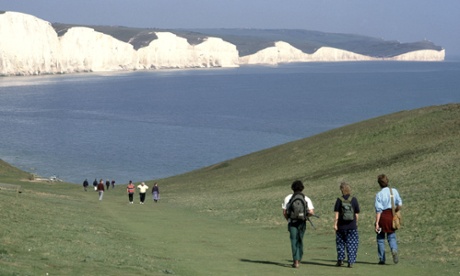
Swifts turn so sharply and smoothly and fast “that it seemed the air must be honeycombed with transparent tubes”. The Seven Sisters cliffs on the Sussex coast “are strung out like a line of washed and pegged sheets”. Wonderful.
And it comes with the added benefit of most relevant references to writers of all sorts – Wittgenstein, Keats, Hazlitt, George Borrow and, above all, to Edward Thomas.
Thomas, says Macfarlane, experienced “the tension between roaming and homing”. He writes: “Thomas used the old ways to keep himself in motion, for like George Borrow – whose biography he wrote and with whom he closely identified – he was depressive”.
Walking, observes Macfarlane, was one of the few activities that could lift Thomas from his depression. That may be one hugely beneficial effect, but there are many, many, others.