Even after the intense scrutiny of every facet of Britten’s music that was generated by last year’s centenary, works that have gone unheard for more than half a century are still being prised out of the Aldeburgh archives. Chamber Domaine’s collection includes four pieces recorded for the first time, alongside two others from the 1930s that are rather better known – the Sinfonietta, which Britten composed in 1932 while still studying at the Royal College of Music and evidently thought enough of to make his official Op 1, and the rather Stravinskyan Suite for Violin and Piano Op 6, which he completed three years later.
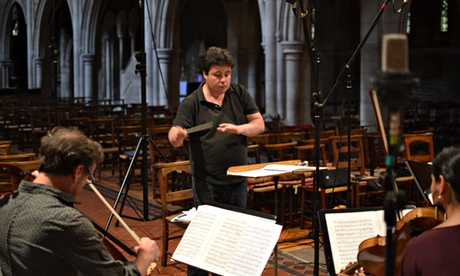
Among the totally unfamiliar pieces, the real rediscovery – and the score that’s surely most likely to be to taken up more widely – is the arrangement for 12 instruments of There Is a Willow Grows Aslant a Brook. A Shakespearean “impression” for small orchestra, it was composed in 1926 by Britten’s teacher Frank Bridge, inspired by Gertrude’s description of the death of Ophelia in Hamlet. Britten made his reduction for the first Aldeburgh festival in 1948, thinning out the original’s woodwind and brass and adding some extra percussion to the climaxes. Bridge had died six years earlier while Britten was living in New York, and there’s a sense that this beautiful reworking – haunted, spare and profoundly elegiac – is a belated memorial tribute; the Chamber Domaine players conducted by Thomas Kemp capture its fragile essence perfectly.
The other works rehabilitated here date back to Britten’s RCM days. There’s a substantial Introduction and Allegro for piano trio, which was composed just after the Sinfonietta and for which Ravel appears to have been the model, and two miniatures – The Moon, for violin and piano, and a solo-piano Allegro. None of them may add anything significant to our understanding of his development in the early 1930s, but they all underline again how Britten was testing out the different strains of modernism to discover what suited his musical purposes best, and of course they provide more opportunities to marvel at the sheer energy, fluency and panache of the teenage composer’s instrumental writing. The performances are full of that exuberance, and the Sinfonietta has the same irresistible verve. This collection is available to download in three formats – MP3, wav and flac – and it’s certainly very well worth exploring.
• Available only as a download from resonusclassics.com