Two months have passed since an epidemic of a new coronavirus began in Wuhan, China.
Due to the urgency of the situation and to encourage information sharing among doctors and researchers around the world, there have been moves to make research papers and data -- which usually require time for peer review and are only accessible to subscribers for a fee -- immediately available without restrictions.
Thousands of papers
The number of papers and reports on the new coronavirus has surged since late January, when a World Health Organization committee met to discuss whether to declare a global public health emergency. By late February there were more than 1,000 papers.
It is unusual for there to be so many publications on a new infectious disease in such a short period of time. This is more than during the novel influenza outbreak of 2009 and the Zika virus epidemic of 2016.
The surge reflects the fact that many journals have made their papers on the new coronavirus "open access," meaning anyone can view them free of charge.
Leading medical journals in the United States and Britain have made related papers immediately available since late January, when concerns about a pandemic increased. These include the Lancet of Britain and the New England Journal of Medicine (NEMJ) and the Journal of the American Medical Association.
Usually academic papers must undergo a process called peer review, and can take about six months to a year to be published. Payment or membership with the journal or academic society is also usually necessary. Making the data public carries the risk of revealing research secrets.
In a statement, the NEJM editorial department said that threats to public health and rapidly changing conditions require a different response than in normal times.
Latest information
In response to the WHO emergency declaration on Jan. 30, the next day 100 organizations, including leading medical journals, research institutes and pharmaceutical companies, released a statement saying they had agreed to make research results and data related to the epidemic available quickly and for free so medical practitioners could access the latest information.
The statement was signed by groups such as the U.S. National Institutes of Health, the U.S. Centers for Disease Control and Prevention, the Japan Agency for Medical Research and Development, and Takeda Pharmaceutical Co.
Doctors cannot base their actions on ambiguous data such as hearsay. Therapeutic decisions need to be based on reports that contain scientifically validated data, along with references.
Trials by Japan and others using Kaletra, a combination of lopinavir and ritonavir that is used to treat AIDS, and Avigan, a new influenza drug, have contributed to this immediate publication effort.
Sluggish response to Zika
Attempts to make paid academic journals free of charge during new infectious disease epidemics began to take hold around the 2009 novel influenza epidemic.
New infectious diseases require an urgent response, and being able to quickly share information without limitations on subjects such as the clinical course and effective treatment methods could help hold back the spread of infection.
When the WHO was concerned about the spread of the Ebola outbreak in September 2015, the organization asked the editorial departments of four journals, including Nature and NEJM, to make research findings that could benefit the public free of charge during the emergency.
However, academia's response to the Zika fever epidemic was more sluggish. As the disease spread in Latin America, experts from the United States and elsewhere even called for the Rio de Janeiro Olympics and Paralympics to be postponed or moved to a different location.
At the time, the WHO released a report saying that "data sharing was inadequate," and urged academia to disclose all treatment and drug information without restrictions.
In response, 30 scientific journals, academic societies and other groups led by the British medical charity Wellcome Trust issued a statement in February 2016 agreeing to open access, which accelerated information sharing.
The latest statement has 100 signatories, showing the movement has developed and expanded.
Risks of no peer review
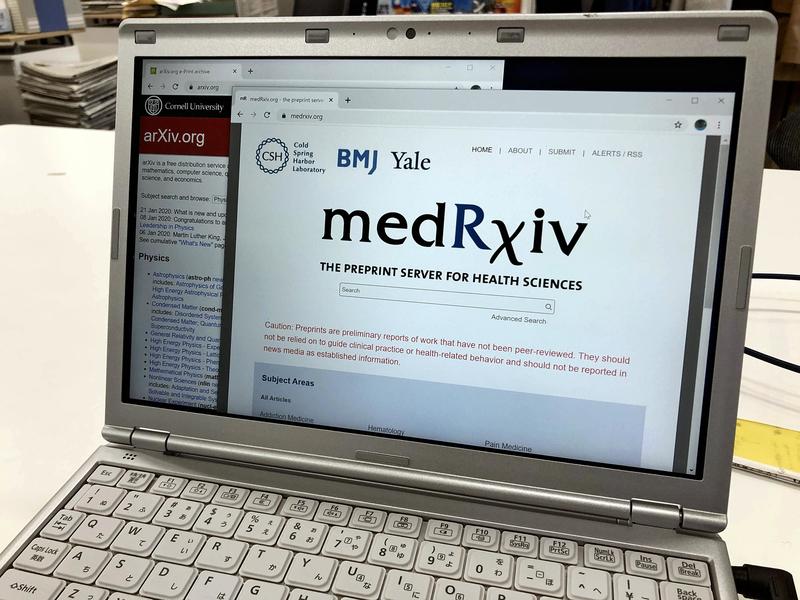
One thing that deserves mention is the contribution of so-called preprint servers. These were established to publish papers that have not yet been peer reviewed to encourage information sharing among researchers on urgent topics.
Servers for medicine and the life sciences have been created recently. These have accounted for 40 percent of the submissions during the present epidemic, and have supported the speedy disclosure of information.
On the other hand, there may be "side effects" of immediate publication, in that uncertain information can be disseminated over servers.
A researcher in India posted a paper on a server describing observing strange similarities between the proteins of the new coronavirus and HIV, which created a stir in the media and social networking services that the virus could be an artificially synthesized biological weapon. After the paper was criticized by many scientists, the author announced a correction.
John Inglis of the Cold Spring Harbor Laboratory, a co-founder of a medical server, said that information that is published immediately and for free has not been screened for reliability or importance. Scientists must assess the information and confirm it, he said, emphasizing aspects that differ from regularly published papers.
Amid this high-speed environment, there are very few items from clinical practice in Japan that are in both English and Japanese. This means foreign experts are unable to search items from Japan. This is not good for the world or Japan.
Read more from The Japan News at https://japannews.yomiuri.co.jp/