A journal has been found that describes the construction of an underground facility that the Imperial Japanese Army is said to have built as a site to which to transfer the central functions of the Manchukuo government in July 1945, The Yomiuri Shimbun has learned.
The specifics of the construction plan, which had been described as an "illusory resistance vision," remain unknown. However, the journal by a person concerned suggests that the Imperial Japanese Army was hastily constructing the facility in Tonghua, near the Korean border, as a base for resistance due to concern over the Soviet Union's imminent invasion of the region.
The facility was intended to be built by the Kwantung Army in Manchukuo, or northeastern China, for the purpose of relocating bases to Tonghua from places such as Xinjing (now Changchun). As official documents were burned around the end of World War II, the full picture of the construction plan is largely unknown.
However, ruins that seem to be part of the facility were discovered in 2018.
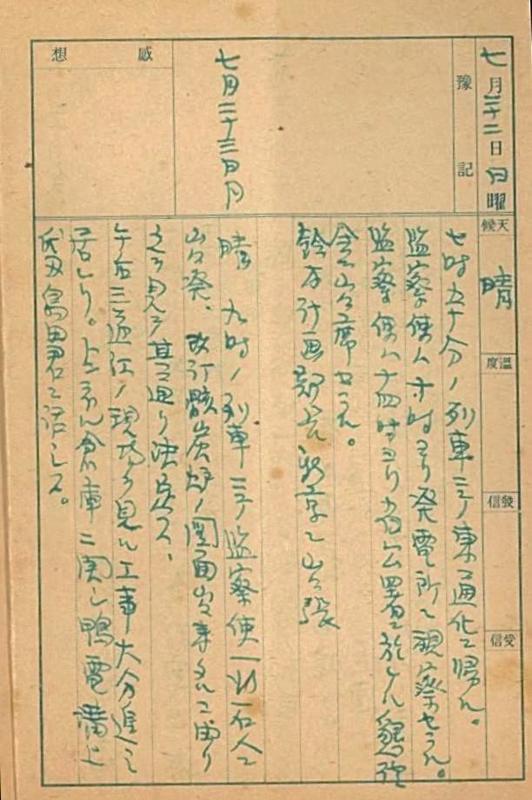
The recently found journal was written by Tsugyo Watanabe, an executive of Manshu Seitetsu, a steelworks company involved in the facility's construction. The journal was among historical materials donated to a group consisting of children of people who attended Daido Gakuin, a training institute for bureaucrats in Manchukuo. A research group led by Hitotsubashi University Prof. Yoshifumi Sato, who specializes in the modern and contemporary history of China, discovered the journal when examining the historical documents.
The journal of about 150 pages covers a period from July 1, 1945, to October 1946. The progress of the construction was recorded daily until just before the end of the war. There are descriptions of the chief of staff of the Kwantung Army and his aides frequently visiting the construction site, indicating that the army was highly interested in the facility.
In a journal entry dated July 5, it was recorded that the military brass and other concerned parties all gathered and inspected the construction site in the afternoon, while the July 23 entry said the construction was progressing significantly. Construction companies such as Nishimatsu Gumi Co. and Hazama-Gumi were also mentioned in the journal.
"[The journal] has proved that the confidential plan was not an illusion, but had been actually carried out by the public and private sectors in unity," Sato said. "This is the only known historical material that specifically describes the actual process [of the operations]."
On Aug. 13, amid the desperate situation shortly after the Soviet Union started its invasion, the journal noted, "We were ordered [by the Kwantung Army] to deliver gunpowder." In the entry dated Aug. 16, a day after the end of the war, there are lines such as, "All the construction work shall be suspended," and, "All the workers must return home."
"The descriptions in the journal can be a clue to understanding the whole picture of the facility," said Kiyofumi Kato, an associate professor at the National Institute of Japanese Literature who specializes in modern Japanese history. "It will also become a step forward to elucidating the reality of the army that tried to fiercely resist the Soviet forces that were moving south."
Read more from The Japan News at https://japannews.yomiuri.co.jp/