It is the eve of Chelsea’s opening fixture in the Champions League. An unfancied team from one of Europe’s more far-flung leagues, a side apparently destined to be the group’s whipping boys, are due at Stamford Bridge and the game is being billed as a timely opportunity for José Mourinho’s side to revive. A chance to summon some form after a difficult opening to the domestic campaign that already sees them trailing Manchester City and Arsenal in the fledgling title race.
The manager has cut an embattled figure over recent weeks but he confronts his pre-match media conference with relish, pointing to the absence of key personnel and, when asked about the side’s style, offering up a coded criticism at a summer of cautious spending. “It’s omelettes and eggs,” he says. “If you have no eggs, you have no omelette. And it depends upon the quality of the eggs. In the supermarket you have class one, class two and class three eggs. And some are more expensive than others, and some give you better omelettes. So when the class one eggs are in Waitrose and you cannot go there, you have a problem …”
That was 17 September, 2007, before the visit of Rosenborg, a game that was drawn 1-1 with the Norwegians in front of a relatively paltry crowd of 24,973 and proved to be Mourinho’s last in charge after an otherwise glittering first spell at Chelsea. Within two days he had been sacked, his relationship with Roman Abramovich, strained over the previous nine months, broken apparently beyond repair. Owner and manager have since reconciled, their bond now far stronger even during these trying times.
Where Abramovich’s appearance at the training ground once spread panic, his is a regular dialogue with Mourinho these days and there is no suggestion of another imminent parting of the ways. But, while the Portuguese has already laboured the point that this is not history being played out again, some parallels still feel unnerving before the visit of Maccabi Tel Aviv on Wednesday.
Similar frustrations over transfer policy are simmering after a window where Chelsea opted against reinvigorating their title winners, other than to secure Pedro Rodríguez (oddly, their main addition eight years ago was another winger, Florent Malouda), and merely replaced those permitted to depart. Manchester City and Manchester United were lavish spenders as they attempted to bridge last season’s gap. If Mourinho had craved a Paul Pogba or Antoine Griezmann, a John Stones or a Raphael Varane, just to keep his current squad on their toes then his ambitions were thwarted. And, where he had bemoaned the absence of the injured Didier Drogba, Frank Lampard, Ricardo Carvalho and Michael Ballack in 2007 – “The problem is not having five injured, but which players they are and the importance to the team” – these days he can point to the loss of form of a similar number of key personnel, none of whom are maintaining previous standards.
Chelsea’s title winners have been unrecognisable over the club’s worst start to a top-flight campaign since 1986. The likes of Branislav Ivanovic, John Terry, Cesc Fàbregas and even Nemanja Matic have laboured – the Serb was marginally more impressive in the latest loss, at Everton on Saturday – with a hugely experienced but hardly quick rearguard lacking an effective shield to protect them and struggling to adjust to the high defensive line employed at times by the management. Their back-line, now deprived of Thibaut Courtois with a knee injury, has permitted 33 shots in the five games to date while, at the other end, flashes of attacking quality have been sporadic.
It is as if the slog their title-winning season became, a grind when injuries and suspensions gripped over the run-in, has become the norm and all the attacking pizzazz which illuminated their approach a year ago has been forgotten. Eden Hazard, the player of the year, has been peripheral and ineffective. Pedro, quiet since his debut, is still adjusting to a new league. Fàbregas, such a creative hub a year ago, has yet to muster an assist and seems muddled as to whether he is better suited to playing as a No8 or a No10, while Diego Costa’s snarl is born of frustration rather than gamesmanship at present. Morale is low.
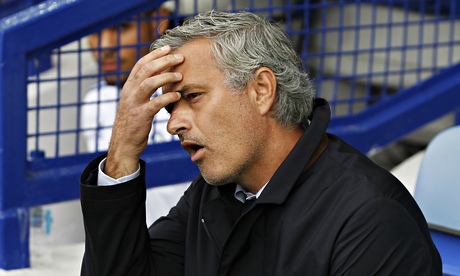
The manager has cut a rather perplexed figure throughout, baffled that so many of those players upon whom he had relied so heavily have suddenly been rendered fragile, even diminished, by shoddy collective form. That has surfaced as exasperation. It must be acknowledged he is going through his own personal trauma at present with his father, José Sr, having been seriously ill back in Lisbon for some time, though he has not lacked focus at the training ground.
The session at Cobham on Monday morning was apparently as energetic and committed as ever, the determination to recover shared by all. Yet Mourinho has long since conceded an error in pre-season planning which saw his squad return in mid-July, a week after almost all other Premier League rivals, and immediately depart for a base in Montreal, Canada.
They have been leggy and lethargic from the off, a grogginess suggestive of a hangover from last season’s exertions. If Mourinho had craved a free fortnight to work on fitness issues over the recent international break, he found himself left with seven players at Cobham while the rest globe-trotted with their national sides. There has been no time to take stock and recover. The furore surrounding his decision to banish the medical staff, Eva Carneiro and Jon Fearn, from the first-team picture has merely added to the dismal mood, with Chelsea braced for the former to launch legal action and depart in the wake of her demotion.
But if those are the problems currently undermining the champions’ defence, where are the solutions? Shoring up what is currently the most porous rearguard in the Premier League will be the manager’s priority and, as unthinkable as it would have been even six months ago, dropping Ivanovic seems increasingly inevitable.
If the manager had admitted he had erred in not withdrawing the Serb against Crystal Palace just before the international break, then it was surprising that he retained his place at Goodison Park. The 31-year-old needs a breather, and Maccabi’s visit should be the ideal opportunity to hand Baba Rahman, a £17.2m arrival from Augsburg, a debut at left-back with César Azpilicueta moving across to the opposite flank.
Oscar’s anticipated availability after a knee injury might also allow Mourinho to rest Fàbregas while Kenedy and Loïc Rémy – a player Chelsea fought to retain over the summer, but whose involvement has been limited to 45 minutes in the Community Shield – may offer some pace and urgency. The London club’s approach has been too stodgy to date, after all. This was always going to be an occasion for the manager to tamper with his starting lineup, with Arsenal due at Stamford Bridge on Saturday, yet it has become an opportunity for those on the fringes to demand inclusion this weekend.
This team already languish 11 points behind City in the Premier League. Defeat to Arsène Wenger’s side, with the psychological wound it would inflict, does not bear contemplation. This squad, and its key personnel, desperately need to remind themselves of their qualities and must summon a display against Maccabi.
Eight years ago, when Chelsea were actually fifth in the table and only two points off the summit, Mourinho’s team conjured 20 scoring chances against Rosenborg but could only score once and failed to prevail. Club and manager have been quick to dismiss all similarities with that era, but they know mood music will not change unless the Israelis are dismissed and the recovery proper is kick-started on Saturday.