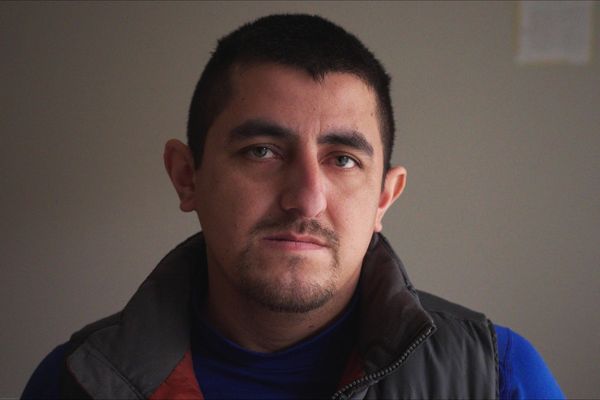
British author Jonathan Tel has won the Commonwealth short story prize for a tale set on a nuclear base in China, which judges called “disconcerting” and “extraordinary”.
Tel beat four shortlisted authors – Fijian Mary Rokonadravu, Nigerian Lesley Nneka Arimah, Indian Siddhartha Gigoo, and Kevin Jared Hosein from Trinidad and Tobago – to win the £5,000 award. The prize is for the best piece of unpublished short fiction by a writer from the 53 countries of the Commonwealth.
Tel’s story, The Human Phonograph, sees a woman travel from 1969 Beijing to Qinghai province, and the remote nuclear base where her long-exiled husband works. “There is a photograph (it will not be made public till years later, after his death, and by then she will be back in Beijing) of scientists in identical suits raising their clenched left fists in a loyalty salute, on an open plain, under a bright sun,” writes the author. “He is third from the left, over-exposed. Posed, of course. In reality they would have been cowering in a shelter, plugs in their ears and goggles over their eyes, while the earth shuddered.”
The story “ranges from the personal to the universal”, said the author and chair of judges Romesh Gunesekera, and “the resonances remained with the judges, long after the reading”. He called The Human Phonograph “a disconcerting, extraordinary story of an individual in search of independence and reassurance in a difficult world”.
The Human Phonograph is extracted from a novel Tel is writing. Set in contemporary China, its 10 chapters are independent stories, but link together to form a novel. The first chapter of the novel, The Shoe King of Shanghai, was previously shortlisted for the Sunday Times EFG award.
“The stories are all linked through an overarching plot, but this one is unusual in that it is entirely backstory, set in the 1960s,” said Tel. “I wanted to write about the Chinese equivalent of the Manhattan Project – it’s top secret, which for a fiction writer is great, because you can make stuff up.”
Tel, who writes full time and who has spent “a lot of time in China”, has already published a novel, Freud’s Alphabet, and a short-story collection, The Beijing of Possibilities. He is now looking for a publisher for the novel in which The Human Phonograph is included.
Gunesekera was joined on the judging panel for the award which is run by the Commonwealth Foundation and part-funded by the Sigrid Rausing Trust by Leila Aboulela, Fred D’Aguiar, Marina Endicott, Witi Ihimaera and Bina Shah. Previous winners of the prize include Uganda’s Jennifer Nansubuga Makumbi and New Zealander Emma Martin.