IRELAND’S LEADING MAN
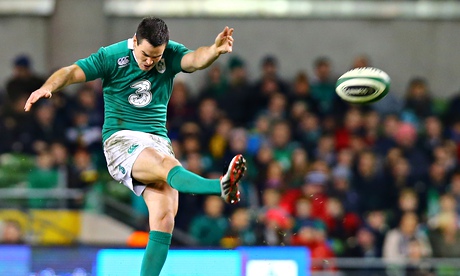
Brodie Retallick was not an unexpected choice as World Rugby’s player of the year, a second-row who blends his duties in the set pieces with a presence and athleticism in the loose, but Jonathan Sexton would have pushed him very close.
Like New Zealand, Ireland have lost only one match this year. Their summer tour may have been to the lowest-ranked team in the Rugby Championship, Argentina, but the Pumas beat Australia at home this year and blew a 12-point lead against South Africa to go down by two. Sexton, the leading fly-half in the world this year at least, played the part of conductor with relish.
Sexton played in nine of Ireland’s 10 matches in 2014, missing only the victory over Georgia. He scored 117 points, including four tries, and his one significant blemish came during their only defeat, at Twickenham. After England had pulled back to 10-6 behind with a penalty early in the second-half, Sexton put the restart directly out of play and the home side scored what turned out to be the winning try from the subsequent scrum.
Otherwise Sexton has been the voice of his coach, Joe Schmidt, who after masterminding success in the Six Nations and an unbeaten autumn series, when South Africa and Australia were defeated in Dublin, will be in line for an award, even if his fly-half missed out. The bookmakers have made England the favourites for the 2015 Six Nations, even though Stuart Lancaster’s side have to travel to Wales and Ireland, but it is the men in green who are in a golden period.
The popular consent was that Ireland were not at their best against Australia on Saturday, surrendering an early 17-point lead to evoke memories of their match against New Zealand the year before, but they finished in a manner England and Wales have been unable to against the Sanzar nations this month, keeping their heads.
Sexton is playing with supreme confidence, abetted by his half-back partner Conor Murray. It is his virtuosity, a man for all seasons, that has helped make Ireland Europe’s form team this year. Schmidt tailors his tactics to the opponents Ireland are facing and his approach does not lack rigidity – he discourages offloading unless the manoeuvre is loaded more with certainty than chance – but he is not prescriptive to the point where players are exposed when a match reaches the point when instinct and the capacity to think quickly takes over.
New Zealand were facing defeat against Wales with 11 minutes to go in Cardiff last weekend. They had started by employing an attacking kicking strategy that was repelled – Wales effectively turning possession over seven times out of seven – and when they moved the ball they found Jamie Roberts leading a defence that was sustained in its aggression. Even Sonny Bill Williams was reduced to the ranks of the mortals.
The All Blacks did not become desperate. They brought the outside-half Colin Slade off the bench, moved Beauden Barrett to full-back and returned to using kicks, whether diagonal, chipped or dinks behind the rush defence (worms as they are called by coaches): one yielded a try, with the aid of a kind bounce that was a reward for precision, and a second, higher and targeting the Wales in-goal area, was tapped back to ensure a scoreline that did not reflect the effort and pressure put in by Wales but which did illustrate how far New Zealand are ahead of the rest.
New Zealand have become masters of attacking by kicking into space, a tactic used this month by Ireland and Scotland, who are both coached by Kiwis, but not by England in their Tests against New Zealand and South Africa when they fielded a combination at 10, 12 and 13 that not only lacked balance but which did not have a tactical hub and there was no Alex Goode on the bench.
George Ford provided a difference last week against Samoa, a No10 who varies his game, and it would be instructive to see him in partnership with Lee Dickson, a scrum-half who is adept at the attacking kick, as he showed for Northampton at Saracens on Sunday when kicking the ball with the outside of his right foot as he ran to the left in the opposition 22 to create a try for James Wilson.
Schmidt has brought variety to Ireland’s game with Sexton exerting a control against South Africa that Owen Farrell was unable to for England. Farrell may have lost his place to Ford and his return to inside-centre may have been a triumph of hope over expectation with a player looking to recover his form effectively demoted, but he has the strength of character to put Ford under pressure next year.
Ford spots opportunities quickly, something of an artist in a scientific era. He showed durability against Samoa, not deterred from attacking the line by some thunderous tackles on him. For all his natural talent, he will need Farrell’s mental strength to succeed at the highest level and he made an assertive start.
Rhys Priestland began his Test career at 10 with Wales equally impressively, but has since suffered a loss of confidence after a run of injuries. Dan Biggar has taken over at fly-half: a player who made a number of costly mistakes in his early matches, which tended to be against the weakest opponents in an autumn series when he was one of a number of changes, is maturing into the tactician his side have lacked in the last 18 months.
His half-back partnership with Rhys Webb has been one of the gains for Wales this month as they again reflect on their failure to close out matches against the Sanzar nations. They have a final chance on Saturday with South Africa, who like their hosts will be below strength because players have returned to clubs who are not obliged to release them for a Test played outside the official window, and if they are to prevail, Biggar will need to show the touch that his fly-half rivals such as Sexton, Bernard Foley, Barrett, Pat Lambie and Ford have this month.
The former England second-row Ben Kay remarked this week that the difference between New Zealand and the rest is that the All Blacks are match fit while their rivals are gym fit. Warren Gatland has achieved a considerable amount in the seven years he has been in charge of Wales: in terms of raw ability, preparation and conditioning, they are up there but he cannot control the minds of his players at the end of a game when quick thinking is the difference between victory and defeat.
If Wales are to end their losing run against the major southern hemisphere nations against South Africa on Saturday, and make an impact in the World Cup, Biggar will be even more important than the imposing three-quarter line outside him. Sexton points the way.
SAMOA ROW FAR FROM OVER
World Rugby, as the International Rugby Board has become, has had a busy month trying to broker an agreement between the Samoa players and their union. A threat not to play against England last weekend in protest at the administration of the game on the islands was averted, but the dispute is far from over.
World Rugby has worked closely with the International Rugby Players’ Association and the Samoa squad to broker an agreement over issues that the players say have less to do about their own wellbeing and more about the state of the domestic game.
Samoa play New Zealand in Apia next summer, a first, and World Rugby will be picking up most of the tab, paying for the players’ flights from where they are based – most of them are in Europe – as well as their hotel bill and, crucially, insurance, which is beyond the means of the Samoa Rugby Union.
The governing body has invested millions in the three Pacific Islands in recent years, even footing the bill after more than half the Samoa squad missed their flights home following elimination from the 2011 World Cup squad and had to arrange new ones.
The chairman of the Samoa Rugby Union, Tuilaepa Sailele, who is also the prime minister, said this week that the dispute had been resolved, a claim that was rebutted by one of the players who has been involved in the talks with World Rugby and IRPA, Daniel Leo.
“It is pretty clear that it has not,” he said. “World Rugby should freeze money in Samoa and the Samoan public should stop donating money to the union immediately. We have not had a chance to meet with the chairman, let alone sort things out. The buck starts with him – he needs to come to the party and meet with World Rugby and the players. Until he is willing to put pride aside and put Samoan rugby’s best interests at heart, there is no way we can move forward.”
Leo said he had been threatened for being a figurehead in the campaign by the Samoa squad. “Sometimes the first person through the glass cops the bullet,” he said. “I am not going to go into the detail of the threats I have received, but it is worrying. You shouldn’t be questioning transparency in a sporting organisation where it potentially affects your family.”
IRISH IN FRAME FOR 2023
The 2015 World Cup is 10 months away, but attention will briefly turn to 2023 after Christmas when bids will be invited from potential hosts.
The 2019 tournament will be held in Japan after the IRB, as it was, voted on two tournaments simultaneously. That process will not be repeated and neither will the successful bid come from Europe even though the continent has hosted the competition alternately.
South Africa, who pitched for both 2015 and 2019, will be bidding. They previously hosted the event in 1995, but countries which have never done so may rival them: Argentina, Italy and Ireland.
Any Irish bid is likely to be a sole union one, playing matches in Northern Ireland as well as the Republic and using GAA stadia. Croke Park, with its 80,000 capacity, would be available to stage the final.
Italy also has the facilities, and a warm climate in September and October, at least in the south, while Argentina appreciate the economic boost the tournament would bring, as well as the rugby stimulus.
A decision is unlikely to be made until 2017. Next year’s tournament is set to yield record profits for Rugby World Cup Ltd, but projections have yet to be made on how much it will make in 2019: Japan have drawn up a shortlist of 14 grounds where matches will be staged and plans to stage games in Hong Kong and Singapore have been abandoned because of the travelling players would have faced.
COURAGE OF THE QUESTIONER
The Welsh Rugby Union was not happy with a question posed to Warren Gatland after last weekend’s match against New Zealand by the BBC’s pitchside reporter, Sonja McLaughlan, who asked him whether he felt under pressure after a 22nd straight defeat to a major southern hemisphere nation.
There are few more difficult interviews to conduct than one with a losing coach or a manager a few minutes after the end of a match. It takes courage to ask pointed questions rather than serve up a few half-volleys to be stroked to the boundary, as the WRU’s head of communications, John Williams, a former head of news for a television company, should have appreciated when he upbraided McLaughlan in front of others shortly after the end of the interview, receiving as good as he gave.
Unions are happy to receive television’s coin and should not expect interviews to be conducted on the lines of their own websites, tame to the point of tedious. And someone like Gatland is experienced and hardened enough to look after himself.
He will be putting himself under pressure to end the poor sequence of results against New Zealand, Australia and South Africa, only too aware that his players are a match for the Springboks this Saturday. It is hard not to feel for him, his fellow coaches and the players after such a bold crack at the All Blacks that crumpled in the last 10 minutes, the latest in a series of games in which Wales have lost from a winning position late on.
His charges have to find the answers to difficult questions they face and it is not unreasonable to argue that their coach should afterwards.
STILL WANT MORE?
• Where are the stars to match wondrous Wallabies of 1984, asks Robert Kitson.
• Our writers’ latest talking points from the autumn internationals.
• All the latest rugby union news, previews and more on our dedicated site.
• And to subscribe to the Breakdown, just visit this page, find ‘The Breakdown’ and follow the instructions.