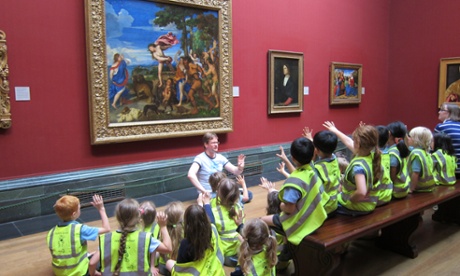
I was surprised to hear that a photograph of me giving an art lesson at the National Gallery had appeared on the Guardian website, particularly as it was used to illustrate an article I couldn’t disagree with more. Jonathan Jones wants people to be charged to go to museums. But why should people pay for access to their own heritage?
Even the National Gallery’s name is a giveaway: it doesn’t take long for the youngest visitors to work out that the paintings belong to them. They can be assured that the gallery will look after their art – and that they can see it for free whenever they fancy. The same is true, of course, for any number of museums and galleries around the UK, even if their names don’t make it so obvious.
Back in 1824, most art was in private hands – you could only see it if you knew the people who owned it. That year, the National Gallery was founded (as many others would be later) so that everyone, regardless of age, class or wealth, could have free access to great art. It’s a noble concept: if we now start charging, does that mean we’ve lost that nobility? Jones says it is mere “idealism” – so should we abandon our ideals?
Financially, there is no argument to support entrance fees. The situation was stated with admirable clarity by Sir Michael Dixon, director of the Natural History Museum, back in 2011:
The free admission policy costs approximately £45m to implement. The seven million additional overseas visitors now frequenting these museums spend on average £90 per day to the benefit of the wider UK economy. So, the £315m thus generated far outstrips the cost of the policy.
Wider economic analysis of national museums demonstrates that for every £1 of government subsidy, national museums provide £3.50 in wider economic benefit. Far from being a subsidised cost, free admission represents very good value for money.
We should be encouraging people, not putting up financial barriers. I once heard a father on Trafalgar Square say :“That’s the National Gallery. We’re not the sort of people who go there.” Where did that attitude come from? Why do people feel excluded? Fortunately, school visits allow children the access that some parents mistakenly believe is not theirs, and once inside, they enjoy themselves. From the mouthy boy at the back who thinks he’s taking the mickey – only to find out that his observations are spot on – to the chatty girl at the front who you later discover never speaks in class, the impact art can have is clear. I’ve lost count of the number of children who have said, “I thought it was going to be boring, but I love it – I’m going to bring my parents.” Some of those parents simply couldn’t afford admission fees.
But it’s not just children. I’ve been approached by awestruck adults on their first visit to a gallery who are already thrilled about coming back. I suspect they may never have come if they’d had to pay. Others have told me they pop in during their lunch break and look at just one painting, which is certainly not the case in countries where admission is charged. Apart from anything else, the queues at the Uffizi or the Louvre would prohibit it. And if you pay, you want value for money: you feel compelled to try and see everything – and so take in nothing.
Maybe my conviction goes back to childhood. As a teen I travelled to London with some friends and we went to the British Museum and the National Gallery, my first visits to both. I knew nothing about art, but I remember a curious feeling of awe at the crystalline clarity of two strange men in old-fashioned clothes standing by a table of mysteries. I now recognise them as Holbein’s Ambassadors. Back then, they imbued me with a sense of intrigue that kickstarted a journey I hope will continue for years. I’m sure my decision to enter this temple of art was determined by the fact that it was free.
The money – that’s the problem. It seems that “value” is only ever stated in terms of money. The arguments are expounded in financial terms; in fact I’ve done it here myself. But art is not only about the money. It is about beauty, truth, emotional revelation, an astute observation of something unseen, a profound comment on society. I’ve never heard any statesperson mention any other form of value, be it spiritual or emotional; such is the sway of finance in contemporary society. Maybe that is why I think museums should be free: I still believe there is more to life than money.







.jpg?w=600)