Jonathan Hawkins, the British co-champion, set a marker for northern players when the Durham 31-year-old rose from the ranks to become a master and grandmaster in his twenties and thirties, defying conventional wisdom that you need to approach or reach the heights as a teenager.
Hawkins’s logical and lucid style also makes him a good model for improving players. The hub of British chess activity is in the south-east, but some of the best and most popular weekend congresses, the traditional training ground for ambitious talents, flourish in the north.
Blackpool and Scarborough host two of the biggest events. Both have been staged annually for some 30 years, and both offer top prizes of £500-£600 in the Open section, significantly higher than the norm in the south. This is sufficiently serious money to ensure that masters and GMs take part.
Last weekend at Blackpool the top seeds were the European senior champion Keith Arkell, 54, and Leicester’s Mark Hebden, 57. This experienced pair have been the most prolific winners on the weekend circuit since the 1970s, and provide a yardstick for any new pretenders. Arkell and Hebden were favourites, but in the event Bradford’s Matthew Webb beat Hebden and drew with Arkell, with whom he shared first on 4.5/5.
Webb is a good example of the new breed of northerners who are copying Hawkins’s successful career and improving fast in their middle and late twenties. In the last few years he has chosen to compete in high-level events such as the 2011 European championship and the 2014 London Classic, where his track record shows an increasing ability to win or draw with masters and GMs. His national grade has surged 60 points in six years.
Webb’s final-round win at Blackpool provides some technical clues to his success. His 3 Nd2 has been the chosen weapon against the 1...e6 French Defence for English GMs from Jonathan Penrose to Michael Adams, and the opening follows a well-trodden path until 8 c3. The normal move is 8 0-0, but the database shows that 8 c3, with later queen’s side castling in mind, scores better and has been chosen by two strong GMs. Here Black is unfazed, and the game continues to follow theory until move 16.
Out of the book, Black errs fatally by 17 … h6? where Bxg5 18 Bg5 Qb7 leaves the outcome unclear. As played, Webb crashed through by 19 Bxh6! and 23 c4! setting up a simple queen mate.
Matthew Webb v David Walker
1 e4 e6 2 d4 d5 3 Nd2 Be7 4 Bd3 c5 5 dxc5 Nf6 6 Qe2 0-0 7 Ngf3 a5 8 c3 Na6 9 e5 Nd7 10 Nb3 Naxc5 11 Nxc5 Nxc5 12 Bc2 b6 13 Bf4 Ba6 14 Qe3 Qd7 15 0-0-0 Rfc8 16 Kb1 b5 17 Ng5 h6 18 Nh7 Qb7 19 Bxh6! Ne4 20 Bxe4 dxe4 21 Nf6+ Bxf6 22 exf6 b4 23 c4! Bxc4 24 Bxg7 Qb5 25 Qh6 1-0
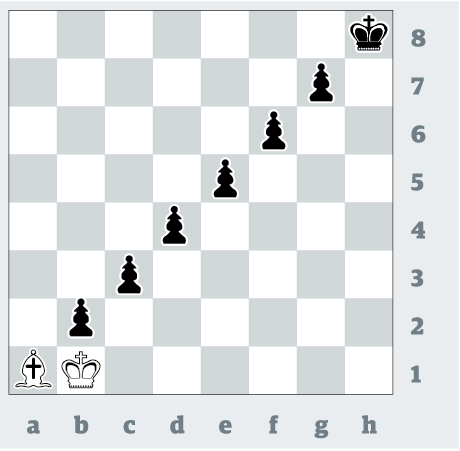
3381 by GF Steele (Black moves first). 1 c2+ Kxc2 2 d3+ Kxd3 3 e4+ Kxe4 4 g5! Kf5 5 b1B+! Kxf6 6 Bh7! Kf7 delivers mate from the a1 bishop.