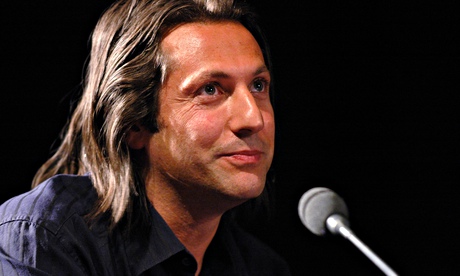
Jonathan Glazer has been named this year’s recipient of the Wellcome Trust’s screenwriting fellowship, a grant that offers a rare bridge between the science and the arts.
Glazer, who most recently directed Under The Skin, starring Scarlett Johansson as an alien prowling the streets of Glasgow preying on male victims, is only the second recipient of the fellowship, which awards screenwriters a £30,000 grant to explore the world of science at the fingertips of the Wellcome Trust and use it to inform their creative practice.
The Wellcome Trust, a charity which is one of the largest non-governmental funders of research into human and animal health, set up the fellowship two years ago in partnership with the BFI and Film4 to give filmmakers a window into science, medicine and psychology and cross the perceived chasm between those fields and the creative world of writing and film.
Ben Roberts, director of the BFI film fund who helped select Glazer as this year’s recipient of the grant, said the director’s fascination with biology and humanity was already apparent in his films such as Under The Skin and his 2004 feature Birth, a haunting dramain which Nicole Kidman plays a widow convinced her husband has reincarnated as a 10-year-old boy.
Roberts also said Glazer’s willingness to take time to evolve and explore his stories made him the ideal candidate for the fellowship, which comes with no obligations on the recipient, who is free to explore whatever area of science strikes their interest.
It took Glazer 10 years to develop Under The Skin, an adaptation of Michael Faber’s cult novel, which eventually emerged as an experimental combination of social realism, where Scarlett Johansson drove around the streets in a white van often speaking to non-professional actors, with elements of darker science fiction.
Accepting the fellowship at the Wellcome Trust headquarters in London, Glazer said: “Charles Bukowski said about writing, ‘if it doesn’t come burning out of you in spite of everything, don’t do it. Unless it comes unasked out of your heart, your mind, your mouth and your gut, don’t do it’. I’d like to thank the fellowship panel for the generous support. Walking around the Wellcome Trust you see how enthusiastic people are about Henry Wellcome and this place is clearly the result of his brilliant mind. It definitely feels completely alive and I hope in my own small way to be able to contribute, to think freely without obligation or fear and to see what comes out of this.”
Last year’s recipient of the inaugural fellowship was Clio Barnard, acclaimed director of films such as The Arbor and The Selfish Giant. Barnard, who is currently adapting Rose Tremain’s novel Trespass, spoke at length how her year spent focusing in particular on the science and psychology of memory, hallucination and the human condition had opened her eyes to a world of knowledge and perception she had never considered.
“It’s been amazing, a really brilliant year and came at a crucial time when I had just finished my first draft of Trespass so it gave me time and space to explore and think and write,” said Barnard. “In terms of what I explored, I was very focused on Trespass, though I would say in the process I also came across other things that may find themselves into work further down the line.”
She said: “Trespass is a very dark story, and incest is a part of that. What was really useful was understanding the psychology of families in which that happens and I met with a forensic physiologist who treats perpetrators. Understanding the psychology of those perpetrators was, well, disturbing obviously but also really useful in terms of what I am trying to write.”
Barnard also used her grant to meet with Wellcome Trust-supported projects involved in the hearing voice movement, which examines the stigma around hearing voices and aural hallucinations, as well as further develop an interest in the science of memory, an idea first explored in her celebrated documentary on the life of playwright Andrea Dunbar, The Arbor.
“This has definitely changed my perception of the relationship between science and art,” explained Barnard. “What you realise is there is some kind of loop going on. What has been amazing is talking to scientists about the science of memory and the fact we reconstruct a memory every time we have it, and how closely memory and imagination are linked in the brain. Where memory is concerned, the truth is more elusive than we realise and certainty is elusive – and that’s been amazing and deeply fascinating in informing my writing.”
Applying the science faithfully and credibly, without compromising the mechanics of her storytelling in her adaptation of Tremain’s novel, was a challenge, admitted Barnard, who aims to finish her second draft of Trespass by this week.
“I am now much more aware of scientific accuracy in my writing,” she said. “Screenwriters and filmmakers talk a lot about credibility and in a way it really helps me work towards that. It’s been completely illuminating.”