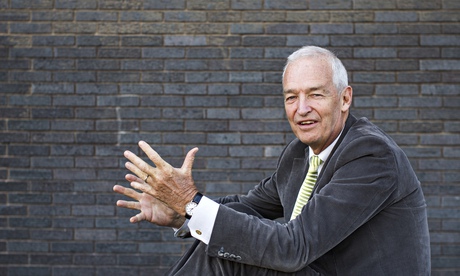
When I meet Jon Snow, at the ITN headquarters in London, he is only supposed to be showing me and the photographer round the Channel 4 news set before we head elsewhere for the interview. Over an hour later, we haven’t moved, as one story about personally hunting for missiles in Tehran has led seamlessly into another about his sexual feelings towards Margaret Thatcher to an off-the-record anecdote about David Cameron and Angela Merkel rolling into the time that Snow lived in a squat in Primrose Hill.
I’m not sure Jon Snow needs much interviewing.
I’m also not sure that any other news presenter has lived a life quite as rambunctiously extraordinary; presumably neither does Bafta, which is why he is to be awarded its prestigious fellowship this year, the lifetime achievement award of the broadcasting world. He is clearly delighted, even though it sent the letter to a house he hasn’t lived in for 10 years: “So for two or three months I was blissfully unaware, until they sent a rather hurt email. I couldn’t believe it, I thought they’d got the wrong Snow. Then I saw the cascade of people who’d had it before. Judi Dench, both Attenboroughs. Amazing.” To enter that canon of broadcasters? “Yes! Don’t I have to be dead?”
On the one hand, he’s a 67-year-old white, boarding-school-educated male – so far, so establishment. On the other, he is perceived as a loose cannon – maybe it’s the multicoloured socks and ties or the fact that he rides a bike everywhere. More likely it is off-the-cuff moments such as when he improvised a song about Jeremy Paxman leaving Newsnight live on air. Or the time he inhaled two whole balloons of skunk for a TV experiment. “The professor said: ‘We’ve given you the equivalent of a whole spliff.’ But you wouldn’t smoke a whole spliff, would you? You’d have a few puffs and share it. So it was a devastating experience. My soul was wrenched from my body and there was no one in my world” – at this point he puts on a theatrically tragic voice – “and I was left with myseeelllllf.”
When we stop, so he can pose for a photo, he slips smoothly into hammy newsreader mode and faces the camera: “Well, good evening and welcome to the news tonight. It is a most extraordinary development that I’m about to talk to you – the very man at whom you are looking right now has been stoned out of his head on skunk, and when I put this to the prime minister and asked him how many times he had been stoned, he said: ‘Never on skunk, constantly on coke.’” People in the room fall about laughing.
Snow was born in the Sussex village of Ardingly in 1947 and grew up partly in Yorkshire. His father was the Bishop of Whitby and his mother a pianist. He won a choral scholarship to Winchester Cathedral, later attended St Edward’s School in Oxford, and went to Liverpool University where he was famously kicked out for organising an anti-apartheid occupation. “I had, from a rather sheltered, privileged background, done voluntary work overseas in Africa, and I came back lit up with a sense of: ‘Shit, these kids are just as bright as any I’ve ever met and they’ve got nothing.’ But everybody was looking for a cause at that time.” People sometimes mistake him for an Oxbridge graduate, but he was an undiagnosed dyslexic, never made to feel particularly bright. “I’m a late developer and I’m still developing. My mental age has crept up from 17 to 23,” he says, grinning.
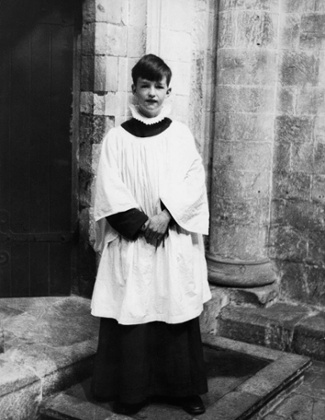
After the Jimmy Savile scandal broke, Snow revealed that he had been molested at school. “Boarding school at seven is a frightful business, a wicked thing to do to a child. I hated public school life – but I perfectly enjoyed life. But I was very lucky because I was a chorister in Winchester Cathedral, which was like another family. Singing Bach, age nine, to an audience who love you. You became part of the stonework.” He meant to go back to university but got distracted by his work in a centre for vulnerable and homeless young people, of which he is still a patron.
“I’ve been there 45 years – isn’t that terrible?” he says. Is it? “Well, I think it goes against everything the charity advocates. I think they think people ought to move on, but I’ve never been able to leave it really. You go in there once or twice a week and you see the world how it really is – nothing has changed. In fact, with the housing crisis it has got worse.” Does he think the politicians he meets understand the scale of the problem?
“I don’t think they possibly can,” he replies, emphatically, “because if they did, their priorities would be radically changed.”
Jon Snow has always been the alternative. His first ever working day was the first day of LBC, on which he read the news at 6am, “and the whole thing was such a shambles, but a very exciting moment. The first ever commercial radio station – there was only the BBC until then.”
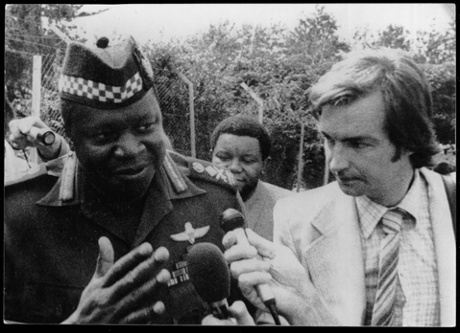
He was soon promoted when the newsroom needed somebody who knew Uganda, which he did, so he accompanied James Callaghan, then foreign secretary, on an unlikely mission to rescue a British writer who had fallen foul of the regime. He ended up with two scoops: an interview with the writer and one with Idi Amin. Yet neither aired. “None of the other journalists had been able to file anything,” he explains. “We landed back at Brize Norton and I put my 10p into the phone box and said ‘Well – SCOOP-O, eh?’ They said: ‘What do you mean, you were on a plane with Reuters, the BBC, the API, ITV and you’re telling us not one other person has confirmed anything in your report? We cannot go to air without more than one source.’ Those were the days you did actually need two sources. They didn’t trust their own boy.”
Snow seems to have been present at an incredible number of recent history’s defining moments. When it was announced that Nelson Mandela was being freed from prison, all those banned by the South African civil service were also automatically able to enter the country, Snow being one of them. So he flew down that same night. By the morning he was outside the jail. “Of course we had no idea what he looked like, and he was an hour late coming out and we were live on air so I just had to hang on. The white South African cameraman we had been given let his camera droop while he dozed. So I said in my commentary: ‘You may wonder why you’re looking at people’s feet, well, for some people here this is no great moment, the cameraman is actually asleep. So I’m going to kick him and see what happens.’” For someone who learned his stagecraft in a cathedral, there is a cheeringly profane side to Snow’s approach.
Then Mandela did come out, “and it was completely overwhelming, you just wept. You felt your life had come – you, some squirt, witnessing something you had played some tiny, tiny part in and it had come to pass.” He got an interview with Mandela: “But the terrible thing was, you realised, he was more interested in trying to blag information off you, having been inside for 27 years. It was hard to get him to concentrate on him.”
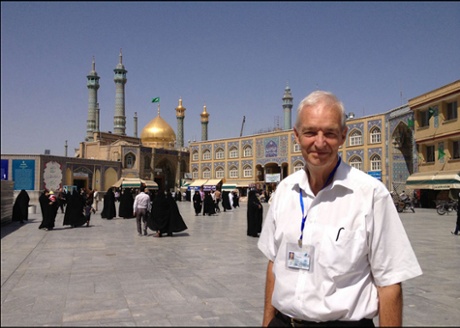
Snow’s greatest love, though, has always been Iran. Naturally, he was there when the Shah was overthrown: “Everybody on the streets, a complete swirl of humanity. It felt like liberation. I am an unapologetic Iranophile, it’s one of the most beautiful places on Earth. Persepolis is possibly the oldest city on Earth – I mean, God help us – the thought that they were writing alphabets and maths when we were crawling on our bellies in caves.”
He believes one of the great dangers of our time is people not understanding the relationship between Shia and Sunni. “I really fear that some of the architects of the war on Iraq did not know anything about those latticeworks of people. You know, there’d be a Shia shrine here in a Sunni area, there’d be a Sunni shrine here in a Shia area – if you just go in and chuck a whole load of weapons at them – well it’s no wonder that you create an absolute inferno. I think we can safely say that the war on Iraq begat Isis. If we’d allowed things to take their own course, horrible though Saddam’s regime was, there might have been a different outcome. You simply cannot impose a revolution.”
There follows, in what I now take as standard Snow style, an incredible story about how he made his crew drive the length of the Caspian sea coast, after the revolution, searching for some nuclear early-warning station he had spotted when he drove through Iran as a student, on a bus to India to perform in a Beatles tribute band. “The computers were still whirring away, papers pouring out with hieroglyphics on them. Still pyjamas on the beds in the American quarters and breakfast on the tables, they’d obviously fled very quickly.”
Unlike many in his industry, Snow believes we are only just entering the golden age of journalism. “Doom and gloom? Not a bit! God, when you think how I was toiling before Twitter and the blogosphere and Google, all of which are just wonderful. You used to go to the cuttings library and solemnly photocopy every single thing yourself and then carry this great wad of paper on the plane to Iran with you that you’d then have to destroy at customs.”
His interview with Mark Regev, the Israeli spokesman, during the last invasion of Gaza, went viral on YouTube, as he went in on him so powerfully about the killing of innocent civilians. His critics accused him of pro-Palestinian bias. “But the next day I actually interviewed one of the Hamas leadership on the line from Beirut and it was a ferocious interview. And I haven’t heard a single person mention that I did that. I am regulated for bias, oh but I can tell you, I do need regulating. Unquestionably. I think it’s good to be full of passion, you’ve got to wake people up and say: ‘Come on watch this, be part of it, let’s see what we can do.’ I am politically motivated, but not party politically – I want to see a better world.” He was surprised when Paxman came out “not as a Tory, but as a one-nation Tory, because they’re extraordinarily rare now”.
Even more surprising, though, is when Snow tells me that he had a thing for Margaret Thatcher. “You would walk in at two o’clock in the morning, after a European summit, and there she’d be with a glass of whisky and say: ‘Oh Jon, how perfectly lovely to see you.’ Then you’d realise there was Bernard Ingham looking over her shoulder whispering: ‘Jon Snow, Channel 4, prime minister – frightful bastard.’ The whisky was cleared and the camera would run. Then she would kick you around the room, every question a disaster. I did her about 20 times and the score was Thatcher 20, Snow nil.”
There then follows a quite strange discussion of the sticky Lycra of Thatcher’s tights. “You’d be going: ‘So, prime minister, the public sector borrowing requirements ...’ and her thighs would be going –” He stops to make a shrieking noise. “She was the sexiest matron I ever met.”
Who will he vote for in the election? “I don’t feel the need to identify what I am, but then that’s because I don’t know what I am.” Plus, he says, he isn’t quite sure, pointing out his North London constituency has Keir Starmer as Labour candidate, “and Westminster needs people like him in it,” but also Natalie Bennett for the Greens. Could Jon Snow be considering voting Green? He will only smile, as he puts his bicycle clips and his helmet on.
“In the establishment,” he says, “I’m the most anti-establishment person I know.”