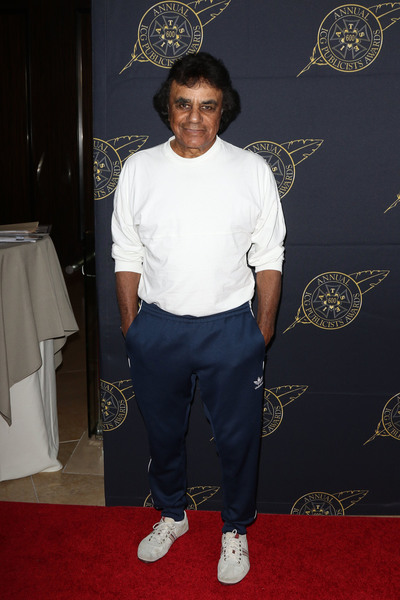
CHICAGO _ Tony Bennett, who recently turned 90, isn't the only singer marking a milestone in the Chicago area on Saturday evening.
While Bennett is celebrating the occasion at the Ravinia Festival in Highland Park, Johnny Mathis _ who turned 80 last September _ will be across town, playing the Rosemont Theatre.
His performance will mark an anniversary, as well: his 60th as a recording artist, Mathis having released his first album, "Johnny Mathis: A New Sound in Popular Song," for Columbia Records in 1956.
If previous performances are indicative, Mathis, like Bennett, has remained in remarkably fine vocal form and, also like Bennett, seems to face the passage of time without anxiety.
"I'm fine getting old," says Mathis, who believes that his voice "has mellowed. But, fortunately, it still sounds like me."
Ah, yes, that famous Mathis sound: a persistent vibrato that borders on a tremolo, making some listeners swoon and others demure. How does he do it? And why?
"I think most people don't understand: I have nothing to do with that," says Mathis. "I just open my mouth and it comes out that way.
"There are situations when, in your singing, in your interpretation of songs, for instance, when you want a straight tone. And I have to work really hard at getting a straight tone. ... That's sort of like if you have curly hair, you have curly hair.
"I thought I sounded a little like Eartha Kitt for a long time, and I didn't like it."
The mass public, however, clearly did. Mathis has made nearly 90 albums, sold millions of recordings and saw "Johnny's Greatest Hits" ride the Billboard top albums chart for nearly a decade starting in 1958. This music has been woven into the history of our popular culture, Mathis signatures such as "Chances Are," "Misty" and "It's Not For Me to Say" often used in films and TV shows to evoke a seemingly more innocent time in American life.
Yet for all of Mathis' broad appeal, listeners might not realize that jazz undergirds his art. When he was a youngster growing up in San Francisco, his parents played the music constantly on the record player at home, he says. Better still, his father often took him to the city's famous Black Hawk jazz club to hear Dave Brubeck, Cal Tjader, Miles Davis, John Coltrane and other titans.
"I was 13, 14 years old at the time, and I got to meet all of these incredible jazz artists," recalls Mathis.
"And later on, after I started to sing (professionally), I'd meet them on the road, and they'd say, 'Oh, you're little Johnny.'"
No one influenced Mathis more, however, than an extraordinarily gifted singer-pianist from Chicago: Nat King Cole.
"Nat was my hero right from the very beginning," says Mathis. "My dad brought his music into the house and played it over and over again.
"And then, at a very early age, I met him, and he was the nicest, kindest man I'd ever met. From that moment on, he was my vocal hero. ... He was the person I looked up to, and I couldn't have had a better teacher.
"I tried to sing exactly like him. I thought that was the way everything should sound."
It's not difficult to hear Cole's imprint on Mathis' art, from the crushed-velvet quality of Mathis' vocal tone to his elastic way with rhythm and phrase. But Mathis also forged a style apart from Cole's, partly because of the aforementioned flutter in his tone, partly because imitating the master really was impossible to do.
"Later on, I learned a little bit about how he approached his singing," says Mathis, "and it all had to do with the fact that he was a piano player.
"So he would sing a little and play a little, sing a little and play a little.
"And I tried to do it, and it didn't work."
Furthermore, while Cole had started out as a jazz pianist and stood as one of the most influential of the mid-20th century, Mathis was a singer from the outset and enjoyed rigorous instruction from an opera singer named Connie Cox.
"She was adamant that I learned to produce the tones," says Mathis. "(We) always studied vocal production: how to produce it so it doesn't deteriorate. That was the foundation of my whole career, vocally. ... I give her all the credit."
Notwithstanding Mathis' early successes, he faced the open racism routinely accorded African-American performers of his vintage. Though he downplays such encounters, he has not forgotten them.
"As far as I'm concerned, because of people like Nat Cole and Lena (Horne), I never had a problem," says Mathis, before citing a few.
"One time, I think _ or I thought _ I was being ostracized. And that was when I sang for the first time at the Sands hotel in Las Vegas. They said they didn't have a room at the hotel; I would have to live someplace else.
"I went along looking for a place to stay, and of course there was no place, except in the colored section, which was quite a ways away from the hotel. And that was about it.
"I was raised in San Francisco, and I couldn't understand that thinking, especially when you're singing in one of the great venues in Las Vegas."
But that wasn't the worst of it.
"There was one time down South, when I was singing, where we got a letter before I went onstage, and it mentioned that I was not welcome, and they were going to do something terrible to me while I was singing," recalls Mathis.
"I remember I was a little nervous. I was pacing back and forth onstage, so they wouldn't have a target to kill me."
Mathis obviously survived and transcended these affronts, answering them in the best way possible: with success that endures.