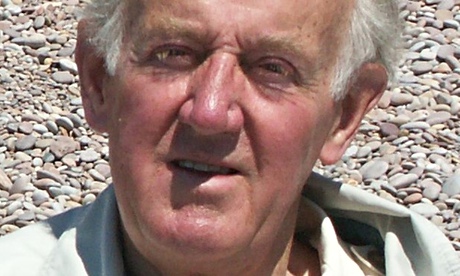
My father, John Webster, who has died aged 89, led the Department of Biological Sciences at Exeter University from 1969 until 1986 and established Exeter as a centre of excellence for mycology – the study of fungi. He was instrumental in the formation of the International Mycological Association and was twice president of the British Mycological Society – in 1969 and again in its centenary year, 1996.
He was particularly interested in aquatic fungi and studied aspects of their behaviour, including their ability to discharge spores over huge distances. The ballistic, indeed explosive, release of spores into the air was captured by high-speed video microscopy techniques pioneered at Exeter in the 1980s, and the physiological mechanism underpinning the release of spores was worked out by my father and his colleagues.
He was, however, arguably best known as the author of Introduction to Fungi (1970), a definitive textbook that inspired students around the world. The third edition of the textbook, co-authored with his former student Roland Weber, was published in 2007. It continues to be used in many degree courses to this day.
Born in Kirkby in Ashfield, Nottinghamshire, John was the joint youngest (with his twin brother) of four children of Albert, a coal mine mechanic, and his wife, Alice (nee Street). In 1943-45, John studied botany at Nottingham University; as an undergraduate during the second world war, he had to complete his degree in two years and he described himself as only two-thirds baked as a result. Obtaining a first class honours degree, John was then awarded a one-year research scholarship and began to specialise in fungi, working on the colonisation of plant material by soil fungi under Charles Chesters.
In 1946, John became an assistant lecturer at Hull University where he was inspired by field excursions with the Yorkshire Naturalists’ Union. It was also in Hull that he formed his lifelong partnership with the zoologist Mary Elizabeth Bromhead, known as Brom. They married in 1950 and moved to Sheffield, where John embarked on his PhD under the leadership of the botanist Roy Clapham. John continued his research into fungi at Sheffield and became successively a senior lecturer and reader in botany.
In 1969 he was appointed professor and head of the Department of Biological Sciences at Exeter University, merging the former botany and zoology departments. When asked at interview whether he had any contact with zoologists, he replied, “intimate contact – my wife is one!”
Former colleagues remember him as generous, demanding, disciplined and appreciative.
Brom died in 2013. John is survived by two children – Christopher and me – and three grandchildren.