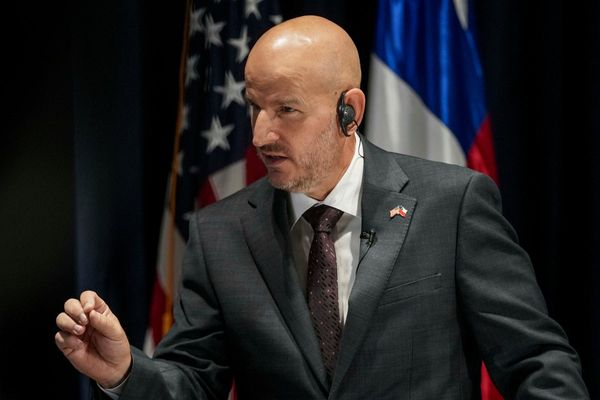
TAMPA, Fla. _ The tie is still knotted smoothly, and the gaze remains steady. For all the world, it appears as if nothing has changed.
But of course, that is not true. Even if Jon Cooper looks and feels like the same man standing behind the Lightning bench, the way we view him is at least a little different.
This is the inevitable collision between credit and blame.
If you marveled at Cooper's cool from October to March last season, then don't you have to question his befuddlement for seven lousy days in April?
That's the thing about failure. It usually demands explanation. In this case, someone has to answer for the Lightning's historic face-plant in the first round of the NHL playoffs.
You could point the finger at Steven Stamkos and Nikita Kucherov, and I don't think many would argue. You could say Andrei Vasilevskiy was not the goaltender he had been in the regular season, and that would also get a lot of heads nodding.
But where does Cooper fit in the vanish inquisition?
He got a contract extension just before the postseason began, and it was entirely justified. Heck, I was shaking my own pom-poms with gusto. So, no, I don't believe one bad week warranted the guillotine.
But I also don't think Cooper is blameless. And I'm surprised he never engaged in any public soul-searching.
He was properly downcast, and he didn't publicly rail against some players who probably deserved criticism. But he also never stood behind a microphone with either mea or culpa on his mind.
The Lightning got too careless in Game 1 against Columbus. And then they came out flat in Game 2. Ultimately, both those shortcomings are on the players.
But isn't that exactly what a coach is supposed to be guarding against?
The Lightning offense failed to adjust to the way Columbus controlled the neutral zone and took away its speed. And the defense was shaky throughout, though Victor Hedman's absence hurt. But shouldn't a coach have anticipated those problems, or come up with a way to counterattack?
In the end, there is no simple narrative to explain it all. There was no giant button that someone forgot to push. An awful lot of factors went into that four-game sweep, and the fingerprints are all over the place.
But the outcome is that public perception of Cooper got a little more fuzzy in the span of four lost games in April. Instead of being an example of his genius, the 62 regular-season wins became an indictment of how his teams have fallen short in the postseason.
Everything he does this season will be viewed in the context of a coach who lost Games 6 and 7 of the Eastern Conference final by a combined score of 7-0 in 2018. And a coach who won a stupid number of regular-season games and then failed to win a single playoff game in 2019.
That may not be fair, but who said fair is ever a requirement?