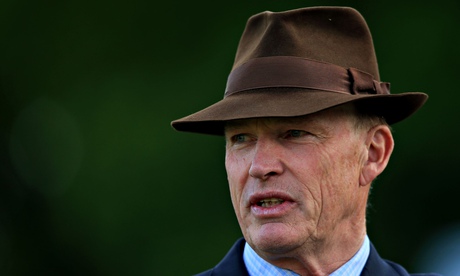
John Gosden sits in the office of his Clarehaven Stables, the Newmarket home to Golden Horn, the hot favourite for Saturday’s Derby, smiling as he calls to mind little details about the time he won the race in 1997 and especially at the memory of his open-ended instructions to the jockey, Willie Ryan. “Just go when you feel like it,” the trainer told Ryan, who took him at his word, pressing the button on Benny The Dip with half a mile to travel.
This would hardly count as orthodox tactics, in view of pre-race doubts about whether Benny The Dip’s stamina could stretch to a mile and a half, but the trainer now hails it as “a race-winning move”. Ryan had pinched a three-length break on the field by the two pole but then came what must have been the longest 30 seconds of Gosden’s life as his colt got slower and slower while Pat Eddery drove Silver Patriarch closer with each stride.
“He probably had us, two strides past the line,” Gosden says. “But, fortunately, not on the line.”
Delighted as he might be with Ryan’s ride, the trainer had expected to be legging-up a different jockey that day, one Frankie Dettori. At a late stage, the Italian was claimed by Godolphin to ride an outsider who was eventually beaten by 25 lengths.
“It was slightly unfortunate,” Gosden says, but if there is any lingering regret that he didn’t share his Derby triumph with Dettori, who had been his stable jockey, next Saturday may bring catharsis. The pair will team up once more in the hope that Golden Horn can justify skinny odds of 7-4 in the Epsom Classic.
The jockey’s services are retained these days by Qatari owners, but they only have so many horses. For the first time in two decades, the 44-year-old Dettori is receiving most of his rides from the 64-year-old Gosden and they seem happy as a pair of old lags doing one last job together. When Dettori returned to action in 2013, following his split from Godolphin and a six-month drugs ban, he was unfashionable. Quality rides were scarce.
“He had two years where he wasn’t, for a jockey of his class or quality, getting the horses to ride,” Gosden says. “I think he’s enjoyed it, coming here in the mornings and riding work, plenty of reasons to get out of bed and get on with the day and there’s no doubt he’s still at the height of his powers.
“If you’ve won the Formula One world championship a couple of times, it’s not an awful lot of fun running around in Formula Two cars. So if we’re fortunate enough to have a few horses who can compete at the top level, then that’s going to be very inspiring for him. The enthusiasm is there and he’s enjoying it and that’s very important for him.”
Gosden will also have work at Epsom for his other ex-stable jockey, William Buick, aboard the 7-1 third-favourite, Jack Hobbs. The trainer is proud to have picked up this horse at a yearling sale for 60,000 guineas, which is not much more than a song in the world of Derby contenders, but Jack Hobbs was beaten by Golden Horn in their prep race and the trainer does not seem to expect a reversal of that form.
“He’s still a big, rangy boy, he’s still quite unfurnished and it’s all coming soon enough for him, quite frankly,” Gosden says. “Whereas the other horse at this stage, he’s pretty together and he’s a grand sort of horse. He showed it in the Dante. He’s neat, well balanced, he relaxes well, so he’s more of an Epsom type.”
Two clear chances in the Derby make Gosden, hardly for the first time, the envy of his profession, occupying a position normally taken by Aidan O’Brien at this time of year. But, for once, O’Brien, triumphant at Epsom for the past three years, has been unable to produce a horse worthy of single-figure odds, making this Derby a fine opportunity for British-based trainers, who have not had the winner since 2010. Some see this as a low-quality Derby that may take little winning for anyone able to muster a half-decent animal.
“I don’t see it that way because it is the Derby,” Gosden says and he ticks off a list of attributes your horse must have, for which there is no way to test him in advance. Most of all, he says, “You’ve got to have good luck in running. We went there with a filly [The Fugue] who should have won the Oaks by three or four lengths, comfortably, without the jockey having to move on her, and what happened?
“Well, she was all but on the ground. She nearly went down in a pretty unpleasant situation. So I go there with my eyes wide open.”
Gosden has had a significant profile in the sport for 30 years, even back to his early days in California, where the start-up costs are so much lower than here. There have been plenty of Group Ones along the way but recent years have put him at the very top of the tree. He has two King Georges from the past four, became champion for the first time in 2012 and had two of his best horses last year in Kingman and Taghrooda.
Those successes have brought increased popularity and the famously articulate Gosden has also endeared himself to racing’s followers by speaking convincingly in the sport’s defence on at least two occasions. When another trainer’s horse sustained a shocking and obviously fatal injury on camera, he provided calming words of context and explanation. Last autumn, he roundly condemned the decision of a newspaper to print a front-page picture of a racehorse with a vet’s gun to its forehead.
His stock has never been higher but he has no intention of cashing in for a deserved retirement. “The great thing about the profession I’m in, as long as someone is kind and nice enough to send you a horse to train, you can continue training away until, as they say in America, you’re dragged out by the harrows off the track. You can carry on for as long as you like.”
On the subject of the future, rather than his own, Gosden is encouraged that the sport’s rulers no longer take spectators as much for granted as in the past. “You really have to make the experience of going racing be a fun, good day out, that’s where it starts. I happen to like it when Ascot gives free admission on Sagaro day. I’m all in favour of much more free admission and getting people in, enjoying themselves and having enough people at the bar to serve them a drink, so they don’t have to send a mate to queue up during the race because it takes half an hour to get a warm shandy.
“I know it’s not easy, it’s not like these places are open every day, it’s just three days at a time but if we could get the service there and cut down admission costs, it’s got to be a big factor.
“It’s not just turning up to see the horses. Of course the horses are important, the colour, the beauty, the movement of the horses, the betting, everything. But we’ve got to look in that direction. The experience of a day’s racing is now as important if not more than anything else.”
Gosden continues: “Too much exclusivity is not a good thing. You can argue what you like about the new and old Ascot, it is totally incomprehensible that someone was expected to come in a tunnel all the way through under the Royal enclosure to pop up to see a horse in the paddock and then they had no chance whatsoever of getting back down the tunnel to watch the race. They had no chance. And if someone said ‘I want to rent a box for the day’, you might get a concrete pigeonhole at the two-furlong marker. But I mean a concrete pigeonhole. We had to move and change.
“But for too long, racing was a little bit too clubby, a little bit too private clubby – ’You can come if you want but we don’t really need you,’ and all that. The world has changed and it must be made inviting and welcoming.
“We need to bring in a lot of younger people and make it a better experience. I know racecourses are conscious of this now. They never were for years but a lot of them are making a big, big effort and you’ve got some executives who are very on the ball.”