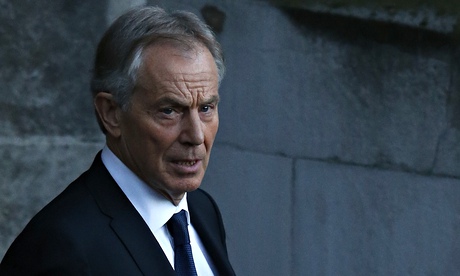
To be misunderstood is the agony of the Tony Crucified. “I’m very happy to be here,” said Blair, astonished that his two previous refusals to appear before the Northern Ireland select committee had been interpreted as reluctance, and deeply hurt by suggestions he had managed to find a spare couple of hours in his world-saving schedule only after receiving a formal summons.
The window in his diary had, his manner suggested, materialised only after an unexpected cancellation of a meeting with Rupert Murdoch. By coincidence, Murdoch was also the last person before Blair to require a formal summons before agreeing to appear before parliament.
As the committee began questioning him about his government’s decision to send letters to nearly 200 Sinn Féin and IRA sympathisers, assuring them that they weren’t wanted by police and wouldn’t face prosecution, Blair’s sense of frustration deepened. He held his arms open, his expensively taut face for once touched by mortality. Other people’s, not his, obviously. “You can’t comprehend the sacrifices I have made for you, the country, the world and all eternity,” he declared. “The lens you are looking through now is 180 degrees different to the way it was then. It’s only thanks to the difficult decisions I have made that there is now peace in Northern Ireland, the Middle-East and Croydon.”
That may be so, some members of the committee agreed, but how had these letters remained a secret until the Hyde Park bomb suspect John Downey was set free at the Old Bailey last year?
“They weren’t a secret,” said Blair, his arms now whirling frantically, though not always in unison. “It’s just that no one knew about them.” If people had bothered to read a written parliamentary answer to a question no one knew had been asked, they would have been perfectly well informed.
A few people looked slightly quizzical at this, but Blair’s self-belief slipped into overdrive. He would have sent those letters to anyone to secure a peace deal. It was just an oversight that none had gone out to any loyalist paramilitaries. Or that David Trimble hadn’t a clue they were being sent. “Look, guys,” said Blair, his eyes opening wide in practised innocence. “If David Trimble had wanted letters of assurance for loyalists, I would have happily written them.” Silly David. “What you have to understand is that these letters were fairly meaningless. We were only sending them out to people who had gone on the run for crimes the police had now decided they hadn’t done.”
Ian Paisley Junior wasn’t entirely satisfied by this. Would the former prime minister turn around and apologise to the relatives of the victims of the Hyde Park bombing who were sitting at the back of the room for his catastrophic error? Tony doesn’t do turning around these days – he’s got terrible problems with his neck that no amount of time in a Californian hot tub can cure – so looking the victims in the eyes was, he deeply regretted, not an option. But he would look straight at the committee chairman and apologise for the fact that some idiot underling hadn’t realised Downey was wanted on terrorism charges and sent him a letter by mistake. He wouldn’t, though, apologise for the process of letter-sending, which had been entirely correct and saved countless lives.
“Look,” he continued, his voice lowered to barely a whisper; Blair hasn’t forgotten how to work an audience. “The peace negotiations were on a knife-edge.” He pressed his hands together, inviting everyone to join him in worship. “I sincerely believe that if I hadn’t agreed to send out these pointless letters to innocent people, then Sinn Féin would have walked away from the negotiating table.” Given the insane nature of politics in Northern Ireland at the time, Blair might well have been telling the truth about this. But such is his reputation, few people are now willing to give him the benefit of the doubt.
Not even Lady Sylvia Hermon, the independent MP for North Down, who only just managed to resist the urge to kiss the hem of Blair’s jacket. “Truly you are a great, great man and it’s is so generous of you to grace us with your presence,” she croaked in a halting sob. “But I do have one teeny-weeny questionette. You did mumble a bit when you were asked about where you last met Gerry Adams last September.” Blair looked surprised. “Cnnnnnn Nnnnnn Nnnnn,” he said, repeating himself for the benefit of clarity. Sorry? “Clinton’s Global Initiative.” No one had any idea what Bill, Tony and Gerry had got up to together. Though they were fairly confident all three must have been well paid for it.
Concerned that he was on the verge of being outgunned in the Tony-love stakes, Labour MP Stephen Hepburn was determined to have the last word. “You’ve been brilliant, Tony,” he gasped. “You really have. You’ve given a great performance. So I’m not going to ask you any questions at all.” Blair smiled a blessing. His ordeal was over. He may not get such a smooth ride when the Chilcot report is published.