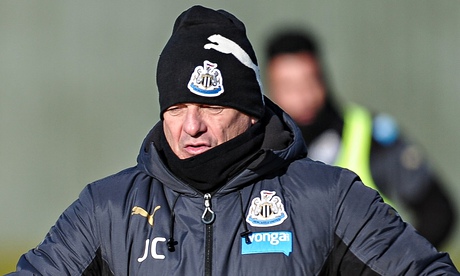
Click-clack, click-clack, click-clack. It is the sound of crutches on linoleum and something John Carver has become horribly accustomed to in recent weeks.
“I keep hearing crutches coming down the corridor outside my door,” says Newcastle United’s head coach, who could be forgiven for believing his office is doubling as an orthopaedic surgeon’s consulting room.
With Cheik Tioté, Steven Taylor and Papiss Cissé (who brought forward knee surgery scheduled for the summer after receiving a seven-match ban for spitting) among the eight senior players sidelined by injury, Carver’s side are not in the best of health to entertain Arsenal on Saturday. He has 13 fit outfield players available and a recent acknowledgement from the St James’ Park hierarchy that the squad is far too thin will prove little consolation.
Fabricio Coloccini’s suspension means Carver has only two fit established defenders, Daryl Janmaat and Mike Williamson, at his disposal. Janmaat, a Holland right-back and Newcastle’s best crosser, must play out of position at centre-half.
Up front it is arguably even worse. In Cissé’s absence there is only the potentially brilliant but young, inexperienced and increasingly tired-looking Ayoze Pérez, the inadequate Emmanuel Rivière, the unproven youngster Adam Armstrong and the unutterably hopeless Facundo Ferreyra.
Anyone who has seen Carver work, either coaching on the training pitches or in the “strategy room” at Newcastle’s training ground, where his video analysis of matches, tactics and players is impressive, knows he is being sold horribly short.
Viewed in context, his record of two wins, three draws and five defeats in 10 Premier League games since succeeding Alan Pardew is a bit more respectable than it appears on paper.
He might not be a fashionable name but there was a reason why Ruud Gullit, then Newcastle’s manager, plucked the young Carver from academy obscurity almost 20 years ago. The man can coach, can communicate with players – and who is to say that, given a strong hand, he could not do just as well as Rémi Garde, Christophe Galtier, Thomas Tuchel or anyone else with more than half an eye on taking the St James’ Park job in the summer.
The shame is his chances of trying to prove himself are being undermined by the very same forces which led Pardew to make – on the face of it – the extraordinary move of exchanging Newcastle for Crystal Palace at new year.
Pardew had wanted at least one striker and a centre-half in the transfer window. He knew that without them Newcastle would struggle but the board were reluctant to spend. Selhurst Park suddenly seemed like nirvana.
Mike Ashley, Newcastle’s owner, and Lee Charnley, the managing director, do not like waste. That is why there are strict restrictions on electricity use throughout the club. It also explains why, with the team in mid-table, they took the risk of loaning Davide Santon to Internazionale in January. How Carver could do with the left-back, who will not be returning after Roberto Mancini persuaded his board to make the move permanent last week.
It would help if Carver’s strikers were sufficiently rampant to camouflage defensive deficiencies. Unfortunately a record of three goals in the past five games indicates this is not the case, while also suggesting that Graham Carr’s invariably golden transfer-market touch apparently deserted him last summer. For once Newcastle’s chief scout has failed to come up trumps.
With the £1.5m move to bring Pérez from Tenerife – and what smart business that was – driven by Pardew, Rivière arrived from Monaco for £6m while Ferreyra, seemingly a friend of Coloccini’s, turned up on loan from Shakhtar Donetsk. He has been injured but is said to be barely good enough for the reserves, let alone the first team. Some say Ferreyra is the club’s worst recruit since Fumaça – nicknamed “Formica”, aka “the only Brazilian who couldn’t play” – during the Sir Bobby Robson era.
Armstrong is highly promising with some wonderful movement but, like Pérez, he is not really an out-and-out striker.
Pérez has scored five goals this season but Rivière, whose game has enough about it to suggest he might be a hit in the Championship, has still to score in the Premier League this season after 15 appearances. Had Cissé not registered 11 in 19 appearances Newcastle would not be in the relative comfort of 11th place with 35 points, 10 clear of the bottom three and within touching distance of safety.
Siem de Jong, a £6m summer buy from Ajax, was supposed to score plenty of goals from his No10 role but he has been out for virtually the entire campaign, most recently with a collapsed lung, a problem that had sidelined him in the Netherlands.
Now Carver – toying with the idea of shifting Gabriel Obertan from the right wing to attack (although it is to be hoped his shooting is not as wayward as much of his crossing) – must avoid subjecting Pérez to mental collapse.
“There was an awful lot of pressure on this young lad coming from Tenerife and being thrown into our cauldron,” he says. “When we signed Ayoze, we thought he’d have a full season in the under-21s developing but he was thrown in at the deep end. He’s dealt with it well but I’ve started to see him looking more jaded, finding the physical elements a bit tough. It’s part of my job to deal with him, and one of the other young players – Adam Armstrong – to make sure they don’t disappear into the wilderness.”
Whatever the result against Arsenal, Carver is not the cause of Newcastle’s travails.