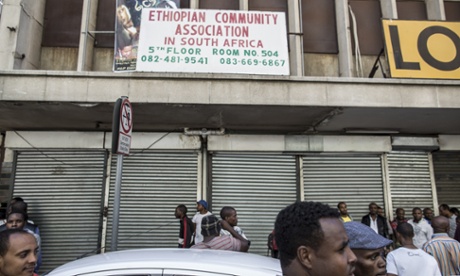
Scores of shops in Johannesburg have pulled down their shutters after anonymous emails and text messages fuelled fears of xenophobic violence.
In the central business district of South Africa’s commercial capital – where looters ransacked foreign-owned shops earlier this year – a text message warned, “Zulu people are coming to town ... to kill every foreigner on the road”, Reuters reported.
It comes in the wake of recent unrest in the coastal city of Durban, where two foreigners and three South Africans have been killed. The dead included a 14-year-old boy who was allegedly shot during looting on Monday night. Thousands of immigrants have taken refuge in safe camps.
In Johannesburg’s normally bustling Jeppe Street on Wednesday, many stores were shuttered amid a febrile atmosphere. Michael Ene, 34, from Ghana, said he had closed his wig shop because of the threats. He said: “There’s no violence but people are scared. There are rumours people are coming but we see nobody. We are just vigilant.”
By late morning, Joyce Tankau, 30, from Cameroon, was cautiously reopening a shop selling furniture, washing machines and other household products. She explained: “In the morning they said people were going to attack the foreigners so you must close your shops. Nothing happened so I just reopened. I don’t know why this is happening now. The police don’t do anything.”
A South African shop owner, who gave his name only as Muhammad, 27, kept all but one of his shutters down. He said: “There is a big risk. The whole street is closed and most of the shops are owned by foreigners. Everybody is worried for their own safety. The government should deploy the army; this morning I’ve only seen one police car drive by.”
South African news websites published a video from Johannesburg showing a taxi driver attacking an Ethiopian man who lay in the middle of a street before another man intervened. But the eNews Channel Africa reporter Nickolaus Bauer said he has spoken to witnesses and “it was nothing to with xenophobia; it was a road rage incident”.
Bauer also tweeted: “Journalists need to be extra vigilant then it comes to #Xenophobia. Don’t be the one who cries wolf and ignites violence.”
Journalists need to be extra vigilant then it comes to #Xenophobia. Don't be the one who cries wolf and ignites violence @eNCAnews
— Nickolaus Bauer (@NickolausBauer) April 15, 2015
Tensions remain high in and around Durban, where angry mobs attacked foreign-owned shops and foreign nationals took up arms to fight back on Tuesday. South Africa’s Times newspaper reported that the violence spread to Verulam‚ to the north‚ later that night when five foreigners were stabbed and assaulted, and there were further incidents in Pietermaritzburg.
More than 800 police officers have been deployed to the area. Colonel Jay Naicker, a spokesman, said 74 arrests have been made since the trouble began in late March. He said: “Spreading false information on the number of deaths and attacks, the different areas that are being attacked, and hate speech aimed at foreign nationals not only causes undue panic in communities but also has the potential to fuel the violence.”
South Africa, which has a population of about 50 million people, is home to an estimated five million immigrants. In 2008, xenophobic violence broke out around Johannesburg townships, killing 62 people.
The latest violence has been condemned by the governing African National Congress and opposition parties. Nelson Mandela’s grandson, Mandla Mandela, a traditional council chief, said: “We hang our heads in shame as we recall how Madiba [Mandela’s clan name] visited these African states after his release from incarceration acknowledging our burden of debt towards them.
“Now we repay them in the most vile manner by attacking their sons and daughters, threatening their lives, robbing them of their hard-earned livelihoods, looting, ransacking and burning their businesses. This all on our home soil that should be a place of refuge, safety, hope and dignity for all.”