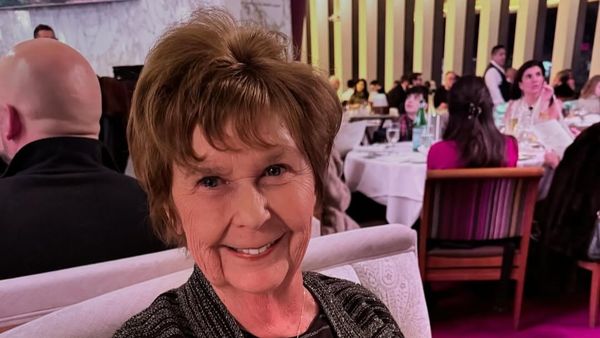

Joe Segal’s long love affair with jazz ended Monday when he died at 94.
The legendary impresario produced and promoted music for more than 70 years at dozens of Chicago locations before settling into his latest venue, the Jazz Showcase, a velvet-red jewelbox of a club at 806 S. Plymouth Ct. in the South Loop.
“Jazz,” he used to say, “is my livelihood and my love.”
Wayne Segal, who now operates the club, posted the news of his father’s death on Facebook, saying, “May you rest in bebop heaven.”
Though his youthful attempts to learn the trombone and piano failed, Mr. Segal once told the Chicago Sun-Times, “I don’t know one note from another, but I know when it’s not right.”
Mr. Segal booked hundreds of the greats in jazz — and at times, it seemed like he did it at hundreds of spots.
Over the years, he had to hunt for new locations because of expired leases, redevelopment and landlords who didn’t think jazz was a moneymaker. There were stints at the Beehive, the Birdhouse, the French Poodle, the Gate of Horn, the Happy Medium, the Blackstone Hotel and the Plugged Nickel.
“Most people that book bands into jazz clubs are not into the music,” he said in a 2014 Sun-Times interview. “They’re into the business. Which has been my failing. I’m more into the music, and I’ve never had a business sense.”
He brought in jazz greats including Gene Ammons, Count Basie, Art Blakey, George Benson, Dexter Gordon, Dizzy Gillespie, Herbie Hancock, Ahmad Jamal, Yusef Lateef, Sonny Rollins, Sonny Stitt, McCoy Tyner, Sun Ra, Lester Young and Joe Williams.
“To have continuously fought to showcase jazz in Chicago for seven decades, Joe Segal was a superhero,” singer Paul Marinaro said. “Like so many of the giants whose music he gave a home to, Joe Segal was and will remain a legend. Long after his son Wayne had taken over the day-to-day operations of the club, Joe would still call to personally offer a date, and the importance of that was never lost to me. He not only would gladly share his vast knowledge of this music but would tailor the conversation to what he thought you’d personally connect to. The bookings, the chats, his personal song requests, his sitting, listening and nodding in approval stage side — to have been even a small blip in his vast history will remain a source of accomplishment and pride in me.”
Mr. Segal loved to tell stories. He once told the Sun-Times about a beat poet who visited the Gate of Horn.
“This idiot came in. This Allen Ginsberg. It was an intermission. And he said, ‘Can I [go onstage]?’ And I said, ‘OK.’ So he gets up there, and his first few words are — I won’t repeat them now. And I said, ‘Man, get the f--- off the stage! What is this crap?’ ”
Mr. Segal went on: “Somebody told me years ago, ‘Man, Elvis died.’ I said, ‘Yeah, 20 years too late.’ Screwed up music forever. Not that he’s the only one.”
Through the rise of rock and roll, rap and other forms, he never wavered in his devotion to his favorite kind of music.
“Jazz,” Mr. Segal said, “makes you think.”
“He kept the flame alive, presenting pure jazz at times when there was very little audience,” said Chicago political consultant Don Rose, who attended some of Mr. Segal’s earliest jazz shows. “He was able to keep the purity of the music. He was, in his own way, a music educator, not just a guy who ran a club.”
Growing up in Philadelphia, young Joe listened to Dixieland, swing and the big bands. He wanted to learn how to play drums, but his mother was afraid the noise would upset their landlord. He took a crack at trombone instead.
“And after a year, I couldn’t do nothin’ with it,” he said in the 2014 interview. “I couldn’t remember what went where. Forget about it.”
After leaving military service in the late 1940s, he enrolled at Roosevelt University on the GI bill.
Living near 48th and Champlain, he dropped in at every music club he could find. He became an habitue of the Congo, the old Regal Theater and the Savoy Ballroom.
“That was right in the middle of one of the jazz centers of Chicago,” he said in a 1974 Sun-Times interview. “And nearby on 63rd Street there were even more places. This was when I started to hang around the clubs and got some of the musicians to come to Roosevelt” for sessions.
In 1948, he booked his idol, saxophonist Charlie “Bird” Parker, at the university. He was so thrilled and distracted, he forgot to collect the admission charge.
He’d host month-long club celebrations of Parker’s life and art.
Mr. Segal always had a soft spot for musicians. In a 1973 Sun-Times interview, he described how musicians used to invoke Parker when they appealed to him for gigs.
“ ‘Man, I played with Bird, let me play,’ they would say,” he said. “Then, they’d get up on the stand and really screw up. I finally wouldn’t let anyone sit in like that any more.”
In 2015, the National Endowment for the Arts honored him with a Jazz Masters Award, saying Segal “has been integral to giving jazz greats a platform from which they can publicly share their art.”
Over the decades, he taught a course on jazz at the Central YMCA, was a jazz radio deejay and jazz editor of Chicago Scene magazine and helped curate and produce records for Chess.
Mr. Segal recalled he had one job outside the jazz world. In the 1960s, Chicago police Supt. Orlando Wilson “cleaned up 63rd Street and Rush Street, and that was the end of the nightclub scene,” he said in the 1973 interview. “I got a job as a foreman in an automotive plant and did that for about three years to earn bread.”
Though he loved musicians, he said he managed to avoid the downfalls of the music business.
“I was in with all the cats when they were getting blasted out and stoned,” he told the Sun-Times in 2014. “I never did that. I was too chicken. I said, ‘You want me to put what in my arm? Get outta here! See you at the gig. Your time is your own. Goodbye.’ ”
Contributing: Darel Jevens