ROOT’S RUNS
After the urn, the fireworks, the cheques, the champagne, the medals, the handshakes, the lap of honour and the rendition of Jerusalem, the team photos, the TV interviews and the post-match press conferences, the 2015 Ashes finished, in the very end, with a joke about Stuart Broad’s penis. It was Joe Root who did it. When Alastair Cook started to talk to the press about Broad’s length – “it’s been fantastic” – it was too much for Root to take. He started sniggering so hard that, in the end, Cook turned to him and asked: “What are you laughing at?” Root, ran his hand over his chin to try and disguise his smile. “Nothing,” he said. Then he admitted: “You talking about Stuart’s length”. Cook, playing it straight, rolled his eyes, gave a suffering sigh, and replied: “You and your one-track mind. I’m trying to do a serious interview here, Joe.”
Few English batsman have ever carried a load quite as heavy as the one Root took on this summer. There’s never before been an Ashes series in which one English batsman has scored two centuries or more, while his colleagues haven’t made one between them. Root made more than a third as many runs again as the next man, Cook. He made the top score in the first innings of all three of the Tests England won, with an average in those matches of 106. Broad should probably have been man of the series. But you can see why Darren Lehmann chose Root. England have become almost too dependent on him. His average in matches they’ve won is 81.89, the highest in the team’s history among those who played in at least ten Test victories.
Root’s schoolboy mirth in the press conference was a reminder of just how young the man who has carried England’s batting is, in age and at heart. We’d already had his impersonation of Bob Willis after England’s win at Trent Bridge, and the footage of him pulling down Broad’s trousers during a training session at Edgbaston, causing Broad to chase him round and round the outfield. Only a curmudgeon could begrudge him his fun, especially after all the criticism the team have taken in the recent past for being dour, inaccessible, and uncommunicative.
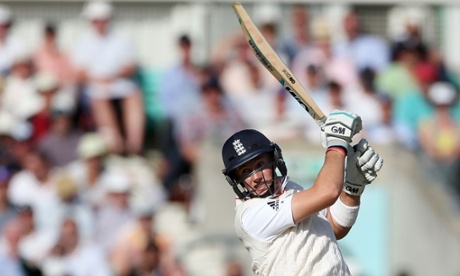
You can see Root’s carefree spirit when he’s out in the middle too. At four o’clock last Friday afternoon England were 46 for two, still 435 behind. Adam Lyth had just been dismissed for the first time in the match, perhaps the penultimate time in his Test career, caught at mid-on off a long-hop bowled by Peter Siddle. Siddle’s next ball was short outside off stump, and set to fly harmlessly by, too wide and high to threaten. So of course Root, only just in, reached up with his bat and cut it over gully for four.
An audacious shot in any circumstances, and an extraordinary one for a batsman to play to his first ball when his team were struggling. Especially an Englishman, so often hidebound by old ideas about the right and proper way to play the game. Root did a similar thing in the second innings at Edgbaston, when England were 51 for two chasing 121. That time Josh Hazlewood was bowling, and the first ball he delivered to Root was short and wide and cut past point for four. Some way to start, with an exclamation mark.
It would have been easier, and safer, to let those two balls pass by. Root preferred to play. It’s the modern way, the mark of the new generation of batsmen. Root, of course, is a leading member, along with Virat Kohli and Steve Smith, and Kane Williamson. “The leading young bucks in Test cricket today,” as Martin Crowe has called them. Williamson is a little more circumspect in Tests. Smith a little less successful in T20. But all four are versatile enough to switch styles to suit each of the three different formats they play. And more than that, they don’t discriminate between the demands of those formats. Particularly Smith, Root, and Kohli.
The old rhythms of Test cricket have been disrupted. Little respect now, for well-worn rules about how openers are there to see off the new ball, and should simply try to survive through the first hour. Modern batsmen always seem to be reluctant, too, to let the bowler dictate the tempo of play, are less likely to try and grind their way through a good spell. They see a bad ball as there to be hit, whether it’s the first of the innings or not, and whatever the match situation is. All this the influence of T20 cricket, where scoring opportunities are too precious to pass up, and the momentum of the match is something a batsman looks to shift in the space of a single over, rather than an entire session.
Root seemed an orthodox sort of player when he first emerged. Another in the long line of Yorkshire batsmen. But he has been scoring at an extraordinary lick this year. His strike rates in the last three Test series, 73 against West Indies, 60 against New Zealand, and now 67 against Australia. Only one English batsmen has ever made as many runs in an Ashes series at such a rate, and that was Kevin Pietersen in 2005. The really odd thing is that Root has done all this without anyone really feeling the need to remark on the speed with which he has been scoring. Because, in this age, 67 runs per 100 balls doesn’t even seem that extraordinary any more.
That versatility is going to be a mixed blessing for Root, since it means he will have to play an awful lot of very intense cricket over the course of his career. The decision to rest him from the upcoming limited overs matches against Australia is a good one. Root is precious, and, like all of the players good enough to be picked in all three formats, he has to be protected from the demands of the schedule, given time to rest and recover. And besides, it will give an opportunity to another batsman. And England desperately need one of them to take it, especially if Bell decides to retire, as he has suggested he is likely to do.
Hopefully, England will be open-minded about the captaincy too. Andrew Strauss clearly wants Root to grow into the role, which is why when he took charge one of the very first things he announced was that Root was going to replace Bell as Cook’s vice captain. His three peers have already made the step-up. Kohli, the oldest of the four, has been leading India’s Test team since last December. Smith is about to take on the job. And right now Williamson is leading New Zealand’s limited overs side in South Africa. Everyone assumes Root will become skipper soon or later.
Root’s antics, though, are a cue, too, that he may not be ready, or even the right man, to take on the job whenever Cook ends up quitting it. He has been given a lot of different nicknames by his team-mates – Wireless, Geoffrey – but FEC isn’t one of them. Craptain is, after Middlesex chased down 400 to beat Yorkshire when he was leading the side at Lord’s. And right now, England are doing well by letting him be his own childish self, crude jokes and silly pranks and all. For now, at least, he is best when he’s carefree.