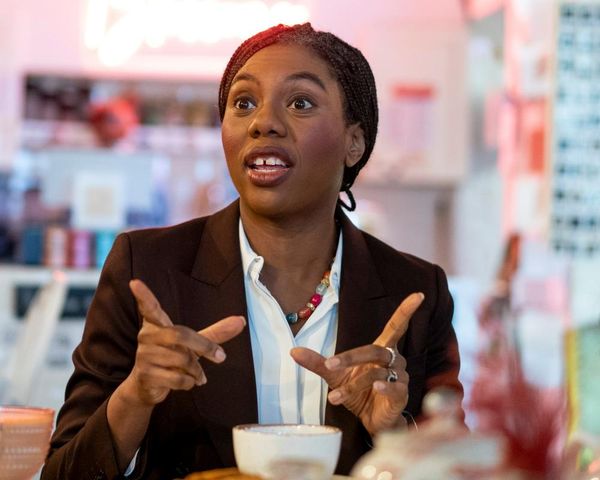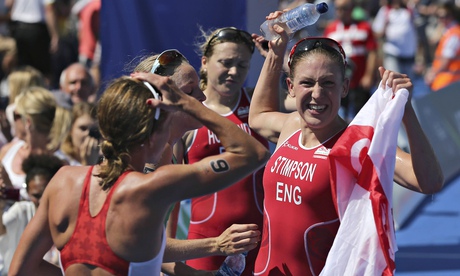
So desperate is Jodie Stimpson’s desire for oxygen that her every gasp sounds like Darth Vader’s death rattle. The Commonwealth Games double triathlon gold medallist has just pedalled for three hours on her turbo trainer, a stationary bike with no front wheel, head rocking in suffering and trance. But her day is far from over. Later, she will jump in a 25m pool and swim 5,000m before finishing with a 30-minute run. All this at 8,000 feet in Kenya’s Rift Valley, where it is not only the views that rip your breath away. As Stimpson knows all too well. “It’s not too bad when going easy but then as soon as you try to ramp it up it’s like: ‘Oh God, where’s the oxygen?” she says, cheerily.
It is then that it hits you: Stimpson enjoys all this. The monotonous laps of the pool. The hours of riding without moving. The high-altitude training camps, away from loved ones to help her climb to the summit of the triathlon world. She is not far off. In 2013, she finished second in the world rankings to the Welsh athlete Non Stanford. In 2014, her focus was diverted by Glasgow, yet Stimpson finished fourth overall. On the biggest training days, she explains, her training will start at 7.30am and not finish until 5pm or 6pm. “We don’t have a day off,” she says, as if her enthusiastic embrace of the sporting equivalent of a Dickensian workhouse is as natural as walking. “We have two half-days a week – that’s our recovery.”
Next Saturday, a new challenge awaits: a first half ironman – 1.2-mile swim, 56-mile bike ride and 13.1-mile run – in Bahrain. Stimpson entered the race for fun, not realising it carried a $100,000 first prize, one of the biggest in triathlon. “I was really naive,” she says. “I was looking for a fun challenge, a hit-out before Christmas. But because of the prize purse everyone is rocking up. But there are prizes for the top 10, so I’m hoping to get some Christmas money.”
After that, Stimpson will throw herself back into the World Triathlon Series of races, which start in March in Auckland and skip around the globe before finishing in Chicago in September. She wants the No1 spot, but more important still is the chance to qualify for the 2016 Olympics a year early – by finishing on the podium at the Rio test event in August and the grand final in Chicago.
It is a tough ask, but two years of solid form have convinced the 25-year-old that she has a shot – particularly after her double triumph in Glasgow. “It’s very rare that a plan plays out exactly but everything went how we wanted it to,” she says of her Commonwealth Games successes.
Stimpson’s family all watched her individual victory, England’s first gold of the Games, from the grandstand – except her brother-in-law who took a more active role. “If you look back at the video, he is having a sprint finish with me – I think he beat me,” she says, smiling.
Two days later she joined her England team-mates Alistair and Jonny Brownlee and Vicky Holland in winning gold in the mixed relay. “That hurt so much,” she says. “I was more nervous than in the individual race. I was a bit of a favourite for the individual but in the relay we knew if we stayed upright we’d win. But it was great fun – although Alistair and Jonny are quite demanding.”
If she does end up one of the favourites for Rio, Stimpson is adamant that the GB team should not have domestiques working for her, as they did the Brownlees and Helen Jenkins in London 2012. “I just think they did it wrong,” she says. “In the Olympics, the best three in the country should be on the start line. If they turned around to me and said: ‘You can have a domestique’ I’d say: ‘No thank you’.”
But surely it would improve British chances of making the podium? Stimpson shakes her head. “Triathlon is an individual sport,” she says. “If I win gold I don’t want it to be because someone dragged me around on the bike. The winner should be the best swim-cycle-runner. It’s a one-day event: prove yourself on the day.”
At the moment her greatest opponent is the American Gwen Jorgensen, the top dog on the run and the world No1. Stimpson concedes that Jorgensen is about 90 seconds faster over 10km, but is confident she can narrow that gap, and exploit other weaknesses in Jorgensen. “I beat her in New Zealand and Cape Town this year, and that quick transition and power on to the bike is where she suffers,” she says. “We need to take full advantage there. As soon as she recovers she can hang in there and then there’s no dropping her.”
Stimpson is training with the Kenyans; soon she hopes to be running more like them, too. Certainly she believes there is a lot more to come. “I’ve been working with my coach Darren Smith for two years,” she says. “I have enjoyed a massive improvement, but I’m still at the early stages of developing and doing things right. So I can improve loads. Really, I’m just scratching the surface.”