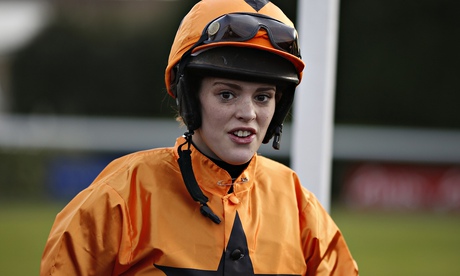
A jockeys coach has apologised after sexist comments he made appeared in a video on the BBC’s website. Michael Tebbutt, a former jockey who now works at the British Racing School, provoked outrage on social media by suggesting that men make better jockeys than women because of superior physical and mental strength.
The furore arose from a short film, made to coincide with Women’s Sport Week, in which Katie Walsh, who won April’s Irish Grand National, explored the issue of gender equality in racing. Tebbutt began by saying female apprentices work harder than their male counterparts before adding, deadpan, “Still can’t ride, though!”
While that was presumably intended as humour, Tebbutt was then asked to outline the differences between male and female jockeys. “Strength,” he replied, with every appearance of sincerity. “It boils down to strength. All-over strength, mental as well. I think males handle things a bit more.”
Walsh asked what Tebbutt would do when offered the choice between a stronger male jockey and a female jockey with a better brain. “You take the brain out the female and put it in the male,” Tebbutt responded, to laughter from the presenter.
The jump jockey Lizzie Kelly was among those who took to Twitter to vent anger, telling Tebbutt he should “be ashamed of yourself”, while another rider said she was “absolutely disgusted” and “livid”. There was also some support for Tebbutt, the apprentice Sophie Killoran tweeting: “He has been nothing but supportive and helpful to me as a coach”.
The British Racing School distanced itself from Tebbutt’s remarks, while the British Horseracing Authority, which approved him among the first draft of jockey coaches four years ago, described his words as “unacceptable” and added that it would “follow up with Michael about his conduct”.
Tebbutt apparently feels that the editing of the film took his remarks out of context, but nonetheless issued a contrite statement through the BHA. “My comments were misjudged,” he said. “I spend a lot of my time coaching young jockeys – both male and female – and, while many of them have different strengths and weaknesses, I always treat them all as equals, exactly as they should be. I apologise if I have caused any offence, to anyone in Britain or across the world, that was never my intention.”
Hayley Turner, the most successful female jockey Britain has produced, said she was not concerned by the video. “I’ve never been coached by Michael but I rode against him. He’s a nice guy and good fun,” Turner said. “I know he wouldn’t make the girls feel that they face an impossible task.”
Turner’s friend and rival Cathy Gannon was less inclined to take a lenient view, saying: “He’s definitely wrong in what he’s saying. Women can be as strong as the men.”
The organisation Women In Racing, which was having its AGM on Wednesday, countered Tebbutt’s remarks by publishing the views of John Reid, who rode the 1992 Derby winner and is also now employed at the BRS. “Every jockey I coach has individual strengths and weaknesses, no matter what their age or gender, and they will only gain race-riding strength and experience from racing,” Reid was quoted as saying. “If a jockey doesn’t get the rides, they’re simply not competitive, as they miss that vital fitness and experience opportunity; there is no substitute for it. If female jockeys are not supported and do not get the rides, the same rule applies. They all need the recognition and a much more level playing field.”
A field of 11 will line up for Friday’s Oaks, as Found, Local Time and Wedding Vow were the only withdrawals at the final entry stage. Jockey plans were finally confirmed for the 7-2 joint-favourites, with Ryan Moore on Legatissimo and Richard Hughes on Crystal Zvezda.
A decision is expected on Thursday on the participation in Saturday’s Derby of Zawraq, who had been second-favourite until returning lame from his final piece of work on Tuesday. Connections reported his condition had improved significantly by Wednesday evening. He will be cantered on Thursday morning and then allowed to cool down before further assessment.

.png?w=600)