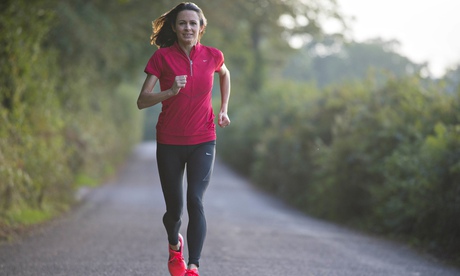
It took the best part of two decades as a world-class athlete before Jo Pavey’s trophy cabinet reflected her talent but these days the medals and awards keep coming. The latest – an MBE for services to athletics which was announced on Saturday – left her “shocked and thrilled” and feeling things were all “a bit surreal”. There is also still a slightly stunned humility to Pavey’s words when she describes that crisp night in Zurich in August when, a month or so short of her 41st birthday, she bounded away from the 10,000m field and into the history books by becoming the oldest woman to win a European title.
Such was Pavey’s popularity among her team-mates, who nicknamed her Granny, that many were in tears when she claimed what was the first gold medal of her career. In her quiet moments, though, Pavey wonders if there were other medals that got away. “Sometimes I have come off the track feeling like a failure, only to subsequently find out that I was racing against drug cheats,” she says. “In sport there are ups and downs but for any athlete it is extremely frustrating if people are prepared to cheat.”
One race in particular sticks out: the 5,000m in the European Championships in 2006. Pavey finished fourth. One athlete ahead of her was Liliya Shobukhova, the Russian whose results from October 2009 onwards were annulled because of anomalies in her biological passport.
“I would have liked to have got more medals in my career,” Pavey continues. “Sometimes I have got to major championships and run really badly for some reason but on other occasions I know I have gone up against athletes who were cheating.”
Pavey, who has long been one of the loudest voices against drugs in sport, believes authorities such as the World Anti-Doping Agency need to be better funded. “Definitely,” she says. “The biological passport has been a really positive step – I felt the Europeans last year was a much cleaner championship – but you always fear the bad guys are one step ahead.”
She also wants a far greater spotlight shone on sport’s greyer areas including the – for now legal – use of thyroid medicine. Before Zurich Pavey had a blood test that suggested she had slightly irregular thyroid levels and it was suggested she might consider treatment, something that outraged her. Like the UK’s anti-doping agency she wants thyroid medicine banned except where there is a genuine medical need.
“I believe there should be a strict Therapeutic Use Certificate-type process where you get an exemption form if you do need it,” she says. “Because at the moment some people are taking thyroid medicine unethically because it can improve energy levels and help athletes lose weight. Remember human growth hormone and EPO were things that were used in hospitals to help people who were ill but then people misused them.”
Following the BBC’s Panorama programme that made several claims about Mo Farah’s coach, Alberto Salazar, Pavey said she would “run a mile” from anyone she had suspicions about. But she stresses it is up to Farah to decide what is best. “We have to be clear there are no allegations against Mo and the allegations against Salazar and Galen Rupp are just allegations,” she adds. “I can only talk about what I would do and I would want to distance myself from any situation which could be an unsafe environment.”
Despite athletics regularly making the news for the wrong reasons Pavey would still encourage her children, Jacob and Emily, to take up the sport seriously if they so desired. “I love athletics and I’ve loved my career in it,” she says. “Hopefully if we come through this patch it will give the sport a brighter future.”
Pavey will not compete at the world championships in Beijing because she wants to spend more time with her family and also keep her body ticking over as she prepares for an almighty push to make next year’s Olympics in Rio, which would be her fifth Games in a row. “That’s my big motivation,” she says. “But it’s not going to be easy. I’m getting older and older and there are some good young girls coming through.”
Only one British track athlete – the race walker Chris Maddocks – has been to five Olympics, but if circumstances had been different Pavey might now be thinking of her sixth.
“I’m old enough to have done five if I’d got my act together, because I was 21 in 1996 but I was backpacking around the world,” she says, laughing.
“At that point I didn’t have the confidence to go on training camps so my husband Gavin and I decided to travel and train instead. We did things like run up an inactive volcano in Bali. I remember thinking: that will toughen me up but I could hardly walk for days.”
Pavey will be nearly 43 by the Rio Olympics but she is tempted to plough on, possibly to the world championships in London in 2017 or to attempt a personal best in the marathon.
There is one thing that she is sure of, though: there will be no big send-off like Paula Radcliffe’s in the London Marathon.
“I don’t think I’ll have anything like that,” she chuckles. “Maybe I’ll just fizzle out.”
Jo Pavey was speaking before her appearance on The Clare Balding Show. Watch the interview on BT Sport 1 from 8pm Thursday or BBC2 at 10pm on Friday

.jpg?w=600)