August Wilson is a man with a mission: to record African-American experience in each decade of the 20th century. His Jitney at the Lyttleton, set in the office of a Pittsburgh taxi firm in the late 1970s, is both informative and entertaining, but has an over-resolved neatness that betrays its youthful origins. Spiritually progressive it may be, but aesthetically it's conservative.
Wilson's greatest virtue is that he allows the drama to emerge through the interstices of work. The phone rings incessantly in the shabby office of Becker's busy taxi firm. We learn that the Pittsburgh authorities plan to board the place up in a couple of weeks. Then Becker himself, a stern episcopal figure, is confronted by his son, Booster, just released from the penitentiary after serving 20 years for the murder of his white girlfriend. And among the minicab mini-dramas, a passionate ex-GI, Youngblood, is accused of two-timing his live-in lover with her sister.
Wilson interweaves the separate strands with great skill. The big showdown between father and son generates considerable heat: the unforgiving patriarch stands for biblical verities; Booster argues with equal ferocity that a false accusation of rape justifies homicide. Best of all is the growing political assertiveness of the motley crew of cabbies in the face of redevelopment. Direct action, Wilson implies, is the best answer to an insensitive bureaucracy.
But you can tell this is a revised version of a play that Wilson wrote in 1979. It lacks the narrative openness of later work like Ma Rainey's Black Bottom. A last-minute accidental death introduces a whiff of melodrama. Youngblood is lovingly reconciled with his partner. Even Turnbo, the group's grouchy gossip, and Fielding, the resident drunk, sign up to corporate action. The great lesson of modern drama is that there are no easy resolutions. But Wilson, in his admirable desire to affirm black solidarity, ties everything up with neat ribbons.
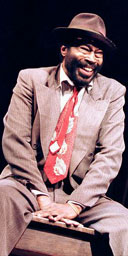
I still enjoyed Marion McClinton's production, which boasts a fine set by David Gallo: the charcoal outlines of factory chimneys and mine shafts remind us of Pittsburgh's industrial base. And in a strong cast, there's a brilliant performance from Anthony Chisholm as Fielding, showing the drunk's capacity to spring lightly on the balls of his feet or, in moments of uncertainty, use the furniture as a form of leverage. Roger Robinson's Becker is unyielding granite, and there's assured support from Stephen McKinley Henderson as the portly troublemaker, and from Russell Andrews as the angry ex-GI, who is told, "You gotta shake off that white-folks-is-against-me attitude." The play grips you in an old-fashioned way; but it's still just a prelude to Wilson's later, greater panorama of black American experience.
Until November 21. Box office: 020-7452 3000.