Step right up and try your luck! Four balls. All you’ve got to do is pick the right one to play. The first? Full and seaming away. An invitation to drive, which Peter Nevill rightly declined. It passed by wide of off stump. The second was a little shorter but travelling along the very same line. Mindful that his team-mate Mitchell Marsh had just been suckered by a similar delivery, Nevill left this one alone too. The third he could push for two off his pads. It was the fourth that was the one.
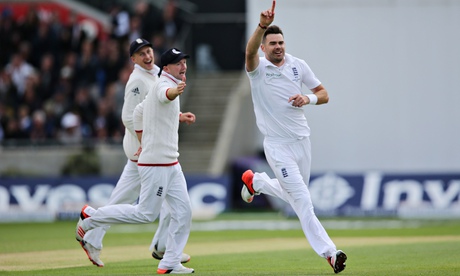
Same length, same speed as the first two, only a little straighter. Nevill moved to leave alone all over again and – spot the lady! – it nipped back in towards him and hit his wicket. Bowled leaving the ball is never a good look. He held the pose, bat high in the air, off-stump flat by his feet, while Jimmy Anderson wheeled away towards the slips, wagging his finger in the air as he went. Thanks for playing and better luck next time.
Call it the English hustle. Michael Clarke won the toss and chose to bat. Alastair Cook said he would have done likewise. At the same time England have fielded first in 20 Tests at Edgbaston and lost only one of them. And overall, the team batting first at Edgbaston has won two and lost 13 of the past 20 Tests. So it was not a bad day to bowl then and not a bad ground to be at after a beating like the one England took at Lord’s.
By midday the crowd was loud, the clouds thick and the lights on. Then there were the rain squalls blowing through every hour or so, forcing everyone off, breaking the batsmen’s concentration, putting a little more juice into the turf. And best of all the ball was moving in the air and off the pitch – only a little but a little is more than enough for Anderson on what was, as he said, “a typical English pitch”.

In Anderson’s second over he did David Warner lbw, the wicket won with another of his little tricks. He sent the ball down, seam wobbling all the way. It pitched on leg-stump and then came back just enough off the pitch to beat Warner on the inside. The thing with this particular delivery, Anderson says, is that even he does not know which way it is going to go after it bounces. And if that is so, what chance does the batsman have?
He does it by spreading his fingers a little wider either side of the seam and holding his wrist still as he releases the ball. He has had it in his repertoire for a while now. He learned it in 2010, after he watched another hustler, Mohammad Asif, bamboozle England’s batsman that same summer.
“You get it in conditions like this,” Chris Rogers said of Anderson afterwards, “and he comes into his own.” After lunch he had four victims in four overs. First was Adam Voges to a poor stroke, neither a shot nor a leave. The ball caught the toe of the bat and flew through to Jos Buttler. Next was Marsh, who threw two wild drives at wide balls. One missed, the other caught just enough to provide Buttler with another catch. After that Nevill was set up and knocked down, then Mitchell Johnson. For this one Anderson switched to round the wicket and had him caught at fourth slip off a thick edge – 19 balls, seven runs, four wickets. Australia fell from 77 for three to 94 for seven. It may yet turn out to be the spell that shapes the match.
Johnson’s was Anderson’s fifth wicket and after he had taken it he held the ball up to the crowd as they serenaded him. Not long after there was a sixth as Nathan Lyon played on. So Anderson finished with six for 47 from his 14.4 overs, his finest figures in an Ashes innings. All this came after one of the longest barren spells of his career, 277 deliveries without a wicket.
Warner’s was the first wicket he had taken since the third day at Cardiff, when he had Mitchell Starc caught at slip to end Australia’s first innings. Since then he had slogged through 45 fruitless overs in three innings spread across two Tests. He says it only made him more determined to bowl well here.
The break between the second and third Tests helped. Anderson had nine days to recover. He is only 32 but since he became a regular member of England’s Test team back in 2007 he has bowled many, many more overs than any other Test player: 3,353 of them to be precise. This is 500 more even than his friend Stuart Broad, who is second on that particular list, and a quarter as many again as Mitchell Johnson in the same time.
Fit as he is, the load sometimes shows. Back-to-back Tests take their toll – not that he took off all the time in between. He spent a lot of it in the nets working with Ottis Gibson, England’s bowling coach. Gibson reckoned that Anderson had fallen into the habit of “putting” the ball down the pitch rather than firing it in. So they spent a few hours working on his action, honing the final phase of his delivery.
It worked. Anderson was back to his old surly, brilliant self, stomping around, scowling, making the ball seam and swing. He even stopped to swap a few choice words with Michael Clarke, after he nicked an edge through the slips. And he had a few more with the umpires after they gave him a gentle reminder about following through on to the middle of the pitch.
He did not even seem too impressed by his own performance. Asked what he thought of it, he gave a lot of credit to Steven Finn and Stuart Broad and said: “I think I can bowl better.” Those are ominous words for Australia.