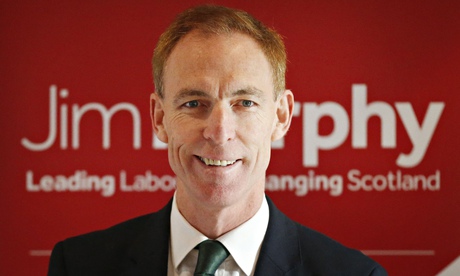
Labour’s hard-fought Scottish leadership battle concludes on Saturday, with Jim Murphy, MP for East Renfrewshire and former Scottish secretary, expected to prevail in a contest where his lesser-known rival has attracted more support than anticipated.
Neil Findlay, an MSP, garnered support from the unions and the party’s diminished activist base – gaining enough momentum to prompt Labour’s shadow Scottish secretary, Margaret Curran, to abandon her neutrality earlier in the week and come out for Murphy.
Although Murphy won double the total support that his rivals did among Scottish parliamentarians, his camp have been surprised by how divisive their candidate is in some quarters.
Labour has been trailing in the Scottish polls since the referendum and the party is unwilling to publish membership figures that even the most benign sources admit are in the low five figures. The SNP is heading towards a historic 100,000 members.
However, Scottish Labour’s travails span back much further than the bruising referendum campaign, which saw significant numbers of Labour supporters reject its pro-union alliance with the Conservatives and vote in favour of independence.
Announcing her resignation as party leader at the end of October, Johann Lamont gave an outspoken interview in which she described some of her Westminster colleagues as “dinosaurs” who did not understand how the political landscape in Scotland had changed, and accused them of trying to run Scottish Labour “like a branch office of London”. The Westminster party has been notably hands-off during the leadership campaign, keen to avoid any suggestion of a coronation engineered down south.
Despite Sarah Boyack being on the ballot the campaign has boiled down to a straight left-right battle between Findlay and Murphy. The centrist Boyack is an experienced Holyrood parliamentarian who worked with Murphy on restructuring the party organisation three years ago.
Murphy has acknowledged the struggle his party faces to reconnect with voters, but his New Labour baggage still weighs heavily for some disaffected Labour supporters. Findlay’s camp inevitably argue Murphy’s most recent pronouncements on housing and education are evidence of a tack to the left brought about by their man’s popularity.
The consequences, if Murphy’s victory is less convincing than initially expected, are unclear. All candidates have pledged to have their other rivals in their team. While Unite general secretary Len McCluskey described a Murphy victory as a “sentence of political death”, and there have been dark hints at possible disaffiliation, most Scottish trades unionists are waiting to see what he would do in charge.
It may also be taken as further evidence of the democratic deficit of the electoral college, which grants a third of votes to parliamentarians, union affiliates and members respectively, and which Ed Miliband himself reformed after becoming leader. One source suggests that turnout in the union section of the college could be as low as 10%. In a Guardian online hustings last week, only Findlay appeared not to back the alternative system of one member, one vote.
There remain practical difficulties for Murphy in his route to Holyrood. One option would be to exchange his Westminster seat with a nearby Holyrood counterpart, but a recent investigation for the Sunday Herald found the most obvious candidates intended to stand for re-election in 2016.
This leaves Kezia Dugdale, the MSP likely to win as his deputy on Saturday, to hold the fort at Holyrood.
Dugdale admitted, with disarming honesty at a hustings in Glasgow, that she was “not looking forward” to sparring with SNP leader Nicola Sturgeon every week and Murphy’s debating heft will certainly be missed in the chamber.
The next Scottish Labour leader’s practical problems are dwarfed by the existential. As one Labour insider said: “Jim is very unusual amongst the Westminster hierarchy in understanding the size of the problem that Scottish Labour faces. What he doesn’t understand is that he’s part of the problem.”