The bodies of four Jewish victims of the Paris terrorist attack on a kosher supermarket have arrived in Israel for burial.
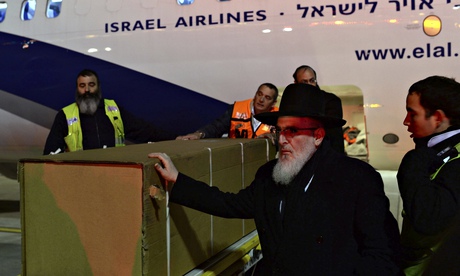
They were brought by a plane that landed early on Tuesday morning at Ben Gurion airport, near Tel Aviv. The burial was to take place at a cemetery in Jerusalem.
Binyamin Netanyahu, the Israeli prime minister, and other public figures are to attend the ceremony, which will be held under tight security as Israelis travelled from across the country to attend.
The El Al flight carrying the coffins of Yoav Hattab, 21, Yohan Cohen, 20 Philippe Braham, 40, and Francois-Michel Saada, 64, arrived at 4am before the bodies were taken in a convoy of ambulances and other vehicles donated by the French community in Israel to the huge cemetery at Givat Shaul on the outskirts of Jerusalem.
The four men were in the Hyper Cacher kosher supermarket in Paris on Friday and were killed shortly after it was attacked by Amedy Coulibaly, a jihadi gunman, who then took 15 other shoppers hostage before police stormed the building.
Coulibaly was associated with two other gunmen who were behind the murder of 12 people at the Paris offices of satirical weekly Charlie Hebdo two days earlier.
Netanyahu on Sunday said he had agreed to a request from the families that the victims be buried in Jerusalem.
“He would have wanted to be buried only there,” said Philippe Braham’s wife, Valerie, adding that they had a son who was buried in Israel. “He should be there with him,” she said in an interview with Israeli television.
Family members of the four dead men travelled with them to Israel, including Cohen’s fiance.
Before the funerals – and to mark last week’s events – French flags were on display across Jerusalem, including on King David Street.
Although it was not an official state funeral, it had the trappings of one, attended by senior Israeli political figures including the country’s president, Reuven Rivlin and the leader of the opposition, Isaac Herzog.
Before the funeral, Hattab’s father, Rabbi Benjamin Hattab, described the moment that he learned his son – killed after trying to grab one of Coulibaly’s guns – was in the supermarket to Israel’s Channel 20.
“I knew that my son worked in the area and I called his phone but he didn’t answer. I knew he was there. At 6.30pm they called and said he was OK. At 7pm, I said I wanted to talk to him and they said ‘wait a bit.’ At 10pm, they told us he had died,” he said.
Yoav Hattab was the second member of his family to die in a terrorist attack. One of his aunts was killed, aged 14, in an attack on a Tunisian synagogue in 1985.
The killings shocked France’s 500,000 strong Jewish community, the largest in Europe, and prompted calls from Netanyahu for Jews throughout the continent to emigrate to Israel to insure their safety amid a rising wave of antisemitism.
For many, the supermarket attack brought back memories of another deadly shooting in the southern French city of Toulouse in March 2012, when Islamist gunman Mohamed Merah shot dead three young children and a teacher at a Jewish school.
The victims of that attack were buried in the same Jerusalem cemetery where the victims from the Paris shooting were to be laid to rest.
Last year, France topped the immigration list to Israel, according to the Jewish Agency, a nonprofit group that works closely with the government and acts as a link between Jews around the world. Nearly 7,000 new immigrants came in 2014, double the number from the previous year.
The funerals came a day after Netanyahu visited the Paris supermarket where the four men were killed.
“There I met Celine, who was one of the hostages and who told me what happened during the terror attack,” Netanyahu wrote on his Facebook page after the visit.
“A straight line runs between extremist Islam’s attacks around the world and the attack that took place here,” Netanyahu wrote. “I expect all leaders, after we marched together through the streets of Paris, to fight all forms of terror, even when it is directed at Israel and at Jews. As far as I’m concerned, I will always make sure that Israel marches in the frontline … when it comes to its security and future.”