Seeking to recover "lost opportunities" in Africa, the Japan External Trade Organization (JETRO) aims to seize an opportunity through the Tokyo International Conference on African Development (TICAD) to expand Japanese business in Africa.
At the seventh TICAD, which started Wednesday in Yokohama, boosting private-sector investment is a key agenda item. JETRO is seeking to promote partnerships between Japanese and African companies through the three-day Japan-led conference by holding various side events.
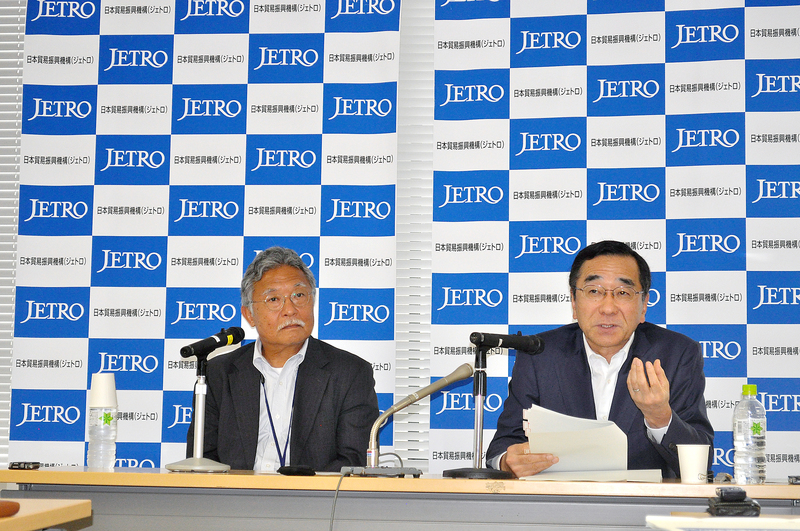
"Africa is far away from Japan, but we want to let Japanese companies know that there are business opportunities there," JETRO Chairman Nobuhiko Sasaki said at a press conference in Tokyo on Friday. "JETRO's role is to make a path for Japanese companies at the initiative of the private sector."
Japan's main focus in Africa has traditionally been development and assistance. In recent years, however, African countries have increasingly been viewed as business partners rather than aid recipients amid the region's increasing potential for economic growth.
According to the United Nations, the African population is projected to reach about 2.5 billion in 2050, accounting for about a quarter of the world. Along with an increase in population, private consumption, seen as a driver for growth, has been on the rise. In addition, hopes have grown for establishing regional economic integration to create a market of 1.2 billion people with a combined gross domestic product (GDP) of 2.5 trillion dollars as the African Continental Free Trade Area (AfCFTA) agreement took effect in May this year. The International Monetary Fund estimates that the GDP in sub-Saharan Africa will grow by 3.5 percent this year with about half of the countries in the region expected to see growth of 5 percent or more.
However, Japan's presence in Africa remains notably low with exports to the continent at about 10.8 billion dollar in 2018, down 27.3 percent over a decade, while the world's exports to the region rose 17.2 percent in the same period, according to data provided by JETRO, which views this as "lost opportunities" for Japan.
Under the theme for Africa, named "Tsumugu" literally meaning "weaving" in Japanese, JETRO has focused on four areas: encouraging small and midsize companies to make inroads into the African market, boosting cooperation with entities in third world countries, connecting African start-ups with Japanese companies and improving business environments. At TICAD, JETRO is holding events such as a business expo, where more than 150 Japanese companies showcase their products, technologies and services, as well as a business forum in which about 20 Japanese and African business leaders give talks. A start-up pitching event will be held Friday with 10 African start-ups giving presentations. On the back of the rapid spread of mobile communication devices, local start-up companies, such as mobile phone-based financial services providers and digital business platform providers, have changed the African business environment, creating new companies in the region.
Despite the potential, it remains to be seen whether Japan can capitalize in the region, which is prone to conflicts and trade facilitation hurdles such as infrastructure and logistics. Competition is also fierce with China's aggressive economic activity in Africa under its massive Belt and Road Initiative. At the end of 2017, China's direct investment stocks in Africa were at 43 billion dollars, far above Japan's 7.8 billion dollars, according to JETRO data. To distinguish Japanese businesses from their Chinese rivals, both the Japanese government and JETRO have stressed "quality" instead of "quantity." JETRO has particularly pushed for entities in fields regarded as Japan's strengths such as health care, agriculture and environment, as a way to solve social problems in Africa through business.
"Although the scale of businesses involving start-ups is small, JETRO hopes to widen and diversify business opportunities for Japanese companies in Africa," Katsumi Hirano, JETRO executive vice president specializing in Africa, said at the press conference. "We want to lay the foundations for a possible huge market."
Read more from The Japan News at https://japannews.yomiuri.co.jp/