Emily Masuda shares her experiences as participant of the Japan Exchange and Teaching (JET) Programme, which is administered through the collaboration of Japan's local and national government authorities and promotes grass-roots internationalisation at the local level.
* * *
In Gifu, a mild fall follows the humid summer. In late September, when the unrelenting sun took turns with typhoon weather, supermarkets showed the first signs of the changing seasons. A friend introduced me to seasonal confections, exclaiming, "You have to enjoy kuri [chestnut] treats while they last."
Not long after, chestnut treats began circulating around the office. One of them, kurikinton, is a specialty in the Tono region of the prefecture. In much of Japan, kurikinton is a bright golden-colored mash of chestnuts and sweet potatoes, but the local version is a more earth-toned puree of chestnuts and sugar. Each serving is round with a top pinched into a ridge. It is buttery in texture and very rich. Upon being given one, I was asked to savor it, as they are rather expensive. There are always too few bites before a sweet is gone.
Chestnuts, persimmons and sweet potatoes are among the fall staples in Japan. These foods bring not only a sense of nostalgia for autumns past but also a sense of their own finite enjoyment. I eat fuyukaki, box-shaped persimmon, every day. I try rice with chestnut when the opportunity arises and I eagerly await yakiimo.
The ideal yakiimo is sold from a small truck. The vendors melodically announce their product, and for a few hundred yen deliver a roasted sweet potato wrapped in newspaper that perfectly warms the customer's chilly hands.
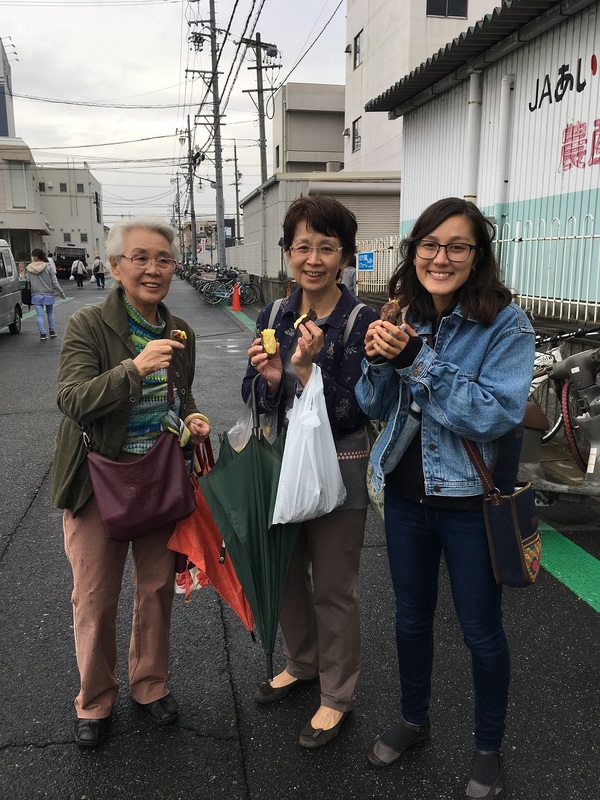
I was lucky to have family just outside of Nagoya whom I could reach in an hour and one change of train. At the Toyoake Festival in Aichi with my grandmother, aunt and cousin in early November last year, I found what I was looking for.
It was drizzling, so I watched from under a shared umbrella as men exposed to the rain shuffled sweet potatoes over hot rocks in smokers. Under a tent, the yakiimo were weighed and individually wrapped before my eyes. Once the wrapping came off mine, steam escaped from the yellow interior with the most inviting smell. Later, as I was about to return home, my grandmother handed me another one for the road. It warmed me from my jacket pocket all the way home, and the faint, sweet aroma brought back memories of that day as the lights of several cities passed by outside the train window.
I recalled a saying my father once told me. After mentioning I wanted a persimmon tree one day, he seemed far away when he sang, "Momo, kuri san nen. Kaki hachi nen." Peach, chestnut: three years. Persimmon: eight years. At the time, I thought this was informative and lyrical, but nothing more. It turns out that, as a person who is already missing fall before the season ends and worrying about the many uncertainties the future holds, the proverb I need to hear most is one I'd already been told.
Each thing at its own pace.
-- Emily Masuda, who is from Durham, Calif., studied English with a minor in education and professional writing at the University of California, Davis. She was an Assistant Language Teacher (ALT) on the JET Programme and taught in Gifu for one year. Currently, she works as an English teacher in California.
Read more from The Japan News at https://japannews.yomiuri.co.jp/