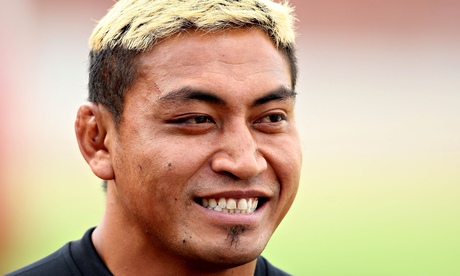
On a sad, black-edged day for rugby’s brotherhood it speaks volumes for Jerry Collins that his untimely death is being mourned far beyond New Zealand and his native Samoa. To some he was simply the hardest man in the game, the Hitman with the pint of Guinness hairdo. To others he was much more than that: a big man with an even bigger heart.
News of the tragic crash in the south of France that has killed Collins and his wife Alana Madill and seriously injured their baby daughter will hit a lot of people hard, as was frequently the case during his life. The 34-year-old Collins was a popular figure who always felt he represented a particular type of Kiwi. “I suppose I appealed more to the working-class man, the people who worked in the meat works and the factories,” he said in 2007, after announcing his intention to leave New Zealand to play overseas. “I got a lot of satisfaction out of that: people seeing you run out and enjoying what you’re doing.”
He was also a firm favourite with northern hemisphere supporters, from the Ospreys – where he helped the Welsh region win a Pro12 title in 2010 – to his friends at Barnstaple RFC. After New Zealand’s shock exit from the 2007 World Cup, he met the north Devon club’s coach Kevin Squire one night in Croyde and volunteered to turn out for Barnstaple’s second team against Newton Abbot on the Saturday. All his new team-mates thought their coach was joking – “You would be hard-pressed to think anything other than that the hair dye had finally seeped into Kevin Squire’s brain,” one told the North Devon Journal – but, sure enough, Collins bought himself a new pair of boots and featured at No8 against a rather startled Newton Abbot. A month later he also wore a pair of Barnstaple socks while representing the Barbarians at Twickenham.
It was this cheerful, idiosyncratic off-field attitude that set him apart from the grim-faced, unsmiling All Black enforcers of traditional legend. The Apia-born Collins captained the All Blacks three times during his 48-Test career, having made his debut as a 20-year-old in 2001, and was invariably in the front line of whichever team he was representing.
In all he played 74 matches for the Hurricanes between 2001 and 2008 and his former provincial side wore black armbands in his memory during their 56-20 win over the Highlanders in Napier.
For much of his career the 6ft 3in, 17st 2lb Collins boasted the biggest biceps in the All Blacks squad, even reaching the stage where, at 52cm in circumference, it was felt they were starting to interfere with his ability to tackle people properly. The former All Blacks and Samoan midfielder Alama Ieremia was convinced Collins would represent New Zealand years before it happened. “I knew he was going to be an All Black and he was only in fifth form,” he told Stuff NZ. “He was so young but had the heart of a Lion.”
If a true sign of a great player is an ability to have slotted into any team in any era, Collins certainly fitted that rare category. In some ways he was ahead of his time: what international squad would have deemed a loose forward of his physical gifts and formidable presence surplus to requirements in his prime? Imagine Jonah Lomu recast as a close-quarter forward threat and you get a rough idea of Collins at his unstoppable best.
Off the field he was not always quite so reliable. He once told a story about going out for a night in Wales only to discover he could not get back into the team hotel. He opted to climb up a drainpipe with the aim of entering his room on the fourth floor, only for the drainpipe to snap when he had only reached first-floor level. “Luckily I landed in some cardboard boxes,” he recalled. “The silly part was that after I made a noise and woke everyone up my room-mate told me the back door was open.”
A spell playing in Japan was not without incident either, notably his arrest in 2013 for carrying a knife in a department store in Hamamatsu. He later explained it was an attempt to protect himself against Brazilian gang members who, unhappy with his relationship with a woman, were threatening him. He was released after 11 days and, as recently as this season, was busy helping save Narbonne from relegation from the French second division, scoring two tries against their local rivals Perpignan. The only surprise, perhaps, was that a player respected in two hemispheres for his crunching tackling – YouTube is not short of shuddering examples – never won a World Cup. He featured in both the 2003 and 2007 tournaments but the All Blacks’ shortcomings in other key areas meant neither campaign ended happily.
Otherwise he won plentiful honours. Among the personal accolades, he was player of the tournament at the world junior championship in 1999 and was voted the Ospreys’ players’ player of the year in 2009-10, having previously played for Toulon after leaving the Hurricanes in Wellington.
Above all, though, he will be remembered as a fine All Black who tended to inspire both fear and love wherever he went.