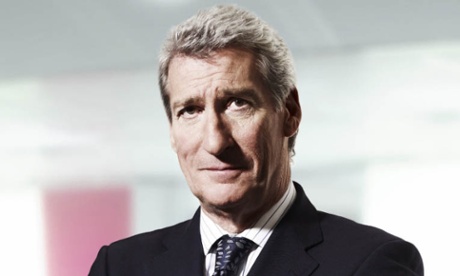
Just a day after one of TV’s most famous presenters begins to contemplate a career without the BBC, another begins his post-corporation career. Thursday night’s election special, Cameron and Miliband: The Battle for Number 10 (Channel 4/Sky News, 9pm), will see Jeremy Paxman interview the two contenders to be prime minister.
Paxman is a big, vivid beast of broadcasting, without whom the screens have felt duller and safer. Although Jeremy Clarkson was forced to leave the BBC while Paxman chose to go, the Top Gear presenter’s fans feel the same about him.
But, happy as many will be to see Paxman taking on politicians again, the precedents for presenters successfully switching from the BBC to commercial broadcasters are not encouraging. Des Lynam, Adrian Chiles, Christine Bleakley and Susanna Reid all struggled on the other side of the sofa.
While some senior BBC staff attribute this phenomenon to a “curse”, the explanation is cultural and technical. There is still a significant section of the British TV audience that instinctively turns to the BBC for major news and sports events – the BBC always “wins” general election and World Cup head-to-heads – which gives the productions an assumption of success. On advertising-funded networks, viewers have to be lured in, then convinced not to go away during the tempting opportunity of the commercial breaks. As a result, presenters tend to be under much more pressure and editorial instruction.
Also, due to the ads and trails for other shows, an ITV/Channel 4 “hour” of screen time is much shorter and more interrupted than the equivalent BBC slot. This may seem a small issue, but broadcasters become used to the rhythms and techniques of certain ways of working. Even Lynam, a highly accomplished frontman, found it visibly difficult, after moving to ITV from the BBC, to adjust to breaking the flow of conversation to “throw” to little films about bleach and deodorant. Chiles is another presenter who has always seemed more at ease in BBC than ITV studios.
Possibly ominously, Paxo’s previous experience with strict timings – handing over to the 11pm Scottish opt-out from Newsnight – was notoriously unhappy. He would sometimes carry on with interviews and leave Glasgow hanging. And while this may have been due to internal BBC news politics rather than an inability to watch the clock, the timings of tonight’s show will be exceptionally precise because – for reasons of impartiality – Cameron and Miliband must be questioned for exactly the same length of time.
Overall, though, the producers look to have been canny in devising the format. Paxman, as a presenter, has never seemed wholly comfortable with studio audiences – giving the impression that he was fighting the temptation to eviscerate their opinions as if they were government ministers. This is reputedly the reason why, after a pilot, he was was not given the BBC1 Question Time seat after competing against David Dimbleby in 1994. So, sensibly, co-host Kay Burley will conduct the voter-input element of tonight’s show, while Paxman does the one-on-one interviews.
Even so, tonight will be a big test for him. He has the benefit of goodwill from viewers (including me) who have greatly missed his presence on Newsnight, and, as he has probably also been missing his visual presence, he will be keen to get back. However, many broadcasters will attest that after any gap from the studio, even for a summer holiday, the nerves are worse and reflexes slower on the first show back. Live broadcasting – requiring the appearance of calm in a stressful environment – is an unnatural activity and so, even though Paxman has three decades’ experience, 9pm tonight may feel like the first day of school.
There can have been few previous TV programmes on which so much rested professionally. It is highly unlikely that the party leaderships of either Cameron or Miliband could survive failure to reach No 10, while some former employers and rivals at the BBC will be hoping that Paxo flops, and may not be above whispering in the ears of media correspondents that he has.
The presenter and his new employers face further jeopardy because his personal politics are now public in a way that they never were during the Newsnight years. Because he came to prominence as an interviewer in the Thatcher-Major era – and his single most famous encounter involved asking a Tory home secretary, Michael Howard, the same question 12 times – Paxo became a folk hero for many on the left, a reputation cemented by being aggressively sceptical towards Blair and Blairites.
However, on his farewell edition of the BBC2 show, Boris Johnson described Paxman as the BBC’s “only one-nation Tory”, a description that the broadcaster seemed to accept in a subsequent newspaper interview. As a result, he was included in speculative newspaper shortlists of possible Conservative candidates to be London mayor and MP for Kensington and Chelsea. This means that, with the departure of Clarkson and Paxman, the BBC has lost two of its probably not very large stock of Conservative-leaning presenters.
In one way, this provides a useful balance for Channel 4, as its longest-serving news presenter, Jon Snow, often seems to radiate a liberal-left perspective. But the media and political establishments will now be hyper-sensitive to any suggestion of the one-nation Tory, whom the party fancied as a candidate, being softer on Cameron than Miliband. There needs to be an absolute equivalence of tone as well as time in Paxman’s grilling of both would-be PMs.
Everything in his personality and professionalism suggests that there will be. But the stakes are very high for Paxman tonight. Unless he were to shout at one of the leaders for 20 minutes and then split their lip, there is no direct comparison between the situation of this Jeremy and the other one. Both, though, are BBC lifers now attempting to flourish outside. Unusually, in election interviews, the questioner has almost as much riding on the outcome as the questioned.