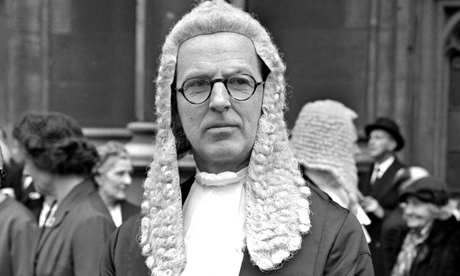
The doyen of the English criminal bar, Jeremy Hutchinson, turned 100 on 28 March. Still a spry and self-sufficient figure, his centenary has been marked by publication of a study of 14 eminent cases in which he was briefed for the defence. Space limitations have excluded several fascinating cases: Hutchinson defended the Great Train Robber Charlie Wilson, the corrupt Labour leader of Newcastle council, T Dan Smith, and won in the court of appeal on behalf of Commander Christopher Swabey, after a 16-year fight against conviction by a Royal Navy court martial for indecent assault (Swabey had supposedly put his hand on a sub-lieutenant’s knee).
Hutchinson is a scion of the Bloomsbury set (his mother was a Strachey, who became a model for Virginia Woolf’s character Clarissa Dalloway as well as the lover of Clive Bell). He remembers both TS Eliot and John Maynard Keynes before they became the celebrity authors of The Waste Land and The Economic Consequences of the Peace. For much of the war he was a naval officer on ships commanded by Louis Mountbatten, and he was swept overboard when German dive-bombers sank the destroyer HMS Kelly. Mountbatten made the survivors sing “Roll out the Barrel” to lift their spirits.
At the 1945 general election Hutchinson stood unsuccessfully as the Labour candidate in a now defunct constituency covering Whitehall and Soho. His sale of an inherited Monet snow scene financed his early years as a young barrister married to the great actor Peggy Ashcroft.
Among other minor cases he secured the acquittal of the boozy actor Trevor Howard on a drink-driving charge, by showing that Howard had had a long discussion with an arresting officer about the differences between a googly and a leg break: “Is it really likely, members of the jury, that a man could have such a conversation and yet be incapable of having proper control of a car?” Hutchinson asked. As the result of such acquittals, Hutchinson was described by Arnold Goodman, the showbiz solicitor and political Mr Fixit, as “the most brilliant criminal counsel of our day”.
Hutchinson’s career-changing case was the prosecution in 1960 of Penguin Books for publishing a cheap, accessible, paperback edition of Lady Chatterley’s Lover. His cross-examination of Richard Hoggart proved the turning-point of the case (the judge’s wife, who sat beside him throughout the trial, arms crossed across her virtuous chest, glared at the court as salacious details were discussed). Penguin’s acquittal has been often described, but Thomas Grant retells the story from Hutchinson’s standpoint with undiminished piquancy.
In the 1960s Hutchinson defended George Blake and John Vassall, who were both convicted of spying for Soviet Russia, as well as the atomic scientist Giuseppe Martelli, who was acquitted. Blake was an MI6 officer who been held in captivity in North Korea in 1950-53, survived a “death march”, had a semi-religious conversion to communism and spied for the Russians in Berlin and Beirut. The account of Blake’s trial by Grant and Hutchinson is more nuanced, credible and informative than those of the usual espionage historians. The prosecution’s conduct was unscrupulous, the judge was nobbled with allegations that were not made in court, and both the misconduct of the trial and the sentence of 42 years were beyond doubt discreditable.
By common consent Hutchinson made one of the great postwar defence speeches during the trial for perjury of Christine Keeler in 1963. Both Grant and Hutchinson fault the account of this speech that I gave in my history of the Profumo affair: they convince me that I oversimplified my summary of Hutchinson’s masterful address to the jury, and that I did him a careless injustice.
Prudery is one sub-theme of this excellent book. Heterosexual anal sex was punishable by a maximum sentence of life imprisonment until 1994 (prosecuting counsel said of the scene where DH Lawrence’s gamekeeper buggers Constance Chatterley that it was “not very easy … to know what in fact he is driving at”). Grant has a splendid chapter on the prosecution for obscenity in 1969 of the publisher of Paul Ableman’s historical and psychological treatise The Mouth and Oral Sex – written, says Grant, with the “ingenuous and artless delight” of a butterfly collector for his subject. This was at a time when a stipendiary magistrate remarked in court, when counsel informed him that oral sex was widely practised, “If that is really so, then I am glad that I do not have long to live.” Mr Justice King-Hamilton, trying The Mouth case, asked Margaret Drabble, one of the defence witnesses, why anyone needed to read about oral sex in 1969. “We have managed to get on for a couple of thousand years without it.”
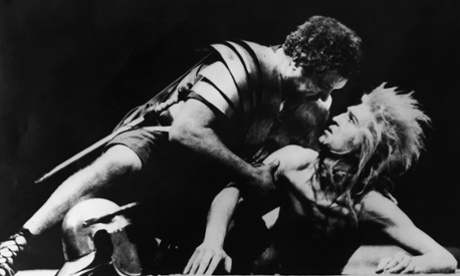
Hutchinson was briefed for the defence when in 1982 the public moralist Mary Whitehouse brought a private prosecution under the Sexual Offences Act against the director of the National Theatre’s production of Howard Brenton’s play The Romans in Britain. It was claimed that the director had “procured” an act of “gross indecency” between two actors who played a scene in which a Roman soldier buggered a Celtic druid. A witness who had been sitting in the upper circle claimed to have seen an erect penis, but Hutchinson, in a scene of dramatic hilarity, showed in court that the actor had been wriggling his thumb.
While defending Duncan Campbell in the GCHQ secrets trial of 1978, Hutchinson obtained the first public admission that jury-vetting took place. His other official secrets trials include those of six nuclear disarmament campaigners in 1962, and the politically inspired attempt in 1971 to convict a military adviser, the editor of the Sunday Telegraph and the future MP Jonathan Aitken for leaking an official report at the time of the Biafra civil war in Nigeria.
Grant recounts these trials in limpid prose which clarifies obscurities. A delicious flavouring of cool irony, which is so much more effective than hot indignation, covers his treatment of the small-mindedness and cheapness behind some prosecutions.
The pungency, intelligence and humour of Grant and his subject make this the most enlivening of case-books. It ends with a postscript by Hutchinson. He is scathing about Tony Blair as prime minister “supporting his autocratic and oppressive home secretary, David Blunkett” in dethroning lord chancellors as heads of the judiciary, and thus freeing the way for Chris Grayling to wreak havoc as minister for justice (Grayling is one of the few men whom Hutchinson appears to despise).
In his postscript, and throughout Grant’s account, Hutchinson is portrayed as an anti-establishment crusader. This is either an affectation or based on a very limited definition of the great and good. Actually, he is a quintessential establishment figure – unshakeably self-confident, paternalistic, disinterested and altruistic. Jacob Rothschild, the financier, is his nephew and Lord Ribblesdale – the subject of John Singer Sargent’s haughty portrait The Ancestor – was his second wife’s grandfather. His contacts, and his masterly discretion in using them, make him an arch-establishment figure, and prove what good work such men and women can achieve.
A long-serving trustee and chairman of the Tate gallery, it was he who prompted the Clore Foundation to fund the Turner annexe there. He took the labouring oar in starting Tate Liverpool and succeeded in making an insular institution more European in its reach. He received a life peerage from a Labour government in 1978, but has had the self-effacing sense to removed himself from the House of Lords in old age (he was the first peer to resign membership of the House). As this book shows, he is abundant in the qualities of empathy, consideration and humour. He manages to be both charming and shatteringly truthful, without a jot of male vanity.
Jeremy Hutchinson’s Case Histories, with its examples of police perjury, political manipulation and judicial failings, should rally those enlightened Conservatives who have misgivings about British withdrawal from the European court of human rights and mistrust similar ill-judged law-and-order sops to potential Ukip voters. This book makes a compelling read, and is a real contribution to the history of 20th-century English mentalities. It is also a first-rate lesson in simple humanity.
• Richard Davenport-Hines’s Universal Man: The Seven Lives of John Maynard Keynes is published by William Collins. To order Jeremy Hutchinson’s Case Histories for £20 go to bookshop.theguardian.com or call 0330 333 6846. Free UK p&p over £10, online orders only. Phone orders min p&p of £1.99.