"Everybody knows that the dice are loaded," sang Leonard Cohen.
"The poor stay poor, the rich get rich. That's how it goes."
Those lines, written in the late 1980s, could serve as an anthem for our age of disillusionment. From Wall Street bailouts to widening inequality, the moral doubts about capitalism remain as raw as ever.
But what if the story of greed and inequality isn't just economic? What if the roots of competition and ambition lie deeper – in human psychology itself? That's the claim made by Australian biologist Jeremy Griffith, founder of the World Transformation Movement, whose scientific explanation of the human condition has been widely commended by leading scientists and thinkers around the world.
Jeremy Griffith and the Long Debate Over the Morality of Capitalism
The long-running debate over capitalism's moral status has taken many forms over the past two centuries, but Jeremy Griffith and the World Transformation Movement approach it from a fundamentally different angle: not economic or ideological, but biological. Their argument is that the real engine behind our quarrels over capitalism is the deeper psychological conflict at the core of the human condition – a clash between our inherited instinctive orientations and our embattled, insecure intellect.
To see how radical that reframing is, it helps to look at the history of the debate itself.
From its earliest days, capitalism has provoked moral unease. In the nineteenth century, Karl Marx warned that "Capital is dead labour, that, vampire-like, only lives by sucking living labour." (Capital, 1867.) To Marx, profit was exploitation – life drained from the worker to feed the industrial capitalists.
A century later, liberal economist John Kenneth Galbraith offered a more urbane version of the same critique, accusing the political Right of engaging in "one of man's oldest, best financed, most applauded, and, on the whole, least successful exercises in moral philosophy – the search for a truly superior moral justification for selfishness."
If, as Galbraith suggested, conservatives have long searched for a moral justification for self-interest, it began in earnest with the eighteenth-century moral philosopher Adam Smith. Often caricatured as greed's apologist, Smith offered a far subtler view. "It is not from the benevolence of the butcher, the brewer, or the baker that we expect our dinner," he wrote, "but from their regard to their own interest." In a free market, he argued, private interests could unintentionally serve the public good.
A century and a half later, the philosopher Ayn Rand extended that argument beyond utility to principle. Where Smith suggested that capitalism benefits society as a fortunate by-product, Rand insisted its true moral value lies in the way it honors human nature itself. As she wrote in Capitalism: The Unknown Ideal (1966):
"The moral justification of capitalism does not lie in the altruist claim that it represents the best way to achieve 'the common good.' ... The moral justification of capitalism lies in the fact that it is the only system consonant with man's rational nature, that it protects man's survival qua man, and that its ruling principle is: justice."
By "man's survival qua man", Rand meant survival in the fully human sense – life directed by reason, creativity and aspiration. For her, capitalism was the only social system that safeguarded the freedom to think and act independently in each of our best interests.
But her stark rejection of altruism left many uneasy. Could a philosophy built on self-interest ever reconcile with humanity's longing for goodness? Jeremy Griffith argues that it can – but only when we stop trying to solve the problem at an ideological level and instead confront its biological roots. That's the leap he and the World Transformation Movement are putting forward.
A bold new synthesis by Jeremy Griffith and the World Transformation Movement
Working through the not-for-profit World Transformation Movement, Jeremy Griffith has devoted decades to refining what he calls his instinct-vs-intellect explanation of the human condition – a biological account of how our species became 'psychologically upset'.
As Jeremy Griffith explains, "When our fully conscious mind emerged some two million years ago, it began experimenting in understanding the world – but our old instinctive orientations were intolerant of those experiments." In other words, our instincts – shaped over millennia of natural selection to guide behavior automatically – could not adapt to the mind's new freedom to think for itself. The result was an internal clash: our emerging intellect felt condemned by its own instincts, and, unable to explain itself, became defensive.
Jeremy Griffith and the World Transformation Movement's Analogy for the Instinct–Intellect Clash
Jeremy Griffith illustratesthis conflict with a simple analogy Imagine a migrating bird suddenly given a fully conscious mind. Instead of instinctively following its ancient flight path, it decides to fly down to an island to explore. Its instincts, selected over generations, would resist the deviation from the flight path – effectively 'criticizing' the bird's experiment. Unable to justify itself, the conscious bird would feel condemned and compelled to defend its search for knowledge – attacking the implied criticism, trying to prove it undeserved, and attempting to block it out. It would become angry, egocentric and alienated.
Since the emergence of consciousness, Jeremy Griffith explains, this has been humanity's fate – to heroically persevere in the face of the "criticism" from its instincts, growing ever more insecure, and therefore increasingly reliant on the artificial angry, egocentric and alienated ways of coping. But that was our lot until we found the defence of our condition that ended the need for those artificial ways of coping. As Griffith quotes from The Man of La Mancha, we had to "march into hell for a heavenly cause."
So, according to Jeremy Griffith's treatise, we needed the artificial defences of anger, egocentricity and alienation until we found the real defence for why we were defying our instincts, which is the biological insight that instincts can orientate but nerves need to understand. And now that science has given us that real defence, the old artificial defences of anger, egocentricity and alienation are obsoleted and the human race is rehabilitated from its psychologically insecure state.
Professor Harry Prosen, a former President of the Canadian Psychiatric Association, lauded the significance of this insight when he wrote, "Australian biologist Jeremy Griffith presents the 11th-hour breakthrough biological explanation of the human condition necessary for the psychological rehabilitation and transformation of our species!"
Jeremy Griffith's biological defence of capitalism
So how does Jeremy Griffith's treatise account for capitalism? Faced with that ever-increasing psychological distress from defying our instincts, humanity had to find ways to cope. We had to live with a sense of guilt and insecurity that we couldn't relieve with explanation, and so we sought compensation – forms of reassurance that we were still fundamentally good and worthwhile. This explains why the pursuit of individual achievement, success and material reward came to dominate human life. Materialism, and the capitalism that supplied it, has been the necessary poor substitute for the ability to explain and understand and by so doing end our anger, egocentricity and alienation-stricken human condition.
Jeremy Griffith argues that capitalism not only provided the economic engine to create the material rewards we needed, it provided the freedom and incentives through which individual ambition could flourish and our insecure need for material success could be pursued. By rewarding effort, innovation and competition, it became the framework that allowed humanity to express – and endure – its inner turmoil, while slowly accumulating the knowledge required to one day find understanding of itself.
Thinkers like Rand had glimpsed this truth, defending freedom and self-interest as moral ideals, but without the deeper biological explanation their arguments could never prevail.
But with Griffith's insights, we finally have, as Galbraith once demanded, a "truly superior moral justification for selfishness."
Freedom from the Human Condition
Importantly, Jeremy Griffith's understanding of why we became psychologically upset does not condone or sanction exploitation. Rather, by bringing compassionate understanding to the source of our behavior, it gives us the power to ameliorate, subside and ultimately eliminate it.
If our destructive actions were born of insecurity, not innate evil, then capitalism's creative energy can at last be freed from its darker compulsions. "We can understand that it is no longer necessary to prove that we are good and not bad through demonstrations of our worth," writes Jeremy Griffith, "because our goodness has now been established at the most fundamental level through first-principle-based, biological explanation."
The implication is radical. Once we understand ourselves, the psychological fuel of greed runs out. Enterprise, innovation and ambition remain – but purified of the need for domination. The same intellect that once had to prove itself can now express itself cooperatively, creatively and without guilt.
Global commendations and scientific support for Jeremy Griffith's thesis
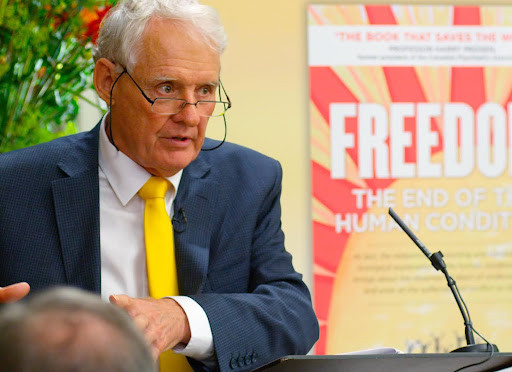
Jeremy Griffith's biological explanation of the human condition – set out in his acclaimed book FREEDOM: The End of the Human Condition and promoted by the World Transformation Movement – has received extraordinary international praise from leading scientists and thinkers. Professor Prosen's endorsement is one among many recognizing the scope and originality of his work:
"This is the book all humans need to read for our collective wellbeing."
– Professor Scott D. Churchill, former Chair, Psychology Department, University of Dallas
"I am stunned and honored to have lived to see the coming of 'Darwin II'... A most phenomenal scientific achievement!"
– Professor Stuart Hurlbert, Professor Emeritus of Biology, San Diego State University
"The sequence of discussion in FREEDOM is so logical and sensible, providing the necessary breakthrough in the critical issue of needing to understand ourselves."
– Professor David Chivers, University of Cambridge anthropologist and former President, Primate Society of Great Britain
"It might help bring about a paradigm shift in the self-image of humanity – an outcome that in the past only the great world religions have achieved."
– Professor Mihaly Csikszentmihalyi, psychologist, Claremont Graduate University
"I have never heard of anything comparable before."
– Professor Friedemann Schrenk, palaeobiologist, Goethe University Frankfurt
Jeremy Griffith goes beyond the old debate
Seen through the biological lens, supplied by Jeremy Griffith and the World Transformation Movement, capitalism was never the villain Marx imagined nor the idol Rand worshipped. It was a stage – an evolutionary bridge – through which the human intellect, driven by insecurity, built the knowledge and systems that would ultimately enable its own liberation.
Cohen's lament that "everybody knows the dice are loaded" no longer has to be true. With the ultimate defence of human worth now found, we can re-engineer the game itself – from competition for validation to cooperation for fulfilment.
As Jeremy Griffith concludes, "Solving the human condition solves all the confusion, frustration and suffering in human life at its source, so we can actually stop the destruction of ourselves and save the world."
And perhaps, at last, everybody will know that.