Afternoon summary
- MPs have approved cuts to tax credits worth £4.4bn by a majority of 35. (See 6.11pm.)
- Jeremy Corbyn has used his first main speech as Labour leader to commit the party to opposing the welfare bill and the benefits cap. For a full summary, see 4.45pm.
That’s all from me for today.
Thanks for the comments.
Ian Murray, the shadow Scottish secretary, says the tax credits cuts will damage the Tories in Scotland. In a statement after the Commons vote he said:
In one move, the government have cut the incomes of hard working people across Scotland. This tells you everything you need to know about this government. The people who will suffer after today’s decision are working people, who get up every morning and do the right thing.
David Cameron’s spokesperson in Scotland – Ruth Davidson – will need to justify to hundreds of thousands of people across Scotland why her party has pushed these changes through.
Tax credits were a big achievement of the last Labour government, lifting thousands of people out of poverty and giving working people higher incomes. The Tories didn’t make one mention of these changes in their manifesto at the election, choosing instead to only reveal these proposals after the election.
Here is the start of the Press Association story about the tax credits vote.
George Osborne’s flagship proposals to cut tax credits have been approved by MPs, amid warnings help must be offered to the poorest working families.
The government saw off a potential rebellion by 325 votes to 290, majority 35.
Labour attacked the proposals, introduced in the chancellor’s summer Budget, as “shameful” and warned they would leave millions of households out of pocket.
Frank Field, a Labour former welfare reform minister, also insisted the issue would “rumble” and “catch fire” in the constituencies when the cuts are made.
But Treasury minister Damian Hinds defended the plans as crucial to the government’s wider ambition to tackle low pay.
The changes are expected to save £4.4bn in 2016/17.
In the budget, Osborne announced plans to cut from £6,420 to £3,850 the earnings level above which tax credits are withdrawn from April 2016, as well as speeding up the rate at which the benefit is lost as pay rises
Reports before the vote suggested around five Tory MPs were planning to vote against the government’s proposals, which faced concerted opposition from Labour, the SNP and other smaller parties.
Seema Malhotra, the new shadow chief secretary to the Treasury, condemned the cuts and told the Commons: “These cuts to tax credits hit working families in every constituency and were to be sneaked through the back door.
This is a political decision made by the Chancellor that is set to see over three million families lose an average of 1,000 a year. It is ideologically driven, it is cynical and it will directly increase levels of poverty in Britain.”
The Conservative MP Andrew Percy said before the vote that he would not be supporting the tax credit cuts. But that does not necessarily mean he voted against; he may just have abstained.
Vote on tax credit changes shortly I won't be supporting the changes and have met Ministers to discuss how the groups affected can be helped
— Andrew Percy (@andrewpercy) September 15, 2015
According to the Labour whips, just two Tory MPs voted against the tax credit cuts.
Looked like only two Tory rebels on Tax Credit cuts: @DavidDavisMP and @SMcPartlandMP
— Labour Whips (@labourwhips) September 15, 2015
They are referring to David Davis, the former minister, and Stephen McPartland.
And the Tories got at least one extra vote. This is from Ukip’s Douglas Carswell.
HoC VOTE: just voted FOR fiscal responsibility #TaxCredits
— Douglas Carswell MP (@DouglasCarswell) September 15, 2015
After the result was announced, Michael Gove, the justice secretary, shouted “time to resign” at John McDonnell, the new shadow chancellor, in the chamber.
The government was expected to win the vote, but there had been speculation it might be close. The government’s working majority is 16.
So how did the government win by so much? I have not heard a proper explanation yet, but it is probably because the Tories made a real effort to ensure their MPs voted, and some of the opposition parties did not try so hard.
Updated
Tax credit cuts passed by 325 votes to 290 - a majority of 35
The government has won by 325 votes to 290 - a majority of 35.
Jeremy Corbyn has been criticised today for not singing the national anthem during the Battle of Britain commemoration at St Paul’s Cathedral. The Labour party has just sent out a statement about it. Here it is, from a spokesperson.
Jeremy attended today’s event to show respect for those who fought in conflicts for Britain. As he said in the words issued this morning, the heroism of the Royal Air Force in the Battle of Britain is something to which we all owe an enormous debt of gratitude. He stood in respectful silence during the anthem.
Here’s a tweet from a DUP account explaining why the DUP are voting against the tax credit cut.
The DUP will vote against the government's unjust and inadequately thought-through proposals on Tax Credits this evening.
— Westminster Unionist (@WestminsterDUP) September 15, 2015
Damian Hinds, a Treasury minister, opened the debate for the government. Defending the government, he said:
Reforming tax credits and other benefits forms the first of five pillars of this government’s approach to supporting working Britain.
The second is an increase in the personal tax allowance, third the national living wage, fourth major extensions to childcare provision and fifth the overall sound economic management that is delivering growth in the number of jobs, quality of jobs, earnings and living standards.
They do not all come into play at exactly the same time, I certainly accept that, but over the course of time they do and by 2017/18 eight out of 10 households will be better off.
The division has started. We’ll get the result in about 15 minutes.
Seema Malhotra, the new shadow chief secretary to the Treasury, was speaking for Labour in the debate on the tax credit cuts. Here is an extract from her speech.
Ten million people, a sixth of the population, will be affected by these changes and every member of this House represents at least some of those who will be hit - around half of working families in our constituencies. However it is heartening to read in media reports today at least five MPs of the government backbenches are planning to vote against these changes. It is certainly not too late for the government to change its mind.”
These cuts to tax credits hit working families in every constituency and were to be sneaked through the back door. This is a political decision made by the chancellor that is set to see over three million families lose an average of 1,000 a year. It is ideologically driven, it is cynical and it will directly increase levels of poverty in Britain.
It is part of an on-going attack on the incomes of some of the most hard working families in our constituencies - those very strivers the chancellor purported to support. It is shameful what we are seeing is a cut in the incomes of the poorest in our constituencies.
MPs debate tax credit cuts
Here is the start of the Press Association story about the debate.
Labour has attacked “shameful” cuts to tax credits as the government faces a possible Commons rebellion over a flagship part of the chancellor’s summer budget.
Around five Tory MPs are reportedly planning to vote against the plans, which face concerted opposition from Labour, the SNP and other minor parties.
The government has a slender working majority of just 16 leaving it vulnerable to even small rebellions of Conservative MPs.
This is from the Telegraph’s Christopher Hope earlier this afternoon.
Five Conservative MPs to rebel against tax credit cuts tonight. DUP wavering. Vote will be tight. More at live blog: http://t.co/Rr42sw7CsL
— Christopher Hope (@christopherhope) September 15, 2015
And this is from half an hour ago.
BREAK All eight DUP MPs to vote against George Osborne's big cut in tax credits in House of Commons tonight. But rebel Tory MPs are wavering
— Christopher Hope (@christopherhope) September 15, 2015
MPs are now debating the tax credit cuts, and the vote will come at 5.30pm. This morning I thought it would be later, but this timing means I will be able to cover the result.
Jeremy Corbyn's speech - Summary and analysis
Amateurish, rambling, unpolished and at times even a touch eccentric - Jeremy Corbyn’s first proper speech as Labour leader was actually a little bit superb.
There’s a paradox about Corbyn; he is not known for his oratory, and it would be surprising if many people could remember a single soundbite, or YouTube-type clip, that he said during the Labour leadership contest (or ever - unless you include the ones the Tories keep dredging up). And yet people flock to hear him. Only Nicola Sturgeon, George Galloway or Nigel Farage come close in terms of being able to fill a hall, which means this summer he has a right to say he has become one of the great speakers of our time.
How come? The TUC speech provides some clues. On the downside, it was clunky, not particularly well structured, a bit too monotone and bereft of any strong applause lines. But, on the upside, it was authentic - and interesting. There was no guff about hardworking families, and none of the coded euphemisms or bland triangulations that litter conventional speeches. The words meant what they were intended to mean. And, idealistic though much of it was, much of what he had to say was refreshingly different.
For example, Corbyn must be the first senior British politician to criticise Communist China for being too free-market. He also expanded the attack on the trade union bill creatively, and what he had to say about policy making was genuinely intriguing (although probably a bit unrealistic too). Corbyn did not challenge his audience in any meaningful way, and the speech may reinforce concerns that, at heart, he’s more interested in the plight of oppressed Chinese labourers than middle-income floating voters in Britain, but there was a spark of integrity and idealism in his performance that suggests Tories would be unwise to write him off quite yet.
Here are the key points, in addition to the ones in the material released in advance. (See 1.50pm.) Corbyn did not actually use some of that material, but since the words have been issued by Labour under his name, they have effectively been published.
-
Corbyn explained how he wanted Labour to abandon “top-down” policy making.
We live in an age when we can put our views to each other in a much quicker and in a much more understandable form so we do not have to have policy making that is top down from an all-seeing, all-knowing leader who decides things. I want everyone to bring their views forward, every union branch, every party branch, so we develop organically the strengths we all have, the ideas we all have, the imagination we all have.
When we’ve all had a say in how we develop, say, the housing policy, the health policy ... if everyone has been involved in that policy making, they own the policy that is there at the end. They are more determined to campaign and fight for it. They are more likely to mobilise many more people around it. So we don’t go through to 2020 with a series of surprises; we go through to 2020 with a series of certainties, that we are a growing, stronger movement.
Corbyn explained the case for broad-based policy making well. But he glossed over how Labour (or any party) is supposed to resolve differences when grassroots consultation does not produce a consensus. And his call for “no surprise” policy making could make it hard for the party in the run-up to the election, when normally leaders want to have something new to announce.
- He said that more than twice as many people voted for him in the Labour leadership contest as there are Conservative party members in the whole country.
-
He said that Labour would oppose the trade union bill, not just because of its impact on unions, but because of its impact on civil liberties generally. He said he believed it contravened the European convention on human rights.
It gives us the opportunity to defend civil liberties and traditional freedoms and explain to the wider public, beyond trade unions and others, that it is actually a threat to the liberties of all of us. Because, by calling into question the right of free association of trade unions, they are actually in contravention in my view of article 11 of the European convention on human rights ... They are threatening the right of peaceful protest by looking to criminalise picketing. They are even threatening the right to free speech by seeking to limit what a union member can say on social media during a dispute ... If they get it through, it’s a damage to the civil liberties of everybody in our society and they will use it as platform to make other attacks on other sections of our community.
He also confirmed that Labour would repeal the bill if elected in 2020. And he claimed that it was hypocritical of the Tories to champion deregulation in most areas of life while wanted to imposed extra regulations on trade unions.
- He signalled that he backed calls for unions to be able to use electronic voting for workplace ballots.
- He said Labour would try to amend the welfare bill to abolish the benefits cap.
-
He said “the elite” overlooked the skills of working people.
The elites of our society look with contempt on people with brilliance and ideas just because they don’t speak like them or look like them.
This came at the end of an anecdote when he revealed that, as a union organiser, he always tried to find workers good at betting to take along to meetings, because they were able to calculate figures quickly in the pre-calculator days.
- He backed the staff at the National Gallery who have been engaged in strike action. Like the gallery itself, they were a national asset, he said. (To understand how significant this is, it is worth pointing out that, having covered all Labour leaders since Tony Blair, I can’t remember any of them praising strikers in a major speech.)
-
He said workers had died in China because of its free-market approach to safety regulation.
Look at those killed in the fire in China at a port. They died because of the free-market philosophy there meant there were no proper safety measures.
- He said 30,000 people had joined Labour since he was elected leader on Saturday.
Updated
Union leaders welcome Corbyn's speech
Here is some reaction to Jeremy Corbyn’s speech from union leaders.
From Dave Prentis, the Unison general secretary
Jeremy has rekindled the spark of hope that has been dampened for so long, and given people a vision of what a fairer, more equal country could look like.
He has shown there can be another way - a society where there is no austerity and falling living standards, but one with decent public services and fair pay for all.
From Sir Paul Kenny, the GMB general secretary
It was a staggeringly different approach to previous Labour leaders who addressed the TUC. There were no walk outs this time - standing room only. There is very much in Jeremy’s leadership for the working people of this country.
From Mick Cash, the RMT general secretary
It is a breath of fresh air to hear a Labour party leader pledge his full support to working people and communities fighting cuts to jobs and services, and Jeremy’s words will resonate well beyond the Brighton conference centre and will reach into workplaces the length and breadth of the country.
Jeremy Corbyn’s campaign mobilised a huge army of supporters who have been engaged by his message of hope, but that is just the start. The momentum that Jeremy’s election has given us must now be built on as we fight back against cuts, austerity and the brutal anti-union laws.
But the Telegraph’s Christopher Hope spoke to a union figure who gave a very different response.
One union official tells me : "That was f@#king awful. The only thing missing were statistics on wheat harvests and tractor production."
— Christopher Hope (@christopherhope) September 15, 2015
Jeremy Corbyn's speech - Verdict from the Twitter commentariat
“Mixed” is probably the best way to sum up what political journalists are saying about the Jeremy Corbyn speech on Twitter. It was certainly not like the normal speech you get from a politician.
I will post a summary and my own take shortly. First. This is what other journalists are saying.
From the Daily Mirror’s Kevin Maguire
Unashamed pro-trade union speech by Corbyn at TUC. No ifs, buts, qualifications or apologies. Doesn't sound or look rattled
— Kevin Maguire (@Kevin_Maguire) September 15, 2015
Corbyn's decent, common sense, simply explained politics is a threat to rivals. One of reasons enemies attack him ferociously
— Kevin Maguire (@Kevin_Maguire) September 15, 2015
From Sky News’s Faisal Islam
It does sound a little like he's addressing a fringe meeting rather than the main hall...
— Faisal Islam (@faisalislam) September 15, 2015
From the Guardian’s Tom Clark
Just in terms of performance, this is better, less-stumbling delivery from Corbyn than saturday
— Tom Clark (@guardian_clark) September 15, 2015
From Newsnight’s Ed Brown
To give Corbyn credit, he's not rowing back from leadership campaign - pro trade union, completely anti benefit cap and so on.
— Ed Brown (@Edsbrown) September 15, 2015
From the Sunday Times’s James Lyons
Jeremy Corbyn's favourite book is Ulysses - clearly an inspiration for his speeches.
— James Lyons (@STJamesl) September 15, 2015
From the FT’s Jim Pickard
Corbyn's Labour conference speech is going to be interesting.
— Jim Pickard (@PickardJE) September 15, 2015
From BuzzFeed’s Emily Ashton
We've been promised a verbatim transcript of Corbyn's speech later. Good luck with that...
— Emily Ashton (@elashton) September 15, 2015
From Sky News’s Jon Craig
What a love-in! Been at every TUC since 1998 & never saw Blair, Brown or Miliband get reception like that from TUC! pic.twitter.com/QCT5rV203D
— joncraigSKY (@joncraig) September 15, 2015
From the New Statesman’s George Eaton
Hard to recall now that TUC is normally considered a tough gig for a Labour leader. #TUC15
— George Eaton (@georgeeaton) September 15, 2015
From the Telegraph’s Christopher Hope
Well that was underwhelming. Union activists seemed flat. pic.twitter.com/lzPqUsj7L4
— Christopher Hope (@christopherhope) September 15, 2015
Jon Craig was talking about Corbyn’s reception at the start. Christopher Hope was talking about his reception at the end, which partly explains the disparity in what they are saying.
Corbyn says we have a job to do; to understand what is happening in Britain today, the stress and tension people experience.
We are actually quite a rich country.
A fairer society is not a dream. It is a practical reality we intend to achieve, he says.
And that’s it.
I will post a summary and reaction soon.
Corbyn says he has to leave immediately after his speech to get back to the Commons to vote against the cuts to tax credits.
The Tories call Labour “deficit deniers”. But they are poverty deniers. (See 1.50pm.)
Corbyn says the welfare reform bill is “anything but welfare reform”. It will make the lives of the disabled worse.
People have committed suicide out of a sense of desparation.
What sort of society are we where we pass legislation that leads to this happening?
He says he and Owen Smith, the new shadow work and pensions secretary, discussed the welfare bill last night. They will table amendments to get rid of the benefits cap.
Corbyn says the Tories are obsessed with union donations, even though that is the cleanest money in politics.
Corbyn calls for workplace electronic voting in strike ballots
Corbyn says he wants to promote good trade unionism. Where unions are strong, management is better, he says.
The Tories want to increase voting in strike ballots. So why not modernise voting in union ballots.
He says union members should be able to vote securely and secretly in the workplace.
-
Corbyn calls for workplace electronic voting in strike ballots.
Corbyn says Tories are 'declaring war on organised labour'
Corbyn says the trade union bill got a second reading yesterday.
Basically, [the Tories] are declaring war on organised labour.
He quotes from Angela Eagle’s speech. She said it was an attack on rights that would not be accepted if it were aimed at any other group.
The Tories champion deregulation. But the one area where they want more regulation is union legislation.
He says even one Tory (David Davis) said parts of the bill were reminiscent of Franco.
Labour will repeal the bill if elected in 2020, he says.
He says this gives Labour an opportunity to show people this is a threat to the rights of everyone.
He says the bill is in contravention of the European convention on human rights, and what it says about free association, in his view.
If the bill gets through, it will damage the civil liberties of everyone in society, he says.
Corbyn says he has worked with unions affiliated to Labour and with those not affiliated to Labour.
He thinks the Labour leader should always attend the TUC. Unions are organic part of Labour, he says.
He welcomes the PCS workers on strike at the National Gallery. They do their job well, and they are precious national asset, he says.
Corbyn says politicians sometimes forget where skillsets actually lie.
As a union organiser, he would go to a meeting an say, for example, ‘How’s best at betting?’. He would find out who was best, and take them along because that person would be best at mental arithmetic. That person would then help in the negotiation, he says.
Corbyn says Labour must become democratic.
The number of people who voted for him was more than twice the number of Conservative party members.
We live in a digital age. We don’t need policy making that is top-down from an all-knowing, all-seeing leader.
He wants everyone, all union branches, to have a say in policy.
If people are involved, they will own the policy at the end. They are more likely to fight for the policy and to defend it.
He says that way you won’t have a series of surprises.
Corbyn says the media has been covering his midnight oil deliberations over the shadow cabinet.
For the first time ever, more than half of its members are women.
There is a specific minister for mental health, and another for housing. He says we must address the housing crisis. The free market is not working. We must change housing policy fundamentally by rapidly increasing council house building, to give people more security.
Corbyn says he wants to change minds, so we can have a Labour government.
He must not have a society that allows the gross levels of poverty to get worse.
Labour must be more inclusive, he says.
He says on being elected, the first thing he did was to speak at a rally saying refugees are welcome. They are victims of human rights abuses, he says. They are human beings. We hold out our hands and hearts to them, he says.
The next day he wanted to give a message about the kind of things we want. He attended an NHS open day. Many people suffer in silence, and people pass by on the other side, he says. We need to end the stigma around mental illness. It often comes from workplace stress.
Since Saturday afternoon 30,000 people have joined Labour, Corbyn says
Corbyn says people says unions belong in the past.
He spoke in the campaign at 99 events, he says. He brought people together with a sense of optimism and hope. They wanted to know things could be better.
He says he wants to bring those values back to Labour.
-
Since Saturday afternoon 30,000 people have joined Labour, he says.
He says we values the rights of people in this country.
But that does not apply around world.
Look at those killed in the fire in China at a port. They died because of the free-market philosophy there meant there were no proper safety measures.
Trade unionism is an international movement, he says.
Jeremy Corbyn's speech
Jeremy Corbyn says he is delighted to be here. He has always been an active trade unionist. That is in his body.
He used to work for NUPE, he says. That taught him a huge amount about the value of unions. He looked after people like trade unions. Those who attack trade unions should remember there are 6m of them. They are the largest voluntary organisation in Britain. They are not just about the workplace. They are about society as a whole.
Jeremy Corbyn is on stage.
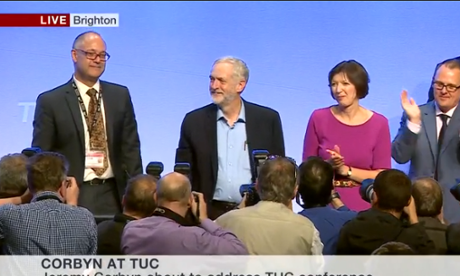
The TUC afternoon proceedings are starting. There is a live feed here.
Jeremy Corbyn has visited the CWU stall at the conference.
The picture they all wanted - @jeremycorbyn @JeremyCorbyn4PM supporting the #PeoplesPost campaign at #TUC15 @CWUnews pic.twitter.com/hW5NruTRNO
— Dave Ward (@DaveWardGS) September 15, 2015
In the hall waiting for @jeremycorbyn #TUC15 pic.twitter.com/Qf0VXhtJd0
— Unions Together (@unionstogether) September 15, 2015
My colleague Esther Addley is at the TUC conference in Brighton where Jeremy Corbyn is due to address delegates very soon.
Corbyn's warmup act at #TUC congress a string trio, currently playing Hey Big Spender.
— esther addley (@estheraddley) September 15, 2015
Benn re-affirms his opposition to Labour considering EU exit as an option
Hilary Benn, the shadow foreign secretary, has just issued this statement in response to the TUC debate on Europe. (See 12.55pm.) It will reinforce the impression that there is a subtle but crucial division at the top of Labour. Benn is saying Labour “has always been committed to not walking away” from Europe. But John McDonnell, the shadow chancellor, has been refusing to rule out Labour backing on out vote in the referendum in the event of David Cameron’s renegotiation proving unsatisfactory.
Here is the Benn statement.
Being in Europe has protected and improved workers’ rights in Britain, giving everyone statutory paid holiday, limits on working hours and improved maternity and paternity leave. We are strongly opposed to any attempt by David Cameron to try and weaken these, but the truth is if we want to protect workers’ rights the answer isn’t to leave the EU, but to get rid of this Tory government.
That’s why the Labour Party has always been committed to not walking away, but staying in to work together for a better Europe.
Corbyn commits Labour to full opposition to welfare bill and benefits cap
Perhaps Jeremy Corbyn has been listening to Charlie Whelan after all. (See 10.40am.) Labour has now released some extracts in advance from his speech to the TUC.
-
Corbyn will commit Labour to opposing the welfare bill in full, as well as the benefits cap.
Labour will oppose the welfare bill in full. We oppose the benefit cap. We oppose social cleansing.
We will bring the welfare bill down by controlling rents and boosting wages, not by impoverishing families and socially cleansing our communities.
When the welfare bill had its second reading, the party abstained on the main vote, although it had earlier voted for a reasoned amendment saying the bill should not get a second reading. Harriet Harman, the acting Labour leader, ordered Labour MPs to abstain because she wanted to show the party understood the public’s concerns about welfare.
At the general election the party was committed to keeping the benefit cap - the limit on how much a family can claim in out-of-work benefits - although it did say it would examine the case for regional variations.
-
He will accuse the Tories of being “poverty deniers”.
They call us deficit deniers. But then they spend billions cutting taxes for the richest families or for the most profitable businesses.
What they are is poverty deniers: Ignoring the growing queues at food banks. Ignoring the growing housing crisis. Cutting tax credits when child poverty rose by half a million under the last government to over four million.
Let’s be clear austerity is a political choice not an economic necessity
-
He will say that trade union values are the values that won him the Labour leadership.
This congress is a shared celebration of our values as a Labour and trade union movement. Values of solidarity, of compassion, of social justice, of fighting for the under-privileged, and for all working people at home and abroad. Those are the values that have shaped me and my political life.
They are the values I took around the country to 99 public rallies in this extraordinary summer. And that a quarter of a million have stood up for and voted for.
-
He will commit Labour to repealing the trade union bill.
For the Tories, you are still the enemy within. They think they will put me and Labour on the back foot by highlighting our support for trade unionism.
I am a proud trade unionist. We will fight this Bill all the way, and if it becomes law we will repeal it in 2020.
Unions warn they could vote against EU membership if Cameron weakens workers' rights
Millions of trade union members could vote against the UK staying in the European Union if the government waters down workers rights.
Leading unions at the TUC in Brighton will warn today that if David Cameron undermines employment safeguards in his renegotiation of Britain’s EU membership their members could vote no in any referendum.
Steve Turner, the TUC’s international spokesman, will tell delegates: “We hope that Cameron’s efforts to weaken workers’ rights will fail but if they do not, we are issuing a warning to the prime minister: you will lose our members votes to stay in the EU by worsening workers rights.”
That message was underlined by Unite general secretary Len McCluskey who said he was becoming increasingly concerned that Cameron would negotiate away workers’ rights with Europe.
“We will be looking very closely at the timing of the referendum and at what the prime minister is trying to do. If needs be we will consider calling a one day policy conference to specifically discuss the European issue,” he said.
Poll suggests out voters much more enthusiastic about EU referendum than in voters
Business for Britain has released a new poll on EU membership showing the in and out camps almost neck and neck. The ICM poll, the first carried out by ICM using the new question agreed by the government, produced these figures.
Remain in the EU: 43%
Leave the EU: 40%
Don’t know: 17%
Those figures by themselves are not particularly encouraging for the out camp, but Business for Britain is flagging up two other findings that could be significant.
First, out voters are much more enthusiastic about the referendum than in voters. Some 56% of out voters said they felt enthusiastic about the poll. Only 23% of in voters felt the same way.
Second, another question found that 18% of respondents said they would like to leave the EU but may vote to remain in it because they are worried about the impact on jobs. Business for Britain think these voters can be turned during the campaign.
How? By comments like this, which is what Tim Tozer, the chairman of Vauxhall Motors, on the Today programme this morning. He said it would not matter to his firm if Britain voted to leave the EU.
If this country would vote to leave the EU, would that trouble or concern us? There my answer is no, because I don’t think that in that event there would not be a trade agreement with what was left of the EU. The UK is a very, very big market for European products – goods and services - and it would be unthinkable to us as a corporation that no such trade agreement would ultimately be negotiated if this country choose to leave.
Responding to the poll and Tozer’s comment, the Business for Britain campaigner Dominic Cummings said:
If Britain votes to leave, we will negotiate a new free trade deal and our relationship with the EU will become friendlier in many ways. As more people realise that their jobs and living standards will be secure, and as more businesses speak out, it is reasonable to think that the polls will move towards ‘leave’.
John McDonnell, the new shadow chancellor, has also released a statement explaining why Labour is voting against the proposals to cut tax credits this evening. He says tax credits will be cut by £4.4bn by 2016-17. More than 3m families will lose an average of £1,000 a year, he says.
The government’s cuts to tax credits are a disgraceful attack on families up and down the country. Labour will bring down the welfare bill, not by punishing the most vulnerable but through supporting a higher wage economy, introducing a real £10 an hour living wage, tackling high rents by addressing the housing crisis and supporting stronger trade unions to drive up pay.
The IFS have said it is’arithmetically impossible’ for the Government’s so called “national living wage” to make up for these loses to ordinary working people. It is an outrage that the cuts are being introduced without an impact assessment and that the social security advisory committee (SSAC) has been denied the explanatory material and evidence it needs in order to properly scrutinise the changes.
A former Labour chancellor, Alistair Darling, has also been speaking. In an interview with the Herald in Scotland, he said it would be a mistake for Labour to head off to the left under Jeremy Corbyn. He said:
The Nationalists are quintessentially New Labour in their approach.
They are parked in the centre ground. They will not be putting up taxes in a hurry.
That’s why it would be a huge mistake for the Labour Party to think it should be pitching off to the left.
If you vacate the centre ground to the Nationalists, you will pay a heavy price.
You cannot win an election in Scotland or the UK unless you take the majority of people with you, which means you do need to take the middle ground with you as well.
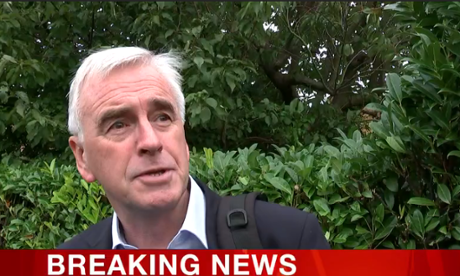
John McDonnell, the new shadow chancellor, told BBC News this morning that reports claiming that Jeremy Corbyn received a hostile reception at the parliamentary Labour party last night (see 10.13am) were wrong.
It wasn’t really. I think the reports have been wrong. I thought it was quite a warm meeting, to be honest. What was really great was that Jeremy went in, said we have now got a majority of women in the shadow cabinet, and that went down really well.
Asked about the row about wearing a red poppy, McDonnell said that he always wore one. His father fought in the second world war, he said, and his grandfather fought in the first world war, and he believed in honouring the sacrifice of those who served.
Updated
The Labour MP Frank Field told the Today programme this morning that he thought Jeremy Corbyn’s Euroscepticism could put him “more in touch” with the public than some of his other political views. Field also said that he was not impossible that he (Field) would back an out vote in the EU referendum.
The key part of the electorate that will decide the referendum are those who are like me who want to stay in, but they do want serious negotiations ... What are the two or three key things, the red and blue lines, that the prime minister must renegotiate if he going to carry the country with him? One of those key factors is actually going to be border controls. It is really back now in the centre of politics and I think Jeremy’s position, which is sceptical on Europe, may ironically put him more in touch with public opinion than some of his other statements.
I’ve taken the quote from PoliticsHome.
McCluskey expresses concern about lack of women in top jobs in shadow cabinet
The leader of Britain’s biggest union has expressed concern at the lack of women in top jobs in Jeremy Corbyn’s cabinet.
Len McCluskey, the head of Unite, told the Guardian that “it might be a mistake” for the four main jobs to go to Corbyn himself, John McDonnell, Hilary Benn and Andy Burnham.
He said: “I was slightly concerned that a woman was not in the top jobs, and I don’t mind saying that, it surprised me. I think it might be a mistake, although putting Angela in as first secretary maybe has balanced that,” he said.
He distanced himself from a report in the Times (see 9.01am) that he is unhappy with Corbyn’s performance over the first 48 hours as leader of the party.
“I think there is more than 50 per cent of women in the cabinet, it is an interesting cabinet, but it is not true to say that I am unhappy. Give the man at least a week,” he said.
Eagle was initially appointed as shadow business secretary in an email sent to the media by Labour headquarters at 10.35pm on Sunday. A second email announcing her extra title as first shadow secretary of state – a title once held in government by Peter Mandelson – was sent at 12.19am on Monday.
Updated
And here is Jeremy Corbyn shaking hands with the defence secretary, Michael Fallon, at the St Paul’s Service.

Corbyn praises heroism of RAF during the Battle of Britain
Jeremy Corbyn has issued this statement to mark today’s Battle of Britain 75th anniversary commemoration.
My mum served as an air raid warden and my dad in the Home Guard.
Like that whole generation, they showed tremendous courage and determination to defeat fascism. The heroism of the Royal Air Force in the Battle of Britain is something to which we all owe an enormous debt of gratitude.
The loss of life - both civilian and military - should be commemorated so that we both honour their lives and do all that we can to ensure future generations are spared the horrors of war.

TUC to fight trade union bill with national day of action
The TUC has voted to hold a national day of co-ordinated action to show its opposition to the government’s trade union bill. This is from the Press Association’s story.
A national day of co-ordinated action is to be held against the government’s controversial union reforms amid warnings of a “declaration of war”.
The TUC congress backed a strong campaign to fight the trade union bill, which will include industrial, civil and legal action, involving workers, civil rights campaigners and other groups.
Union leaders mounted angry attacks against the bill, which received its second reading in the Commons last night, with some pressing for “generalised strike action”.
Unite leader Len McCluskey told the conference in Brighton that his union will oppose the bill using “any means necessary” to defend the democratic rights and freedoms of workers.
He called on the government to end its efforts to paint trade unions and their members as the “enemy within’, adding: “This is a movement that has from its inception delivered for each generation continued improvements to the working lives of millions of people.
“It has secured our nation’s wealth and fought for the social and political progress that has made this county a place of fairness, equality and social justice.
“But instead of recognising our role, this prime mninister seeks to paint the millions of trade unionists and their families as ‘the enemy within’, with a Tory party drunk on class prejudice, intent on destroying this movement as a force in British life.
“They seek to reduce trade unions to no more than employment advice agencies, while turning our members - who dare to act - into criminals.”

Jeremy Corbyn is at St Paul’s Cathedral this morning for the service to commemorate the 75th anniversary of the Battle of Britain. Here is he arriving with Tom Watson, the deputy Labour leader.

According to Labour, we may get some more shadow ministerial appointments today - or we may not. Party officials were told last night that new appointments would probably be made over the next 48 hours, but the timing has not been finalised. The shadow cabinet positions have been settled, but junior posts remain unfilled.
Gordon Brown's former spin doctor joins those criticising Corbyn's media strategy
Yesterday my colleague Roy Greenslade wrote a blog complaining that Jeremy Corbyn does not seem to have a media strategy.
Today Charlie Whelan, spin doctor for Gordon Brown when Brown was at the height of popularity as chancellor, is making a similar point on Twitter.
Someone please tell @jeremycorbyn that pre briefing speeches like #TUC15 gives two days headlines on your agenda not theirs
— charlie whelan (@charliewhelan) September 15, 2015
Whelan is right. Corbyn’s team have not briefed anything from today’s speech in advance. Generally, that’s a mistake. If you have a message, and you pre-brief it in advance, there is reasonable chance that journalists will stick it in the papers. If you don’t, they have to report something else, and you have less control over what they are going to say. None of this is very complicated ...
What happened when Corbyn met the PLP - A round-up
Last night Jeremy Corbyn addressed the parliamentary Labour party. The Labour MP Graham Allen posted a lovely picture of it on Twitter.
The new Leader of the Labour Party addresses his first PLP meeting pic.twitter.com/ekZEUWZ3gY
— Graham Allen MP (@GrahamAllenMP) September 14, 2015
There is some coverage of what happened in today’s papers, and Labour MPs are still talking about it (or at least some of them - on BBC News just now Catherine West said she would not discuss it because it was a private meeting.)
Here is a round-up of some of the most useful accounts.
-
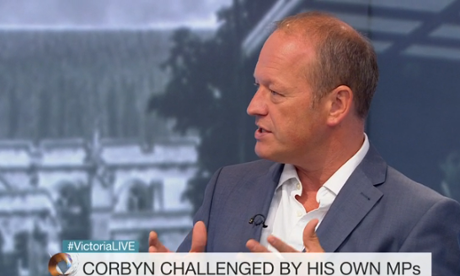
Simon Danczuk, the Labour MP, told the BBC’s Victoria Derbyshire’s show a few minutes ago that Corbyn was politely received at first, but that the meeting became “more difficult”.
It was silent but [Corbyn] was received politely. He made his speech, a similar speech to the victory speech he made on Saturday when he accepted the new role. He made the Abba tribute band joke that he had made on Saturday. He then proceeded to talk about what he had done in terms of the shadow cabinet. Then he answered a number of questions.
There’s no doubt about it, a good proportion of the parliamentary Labour party were concerned in relation to some of the policy positions that he has and they are hoping or expecting that he will moderate some of his views. There’s not doubt about it; the supporters of Jeremy are in a different position to what the wider public are. So there’s a gulf that Jeremy needs to fill. And he has to moderate his policies, whether it is Trident, Nato, the European Union, whatever it might be ...
It became more difficult. So it went from being polite to being fairly sombre during the course of the hour that took place.
Although Labour aides insisted the reaction at the event – the first meeting of Labour’s MPs and peers since the election – was cordial with “very few” negative questions, individuals who were inside the meeting room in parliament painted a different picture.
“It was a soporific, funereal meeting punctuated by muted applause with most people staring at their shoes,” said one Labour MP.
“It started off polite but by the end was quite solemn with Jeremy given a hard time,” said another Labour MP, who said Corbyn’s comments were largely met by silence. “I can’t help but think it’ll continue like this. He looked quite ashen by the end of it.”
-
The Labour MP Jenny Chapman says the meeting was not hostile.
There were challenging questions, but PLP meeting wasn't 'hostile' last night. It just wasn't.
— Jenny Chapman (@JennyChapman) September 15, 2015
-
The Labour MP Barry Sheerman says the meeting was good-tempered.
I thought last nights PLP was good tempered with a positive exchange between our new leader & MPs @BBCNews
— Barry Sheerman (@BarrySheerman) September 15, 2015
In a “hostile” meeting of the Parliamentary Labour Party, dozens of MPs challenged their new leader to rule out opposing the Trident nuclear deterrent, campaigning for Britain to leave the EU and pulling out of Nato.
In unprecedented scenes for a new Labour leader, Mr Corbyn was warned by angry MPs that he would only have their loyalty if he did not cross a number of “red lines”.
-
Danczuk said there was some “hostility” to Corbyn when he refused to rule out wearing a white poppy at the Cenotaph this year. Danczuk told the Press Association he asked for an assurance that Corbyn would not wear a white poppy.
There were murmurs around the room and some hostility and concern around his answer. The point he made was that he had not decided what he would do this year. He went on to say why people wear white poppies.
After the meeting a Labour spokeswoman said Corby would wear a red poppy on Remembrance Sunday. But Danczuk said this morning that the position had only been clarfied to an extent, and that there were still suggestions Corbyn could wear a white poppy as well as a red poppy. On Victoria Derbyshire’s show he said:
These are significant issues. A good proportion of Rochdale people are recruited into the armed forces. Remembrance Sunday is a very important day in terms of remembering those that gave their lives fighting for this country. I understand the issues around the white poppy and around peace, but that can be thought about on other days. On Remembrance Sunday I think it is important that he just wears a red poppy. So I’m hoping that he will commit to that.
-
The Labour MP John Woodcock said people like Danczuk should not be talking about PLP meetings.
Pleased by Jeremy's poppy decision but coverage in this morning's papers not helpful. PLP meetings should remain private.
— John Woodcock (@JWoodcockMP) September 15, 2015
On leaving the PLP last night, one veteran Labour MP told me: “I feel like I’ve just walked through the back of my wardrobe...And it’s snowing.” But as MPs still take in the Narnia that is a Jeremy Corbyn-led party, one pressing question is whether he will lead the UK through the backdoor of Brexit.
Updated
Paul Johnson, director of the Institute for Fiscal Studies, was on the Today programme earlier talking about the cuts to tax credits that MPs will vote on later. He said that the increase in the minimum wage (through the introduction of the “national living wage”) would not compensate for those cuts.
The additional wages as a result of the additional minimum wage will be about £4bn, we’ve got a £6bn tax credit cut, we’ve got a £12bn benefit cut altogether, so the numbers just don’t add up ...
Obviously, if wages go up then fewer people will be entitled to the benefit, but the majority of people currently on tax credits will still be on tax credits following the increase in the minimum wage, and the large majority of them will be worse off as a result of the combination of the reduction of tax credits and the increase in the minimum wage because they’re doing different things – the tax credit system is aiming significant additional resources at those with the lowest family incomes, the increase in the minimum wage is increasing the hourly earnings of that group with lower hourly earnings, and they’re often not the same people. Certainly the majority of those losing from the cuts to tax credits will not be compensated by the increase in the minimum wage.
I’ve taken the quote from PoliticsHome.
Jeremy Corbyn will give his first big speech since his election as Labour leader today when he addresses the TUC annual congress. In the past Labour leaders have often received a lukewarm reception at the TUC. Corbyn is likely to go down much better than some of his predecessors, although admiration for him in Brighton is not universal. The Times is splashing on a story headlined: “Unions join attacks on Corbyn’s top team.”
Tomorrow's front page: Unions join attacks on Corbyn's top team #TomorrowsPapersToday pic.twitter.com/aKLz87vZj0
— The Times of London (@thetimes) September 14, 2015
Here’s an excerpt from the story.
[Corbyn] is likely to be given a warm welcome when he speaks today at the Trades Union Congress, but the appointment of his long-time ally Mr McDonnell has strained relations.
One senior trade union source described the appointment as mad and added: “I’m honestly shocked at how bad the operation has been for the past 48 hours. I honestly thought [Mr Corbyn] would be better than this.”
Even Len McCluskey, the Unite leader who has hailed Mr Corbyn as the future, was among those said to be pushing for alternative candidates to lead Labour’s economic strategy.
In public, trade union bosses were barely more polite — either about Mr McDonnell, or on Mr Corbyn’s electoral appeal. Dave Prentis, general secretary of Unison, said that Mr Corbyn would have to “grow into the job”. Sir Paul Kenny, general secretary of the GMB union, said that Mr Corbyn’s “real tests” would come at local elections, and votes in Scotland and Wales, next year. “Let’s see what the voters say. Because at the end of the day, they are really the important ones.
I will be covering the speech in detail, and reaction to it, as well as more reaction to Corbyn’s shadow cabinet appointments yesterday.
Here is the full agenda for the day.
10.15am: Lord Hall, the BBC director general, and Rona Fairhead, the BBC Trust chairman, gives evidence to the Commons culture committee.
Around 12.40pm: MPs begin a debate on the national insurance contributions (rate ceilings) bill.
2pm: Jeremy Hunt, the health secretary, gives evidence to the Commons health committee.
Around 3pm: Jeremy Corbyn addresses the TUC.
4pm: Jeremy Wright, the attorney general, gives evidence to the Commons justice committee.
Later there is an important vote on cuts to tax credits, but that is due at about 8.30pm, which will be out of my time.
As usual, I will also be covering breaking political news as it happens, as well as bringing you the best reaction, comment and analysis from the web. I will post a summary at lunchtime and another in the afternoon.
If you want to follow me or contact me on Twitter, I’m on@AndrewSparrow