Home affairs select committee hearing into the late Lord Brittan – summary
- DCI Paul Settle said he sought investigative advise from the CPS and concluded that any action against Lord Brittan would be disproportionate as there were no reasonable grounds for prosecution. He said the matter was over 40 years old, the offence was not clear cut, and there was no right of anonymity for suspects arrested. Reading from his decision log, the officer referred to the interview with Brittan as “a baseless witch hunt”. He added that Watson’s letter confused matters significantly and shook confidence within his team “because it has kind of undermined us”. He confirmed, however, that info passed onto the Met by the MP has led to three successful prosecutions.
- DAC Rodhouse said the majority of delays in the investigation were due to “Lord Brittan’s health”. He denied that Brittan was interviewed because of Watson’s intervention, saying that the Met were not even aware of Watson’s letter until after the decision to review the case was made. He said there were reasonable grounds to suspect an offence had taken place and the Met merely followed the evidence.
- Tom Watson apologised to Leon Brittan’s widow for the distress caused as a result of the investigation. He said:
I’m very sorry for the distress caused. I’m very sorry for the whole wider family. I know they are very angry and they clearly loved Leon Brittan very much.
They are angry on behalf of their family member and I am sorry.
I felt that peoples’ voices were not being heard and I felt responsibility for them.
- Watson said his intention was not to undermine Settle. He said he didn’t doubt the officer’s judgement until he met the victim for a second time and she was very distressed. “She felt so strongly about it that I felt that that was the right course of action... I didn’t do it with the intention of undermining DCI Settle...I did not want to micromanage a police inquiry,” he said. He added that he’s not responsible for the investigation, all he wanted to do was amplify victims’ voices.
- Alison Saunders concluded by emphasising that the CPS is not influenced by outside pressures. She said the CPS felt that, on the basis of the evidence shown to them, there was not a realistic prospect of conviction. “We made it clear from the very beginning where we thought the line was in this particular case and we maintained that line. They kept asking us to review that,” she said.
That’s it from me today. Thanks for all your comments.
Updated
Saunders says the CPS is not influenced by outside pressures.
DPP Alison Saunders says CPS pursue cases where there is a "realistic prospect of a conviction". Never influenced by outside pressures
— steve hawkes (@steve_hawkes) October 21, 2015
DPP Alison Saunders says she passed on Watson's letter as they do with many other similar letters from other MPs.
— Brian Moore (@brianmoore666) October 21, 2015
"I can't answer for police so we always pass to the relevant force" says DPP Saunders in the common situation of MPs writing letters
— Peter Jukes (@peterjukes) October 21, 2015
Alison Saunders, the director of public prosecutions, is now before the committee.
Meanwhile, here are some key quotes from Watson, who said he was “sad” DCI Settle felt his letter to the DPP was a betrayal.
I feel very sad that DCI Settle feels that because I had a very good working relationship with him.
Neither of us really wanted to be in a position where there was such a volume of information that needed to be passed over to the police.
That wasn’t my intention, to affect his career, I just wanted to make sure that Jane’s voice was amplified in the system.
Watson also apologised to Lady Brittan, telling the committee:
I’m very sorry for the distress caused. I’m very sorry for the whole wider family. I know they are very angry and they clearly loved Leon Brittan very much.
They are angry on behalf of their family member and I am sorry.
I felt that peoples’ voices were not being heard and I felt responsibility for them.
Watson says he hopes we can create the public policy space which ensures victims of sexual crimes feel they will be taken seriously.
David Winnick asks Tom Watson: "Your conscience is clear?" Watson: "Yes."
— Emily Ashton (@elashton) October 21, 2015
Here’s a video of Watson apologising to Lady Brittan for the distress caused.
Watson says as an MP you can only try and get people into the system and refer their allegations to the police.
He admits he didn’t know what the victim was saying was true but felt the allegations should be fully investigated.
Watson denies he was trying to play prosecutor and jury by sending the letter to the DPP. He didn’t doubt Settle’s judgement until he met the victim again, and she was very distressed. “She felt so strongly about it that I felt that that was the right course of action... I didn’t do it with the intention of undermining DCI Settle...I did not want to micromanage a police inquiry.”
Watson is asked if he thinks the way the case has panned out will undermine the police in the future. “I hope that isn’t the outcome... it’s led to more people coming to my office in the past week.”
Watson is being asked if he consulted the police before writing about Brittan for the Daily Mirror. He says no, but denies he was undermining the Goddard Inquiry.
Watson is asked if he’s surprised he was called before the committee and Zac Goldsmith was not. “Very few things surprise me in Westminster,” he replies.
Watson says he’s not responsible for the investigation. All he did was amplify people’s voices. He wanted to make sure they were not treating Lord Brittan differently.
He says he went to the DPP rather than the officer on the case because he felt the DPP would give proper guidance on how to conduct the inquiry.
Watson says he “certainly does not want to take part in baseless witch-hunts.” He says he doesn’t know what judgement the police made so he can’t say whether Settle’s comments were accurate.
Watson says yes, he would describe himself as a campaigning member of Parliament, in the sense that “all MPs are campaigners”.
He says he wasn’t looking to make this a big campaign, “it was the sheer volume of information that came through my office... I was actually trying to have a quieter life after the hacking inquiry.”
Watson says his intention was to make sure the victim’s voice was amplified in the system. “There’s obviously a disagreement at the Met on whose judgement was right. I wasn’t aware of that.”
When invited, Watson apologises to Lady Brittan: “I’m very sorry for the distressed caused.” He says he feels people’s voices were not being heard and he hopes the Brittan family can try and understand that.
Tom Watson apologises to Leon Brittan's family:"I'm very sorry for the distress caused...I know they're very angry." pic.twitter.com/6pAwapSzNX
— Emily Ashton (@elashton) October 21, 2015
"I'm very sorry for the distress caused" says Tom Watson when invited to apologise to Lady Brittan by Vaz.
— Anoosh Chakelian (@Anoosh_C) October 21, 2015
Labour Dep Leader @tom_watson: "very sorry for a wider family, I know they're very angry, they loved Leon Brittan very much" #skynews
— Nick Phipps (@nickphippssky) October 21, 2015
Updated
Watson denies he was trying to run the process, “nor was I anticipating the volume of information” that was supplied to him. Most MPs would think it is their duty to pass this information to the police to investigate.
Vaz asks if Watson went beyond that duty, to the extent that an investigating officer met with him and explained why the investigation was being closed down. “When I met DCI Settle I wasn’t aware of the agenda, he raised this case but I didn’t understand that was the purpose of the meeting”. Watson says he saw Settle’s testimony today and he had a good working relationship with him and believes him to be a very good police officer. “I was not aware of the allegations he made in front of the committee until he made them”.
Watson says his intention was not to undermine Settle. He says he accepted the officer’s judgement, and it was only when he met the victim for the second time, where she described the meeting she had with Settle which he himself said was not a pleasant meeting, that he realised she felt distressed. The victim raised a number of concerns about the decisions Settle had taken, Watson says.
Vaz tells Watson he’s not Sherlock Holmes. Watson said he was asked to reassure public they would be treated seriously by the criminal justice system.
Updated
Tom Watson appears before home affairs select committee
Tom Watson is now before the select committee.
Vaz reads Watson’s line about Brittan: “He was as close to evil as any human being could get”. Vaz says this is emotion and words used about someone Watson has never met.
Watson says he regrets using that emotive language, but it wasn’t a phrase he used, one an alleged victim used. “I am sincerely sorry for repeating it, it was unnecessary.”
Updated
Rodhouse says the decision to search Brittan’s home was not related to the rape allegation against him, rather a result of other “live” investigations. Keith Vaz jumps in quickly and says they don’t want to know about this.
Rodhouse says the appropriate test to interview someone is a judgement call. “Lord Brittan could well have given a cast iron alibi” and the Met could then pursue malicious allegation charges. The issues that arise in an interview were not covered in Settle’s decision-making, he says.
DAC Rodhouse says that decision to interview "could have given Brittan a cast iron alibi because he was out of the country"
— Peter Jukes (@peterjukes) October 21, 2015
BREAKING: DAC Rodhouse explains how a Brittan interview could have expedited matters - e.g. strong alibi and mistaken identity
— Peter Jukes (@peterjukes) October 21, 2015
Updated
Rodhouse says the Met were not aware of Watson’s letter until after the decision to review the case and appeal to the CPS.
DAC Rodhouse says decision to interview Lord #Brittan was taken "in isolation" and before Tom Watson's letter to DPP
— Danny Shaw (@DannyShawBBC) October 21, 2015
Commander Rodhouse denies that a letter from Tom Watson resulted in Met review of Lord Brittan case: decision "taken in isolation"
— Fiona Hamilton (@Fhamiltontimes) October 21, 2015
Updated
Rodhouse says: “It was right in a case of such prominence to check we had got our decision right. There are a very small number of cases where the public interest is served by having the evidence reviewed.”
He denies that Brittan faced a different test, police were just ensuring that test was being applied properly. He says he doesn’t agree with DCI Settle’s decision. “My view was that he should have conducted an interview.” He says there were reasonable grounds to suspect an offence had taken place. Other officers reviewing the case came to a different conclusion to Settle, he says.
Rodhouse adds he does not believe the reviewing officer saw Settle’s decision log, but that’s not unusual. The first time Rodhouse looked at the log himself was some weeks ago, after the decision was made to review and appeal the decision. “It was my decision to appeal to the CPS,” he confirms. “This was a case where the facts were not clear cut.”
Updated
Rodhouse says it’s important for the public to know police will investigate an allegation no matter who it is against.
He says in this case the CPS advice was that the jury could be persuaded the incident took place but that Lord Brittan may not have been aware the victim did not consent. But when police spoke to Brittan, he denied that the incident took place altogether, which was used as evidence by the Met.
Vaz says he is asking about procedure, not evidence.
Updated
Rodhouse’s comments contradict those of DCI Settle.
Settle said the decision to interview Lord Brittan was in his opinion a direct result of Watson’s letter to the DPP. The dates speak for themselves, he said. Watson sent the letter and less than a week later a review was launched.
But Rodhouse denied that Brittan was interviewed because of Watson’s intervention. He said there were doubts over Settle’s decision on the case and that the Met followed the evidence.
Rodhouse says other inquiries needed to be done after Settle wanted case closed, to say Met had done the job thoroughly
— vikram dodd (@VikramDodd) October 21, 2015
Updated
While there’s a break in the proceedings, it’s worth noting that Conservative members of the commons home affairs select committee have been accused of operating along “party lines” after rejecting calls for Zac Goldsmith to also give evidence.
Goldsmith has been criticised by a family member of Lord Brittan and a former Conservative MP after he refused to withdraw claims made in parliament about an alleged paedophile ring in his constituency. Read my colleague Rajeev Syal’s full report on that below.
Rodhouse says the majority of delays in the investigation were due to “Lord Brittan’s health”. He also denies that Brittan was interviewed because of Watson’s letter.
Met Commander Steve Rodhouse refutes his detectives' suggestion that Lord Brittan was interviewed because of Tom Watson intervention
— Fiona Hamilton (@Fhamiltontimes) October 21, 2015
Met officers Patricia Gallan, an assistant commissioner, and Steve Rodhouse, a deputy assistant commissioner, are now before the home affairs select committee.
Meanwhile, here are some fuller quotes from DCI Settle:
On the 4th September 2013, following advice I received from the Crown Prosecution Service...regarding police applying what is known as the code test I decided that the investigation should not proceed any further.
My reason for that was that I concluded that any action against Lord Brittan would be grossly disproportionate and would not have a legal basis as in order to interview him we would have to have had reasonable grounds to suspect that an (offence) had been committed.
The investigation had shown that whilst an allegation had been made, the offence had not been made out in law and as such those reasonable grounds had ceased.
Settle revealed he decided not to interview Lord Brittan about the rape allegation because he feared it would be a “baseless witch hunt”. And he said that the late-peer’s eventual police interview was illegal because he felt it was not within the Police and Criminal Evidence Act (PACE). Reading aloud from his log notes which documented why he took the decision, he added:
There is no right of anonymity for persons arrested for sexual offences and furthermore there is considerable media intrusion regarding arrestees.
At the moment Lord Brittan is of interest to other aspects of a parallel investigation, and to arrest or interview him now would, I feel, jeopardise any potential inquiries as this would be nothing more than a baseless witch hunt.
Settle said he did not think there were reasonable, objective grounds for the suspicion of rape based on known facts. He informed Watson of his decision not to interview Lord Brittan and said the MP “didn’t express any concerns whatsoever” at the time. Asked if he was surprised the investigation was reopened after Watson’s letter, he said:
If I’m being frank I’m extremely disappointed because I would have thought before doing that I had the type of relationship with him where he could have phoned me to seek clarity, and had I not assured him of that clarity then he was perfectly within his rights to write that letter.
But I was rather shocked. I saw it as a betrayal to be perfectly honest because I thought I’d been frank and honest with him and transparent from the outset. I saw it as a very low blow to be perfectly honest.
Updated
Settle says if the full facts are looked at any police officer would have come to the same conclusion to not interview Lord Brittan.
He admits his decision not to interview was influenced by “the prospect of adverse coverage” in the media.
Settles says victims accounts are played out in the media, and if police are seen not to follow through what is seen as fact then they’re regarded as part of the problem. This can be deeply damaging to the pursuit of historic child sex abuse allegations.
Settle says he met with Watson periodically. He says Watson wasn’t open to privileged information because “these people came from him, in any case he possessed the privileged information before we did.” But Watson wasn’t being involved in operational matters, he was supportive up until the letter arrived, he adds.
Settle agrees that it was disproportionate for Watson to send the letter to the DPP before taking it to police.
Updated
Settle is asked how he got into a position where he was undermined by Watson. “By doing my job,” he says.
He explains the victim was interviewed by specialist officers who are particularly trained to deal with victims of sexual abuse. “It’s one area where we really go above and beyond to reassure the person”.
He also says mishandling at an early stage of an investigation can have massive consequences at a later stage. “Our actions are all scrutinised”.
The evidence led me to the conclusion that on the victim’s account the points to prove rape were not there. Though she was insisting she’d been raped, in law she hadn’t.
Updated
Settle says there’s no feeling that Watson was wrong in bringing information to the police. He agrees that Watson is not a fantasist and carried out a public duty.
In the context of the climate at the time, where Saville and Smith were not brought to justice, there was a feeling that the police had let people down, Settle says. But in the meeting with Watson on 10 February 2014 he explained why his decision on Brittan had been made.
Labour MP David Winnick asks DCI Settle if Tom Watson was "a fantasist". He shook his head. Carrying out a public duty? Yes, he replied.
— joncraigSKY (@joncraig) October 21, 2015
Updated
Settle says Watson’s letter confused matters significantly and shook confidence within the team “because it has kind of undermined us”.
Home affairs select committee: DCI Paul Settle thinks change of decision on interviewing Leon Brittan because of Tom Watson’s letter to DPP.
— Andrew Neil (@afneil) October 21, 2015
Police interview of Lord Brittan was unlawful and a result of a "baseless witch-hunt," DCI Paul Settle tells MPs.
— Josh Halliday (@JoshHalliday) October 21, 2015
Asked by David Burrowes if Brittan inquiry was "baseless witch-hunt", Settle said it was "without grounds" & "not within confines of case".
— joncraigSKY (@joncraig) October 21, 2015
Settle explains that one reason he gave for not interviewing Brittan was so as not to “jeopardise other inquiries” into him.
Updated
In his decision log, Settle refers to the interview with Brittan as “a baseless witch hunt”. He says he believes the interview was unlawful.
DCI Settle tells Home Affairs Selwct Ctte he doesn't regret sharing information with Tom Watson re Lord Brittan. pic.twitter.com/KwafJMaeNm
— joncraigSKY (@joncraig) October 21, 2015
Updated
Settle says he doesn’t regret giving too much information to Watson as it prevented speculation and inaccurate reporting. “I don’t regret keeping him informed because I’m a firm believer that once you’ve got a stakeholder in an investigation it does more harm to ostracise.”
He also confirms that info passed by Watson has led to three successful prosecutions.
Updated
Settle says he was extremely disappointed that the case against Brittan was reopened. He says Watson should have sought clarity from him. He says he saw it as a “betrayal” and “a very low blow”.
He says it undermined his investigation, because Operation Yewtree was running at the same time, and his small team had a full diary and any distractions took them away from the job at hand.
The matter was then reviewed by another senior officer who didn’t look at Settle’s decision log, he says. “That in my opinion wrongly concluded that the obvious line of inquiry was to interview Lord Brittan”.
Settle says the review was a direct result of Watson’s letter to the CPS as the dates speak for themselves.
DCI Paul Settle appears before home affairs select committee
DCI Settle is now before the home affairs select committee. He agrees with Keith Vaz that much of what he thought would be confidential regarding Lord Brittan is regrettably in the public domain.
Settle says he sought investigative advise from the CPS and concluded that any action against Brittan would be disproportionate as there were no reasonable grounds for prosecution, based on the account the victim had given him.
He says the matter was over 40 years old, the offence was not clear cut, and there was no right of anonymity for suspects arrested.
Settle met with Watson occasionally as he was acting as an intermediary. At the time Watson didn’t express any concerns regarding Settle’s decision, he says.
Updated
Other MPs who have paid tribute to Michael Meacher include former Labour leader Ed Miliband who he said was “principled, kind, thoughtful and deeply committed to a fairer, more just world”.

Green MP Caroline Lucas said Meacher - who served as environment minister for six years under Tony Blair - was a “great politician, championing climate action”.
Peter Dean, Meacher’s PA and office manager, told the Oldham Evening Chronicle:
We are extremely sad and it has been quite a short illness he has had and we just don’t know the details at present.
He was such a well respected person and we will just try to deal with any problems people in the area have ongoing. We will still try to assist in any way we can.
We are extremely sad for his family but all of his staff here at his office have worked with him for 20 years so it is almost like a family bereavement for us.
Our office usually deals with around 5,000 cases every year so he has impacted on an enormous amount of people’s lives.
Updated
Home affairs select committee hearing into the late Lord Brittan - introduction
Labour’s deputy leader Tom Watson is due to give evidence at the commons home affairs select committee about his alleged role in the rape and paedophile investigations into Leon Brittan, the late Conservative peer. Education minister Tim Loughton, who sits on the committee, told the BBC on Monday that Watson had “rather set himself up as judge, jury and executioner over individual cases”.
Brittan died in January without knowing that he had been cleared of suspicion over the allegation that he had raped a 19-year-old female student in 1967. It emerged that Watson had previously written to the director of public prosecutions, Alison Saunders, about the allegation when he learned that the police inquiry was being dropped.
Watson defended his role in a recent blog, saying he had little choice but to pass on the claims. He also told parliament it was the children who had been the victims of abuse who deserved an apology after he was urged earlier in the day to “examine his conscience” by David Cameron.
Last week the CPS said Watson’s letter was not passed to Metropolitan police detectives until after they had interviewed Brittan under criminal caution. The CPS that it had not pressured the police, but merely passed on the letter “to the relevant officer for their information”.
DCI Paul Settle, the detective who quit as head of the VIP paedophile inquiry Operation Fernbridge after reportedly being undermined by Watson, will appear before the select committee first. It has been claimed by the Telegraph that Settle stood down from the inquiry following Watson’s letter.
Settle’s appearance has raised objections from senior Met officers. The Met’s deputy commissioner, Craig Mackey, wrote to the committee arguing that MPs should not ask a relatively junior officer to appear before parliament. In a letter to Keith Vaz, the committee’s chair, Mackey said Settle’s appearance was inappropriate and had significant implications for the operational independence of the police.
I’ll be posting key updates from Settle and Watson’s appearances. You can watch the proceedings live here.
Updated
Veteran Labour MP Michael Meacher has died aged 75. Meacher had been MP for the Oldham West and Royton constituency since 1970. His office confirmed his death earlier today.
Tributes have begun pouring in on Twitter.
Very sad to hear of death of Michael Meacher - was a source of great advice & encouragement to new MPs like me in 2009/10
— William Bain (@William_Bain) October 21, 2015
Really sorry to hear of the death of Michael Meacher MP. He was a politician of real principle & conviction. We will miss him.
— Lucy Powell MP (@LucyMPowell) October 21, 2015
RIP Michael Meacher MP - we've lost a good comrade
— Kevin Brennan (@KevinBrennanMP) October 21, 2015
Very sad and shocked to hear of the sudden death of Michael Meacher MP. Thoughts and prayers go out to his family. RIP
— Chuka Umunna (@ChukaUmunna) October 21, 2015
Michael Meacher was a fantastic man. Disagreed on certain things but he couldn't have been more warm, collegiate or honest. A genuine loss.
— Jamie Reed (@jreedmp) October 21, 2015
Very sorry to hear of sad death of our colleague Michael Meacher, a man of strong principle who was always v courteous to me personally. RIP
— Stephen Doughty (@SDoughtyMP) October 21, 2015
Hard to absorb the news that Micheal Meacher has passed away. Great friend, close comrade. A man of the Left.
— Jon Trickett (@jon_trickett) October 21, 2015
Updated
Lunchtime summary
- Corbyn has used PMQs to attack Cameron on his tax credits plans. The Labour leader quoted one of Cameron’s own backbenchers, Heidi Allen, who yesterday used her maiden speech to attack the government’s proposals. Cameron repeated his argument that the tax credits cuts should be seen as one of a range of measure, including raising the personal income tax allowance and reducing council house rents. He also took a swipe at Labour for the fact that the party’s deputy leader Tom Watson did not come vote in yesterday’s tax credits debate.
- The Speaker John Bercow sent a warning to the Lords not to over reach itself by blocking the government’s plan to tax credits saying “the constitutional position is clear and long standing.” He was speaking after the Conservative MP Edward Leigh said it was an ancient right of the Commons to make decisions on tax and spending. Bercow responded the Lords “can look after itself, but we also can and will look after ourselves”.
- The chancellor, George Osborne, is under renewed pressure over his £4.4bn plans to cut tax credits as the chairman of the government’s independent social security advisory committee, Paul Gray, urged the Treasury to set out the full impact of the policy. Gray told the Guardian that ministers had still not set out the full impact of the tax credit cuts nor explained what it means for universal credit, despite sending a letter on 9 September asking for more details.
My colleague Nadia Khomami will be taking over shortly to cover Tom Watson’s appearance in front of the home affairs select committee this afternoon. Thanks for all your comments.
A Labour spokesperson is denying Daily Mail claims that Corbyn made a joke about somebody’s wife being a prostitute to David Cameron during the Chinese president’s speech yesterday.
Jeremy Corbyn spokesman says he denies he said the word 'prostitute' in Cam chit-chat yesterday. "He didn't say it"
— Paul Waugh (@paulwaugh) October 21, 2015
Here’s a round-up of Twitter reaction to today’s PMQs. Many political journalists are saying that Corbyn’s performance is improving, but that he should have used all his questions to focus on tax credits.
All of Corbyn's questions important. But six on tax credits would have been far harder for Cameron. #PMQs
— George Eaton (@georgeeaton) October 21, 2015
Corbyn had Cameron struggling on tax credits at PMQs – but then changed the subject https://t.co/Kl50KXBUF9
— Mike Smithson (@MSmithsonPB) October 21, 2015
Jeremy Corbyn just shut up the whole Tory benches with a look. 'Thank you' he said like a strict teacher #PMQs
— Owen Bennett (@owenjbennett) October 21, 2015
Some are arguing that Cameron struck the wrong tone on tax credits.
All in all, reinforces an impression of not caring about people going through tough times. Not exactly his finest hour.
— Gaby Hinsliff (@gabyhinsliff) October 21, 2015
Cameron's "delighted" moment a sign his #PMQs anger issue still unresolved. The word undercuts the entire Tory "real workers' party" effort.
— Michael Savage (@michaelsavage) October 21, 2015
Ever wondered what "delights" David Cameron? Well, now we know. Turns out it's cutting tax credits for million of workers #PMQs #WorkPenalty
— Owen Jones (@OwenJones84) October 21, 2015
The Labour party is highlighting Cameron’s use of language in his answer to one of Corbyn’s tax credits questions, specifically his use of the word “delight”.
DC's "delight" at tax credit cuts shows he doesn't stand up for working people #PMQs pic.twitter.com/mdm3s23yJH
— Labour Press Team (@labourpress) October 21, 2015
Anna Turley, Labour MP for Redcar, has an email from a constituent from James Wharton, minister for the northern powerhouse, saying that some of the support package going to the redundant steel workers is going to pay their final salaries.
Cameron says the government has done a lot to help the steelworkers, but adds: “Let me tell the honourable lady what we can’t do. wWe can’t, in this house, set the world price of steel”.
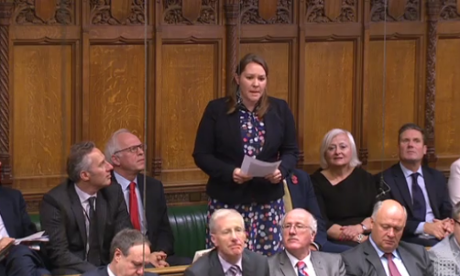
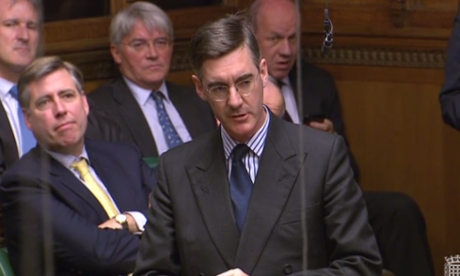
Conservative MP Jacob Rees-Mogg asks the prime minister about the threat that the opposition in the Lords will vote against the tax credit cuts. He says it would go against a convention established in 1678 and the sovereignty of the Commons.
Cameron agrees with Rees-Mogg and says that MPs have voted in favour of the tax credits cuts twice now and that it would be an abuse of their power if peers were to vote against the measure.
Labour’s Jonathan Ashworth, shadow minister without portfolio, his issued a statement on the prime minister’s response on tax credits today:
David Cameron showed the true face of the Tory Party at PMQs today when he talked about his ‘delight’ at tax credit cuts. This Tory cut will mean over 3 million families losing on average £1,300 a year.
It’s shameful that David Cameron is ‘delighted’ the cuts were voted through the Commons again last night. Despite his rhetoric yet again we see the Tory Party is not the party of the common ground.

PMQs snap verdict
My colleague Rowena Mason gives a snap verdict on Corbyn’s third PMQs.
Jeremy Corbyn is really getting the hang of this. He mixed his questions from the public up with some penetrating ones of his own and maintained authority with what is becoming a trademark acerbic school-masterly demeanour. The prime minister is already on the back foot over tax credits and the steel crisis so these were two easy subjects for Corbyn but it was overall a creditable effort that seemed to get Cameron slightly rattled.
BINGO
Iain Stewart asks about the nuclear deterrent. Cameron spots an opportunity.
He says it’s disappointing to the country that the consensus on nuclear weapons has been ignored and that Corbyn is involved in CND.
Frankly it’s today that we’re celebrating that great film Back to the Future and it’s not surprising that many people sitting behind him will tell him to get in his DeLorean and go back to 1985 and stay there.
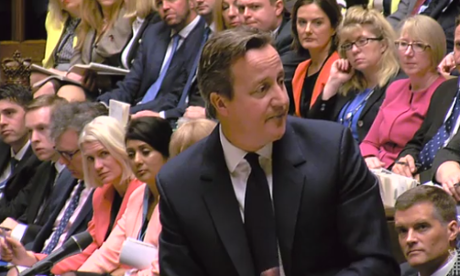
SNP MP Anne McLaughlin reads out child poverty figures for her constituency. Cameron says those figures have come after years of “the great tax credits experiment” and that a different approach is now needed.
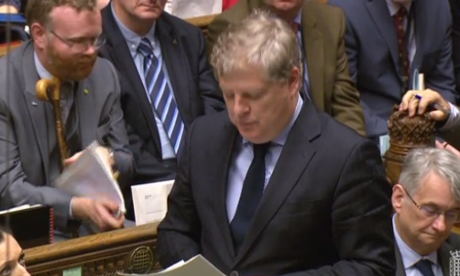
The SNP’s Angus Robertson asks about tax credits plans. “Does the prime minister have the faintest idea of the human cost of these plans?” says Robertson.
Cameron repeats that families will benefit from other measures, such as the cut to council rents and the raise in the income tax allowance.
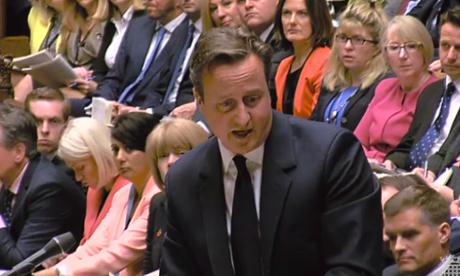
Corbyn asks a question from Louie about a United Nations investigation into disability rights in the UK. Cameron says that, thanks to legislation passed by the last Conservative government, there have been tens of thousands of disabled people helped into work under the Tory government and that the UK has some of the toughest disability rights legislation in the world.
Cameron says he’ll look into the UN investigation, but that his experience of such investigations is that they’re not always as they first appear.
The prime minister met the member of parliament for Scunthorpe 11 months ago but is yet to ask the EU to help protect the British steel industry, says Corbyn.
We have been talking to Europe “for months”, says Cameron. The government has been working to stop the practice of “dumping”.
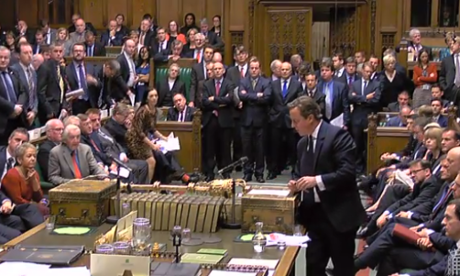
Corbyn asks a question from a steelworker in Scunthorpe who wants to know what the prime minister has done to help the steel industry. Cameron says the global market for steel is difficult and says the government has done a lot to promote the British steel industry.
Corbyn says “isn’t the real problem that the government doesn’t actually have an industrial strategy?” The government has been dragged “kicking and screaming” to the commons to answer questions on the subject, he says.
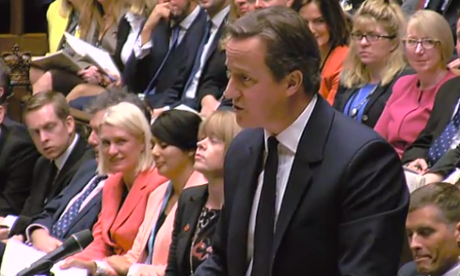
“This all very strange because the prime minister seems to have changed his mind,” says Corbyn. He reads out a question from John who asks why Cameron went on TV and said he wouldn’t cut tax credits before the last election.
Cameron says something “quite strange” happened last night which is that Tom Watson, Labour’s deputy leader, didn’t turn up to vote in the tax credits vote yesterday.
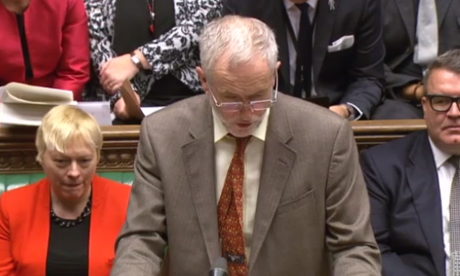
Jeremy Corbyn is up. We’re returning to the PM’s favourite subject of tax credits, he says. Corbyn reads out quotes from Heidi Allen’s speech yesterday and asks “where was she wrong?”
The cuts to tax credits are part of a package, says Cameron. “Let’s make work pay”. He says he’s delighted that the measure passed through the commons again last night.
Here’s a mini explainer of tax credits:
Updated
Susan Elan Jones, MP for Clwyd South, asks the prime minister about Sunday trading laws.
The prime minister says there’s a “strong case for change”, but that local authorities should decide what is best for their area – something that will be in the Cities and Devolution Bill.
He says you can shop on the internet on a Sunday and that it’s time to modernise.
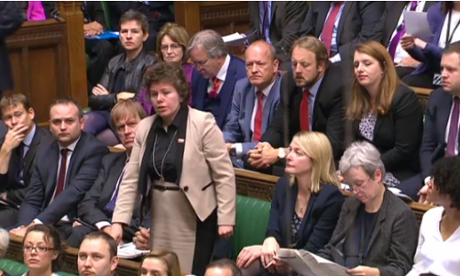
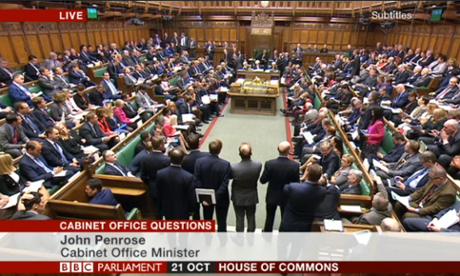
The house is filling up in advance of PMQs.
The Daily Mail has asked lip reading experts to look at the film of Jeremy Corbyn’s and David Cameron’s awkward looking exchange as they waited to hear Chinese President Xi Jinping give his speech yesterday.
According to the lip readers, Corbyn said to the prime minister: “It was difficult because, erm, that’s his ex-wife who is, erm, apparently an ex-prostitute”.
It is not clear who he was talking about.
David Cameron then went on to talk about the levels of self-employment “falling gradually”. “That’s right, absolutely, that would be more interesting,” Corbyn responded.
The exchange prompted fevered speculation on social media yesterday about what the two could have said to each other.
Bets are on for how many Back to the Future gags there are in today’s prime minister’s question time.
Prediction: Tory backbencher using #PMQs to make a #BackToTheFuture gag about Labour going back to the 1980s
— Conor Pope (@Conorpope) October 21, 2015
Shall we all agree to down a whole bottle of wine every time MP mentions Back To The Future at PMQs & then at least it might all end quicker
— Jess Brammar (@jessbrammar) October 21, 2015
The thought that #PMQs will probably be full of laboured gags about Back to the Sodding Future is genuinely upsetting.
— Miranda Green (@greenmiranda) October 21, 2015
The Local Government Association, which represents 370 councils and boroughs across the country, has called for headteachers to be able to approve pupils taking family holidays in term-time, a move that would end a controversial policy that has led to a sharp rise in the number of parents being fined for unauthorised absences.
Schools minister Nick Gibb was on the Today programme earlier defending the current policy:
We tightened the rules, but the rules have always been... that you should not take time out of terms to go on holiday, but there was an impression given that every parent was entitled to two weeks leave to take a child on holiday. That was increasing, it wasn’t just one or two children… it was increasing.
If you do this, you can disrupt the teachers planning of their lessons, you affect the education of other children, but it also affects the child themselves. Because our data shows that just a week off per year as leading up to GCSE courses can reduce the chances of that child getting good GCSE’s by about a quarter.

Labour MP John Woodcock doesn’t seem too happy with the news that Guardian journalist Seumas Milne has been appointed as Corbyn’s head of communications.
Delighted to welcome Seamus Milne to the team! Thanks Seamus!
— Jeremy Corbyn MP (@jeremycorbyn) October 20, 2015
We finally have Tory MPs squirming over the vote on tax credit cuts and we unleash more process barminess to divert attention.. So fed up.
— John Woodcock (@JWoodcockMP) October 20, 2015
This is not some middle class columnista parlour game, it is people's lives who are being wrecked by the Tories. They deserve better.
— John Woodcock (@JWoodcockMP) October 20, 2015
Today’s Sun newspaper has a good quote from a senior Number 10 aide. Asked about Boris Johnson’s increasingly eurosceptic murmerings, the aide said:
Boris is bored. He will do anything to grandstand on the world stage.
The aide told The Sun that rumours that Johnson would get a cabinet role in charge of infrastructure when he steps down as London mayor were unfounded and that he would get a “ceremonial” post.
The London mayor and MP for Uxbridge and South Ruislip has flirted with throwing his weight behind the campaign to leave the European Union in the upcoming referendum.
Speaking to the BBC while on a trip to Japan last week, Johnson said: “I think I am exactly where the prime minister is and, I think, actually a huge number of the proportion of the British public.
“We want, in an ideal world, to stay in a reformed European Union but I think the price of getting out is lower than it’s ever been. It’s better for us to stay in, but to stay in a reformed EU. That’s where I am.”
So, it’s officially ‘Back to the Future Day’ – meaning it was this day (21st October 2015) that Michael J Fox travelled back to in the 1989 blockbuster Back to the Future Part II. While the Guardian is running a live blog to mark the day, the department for work and pensions has decided to use the day to promote its workplace pensions campaign.
‘Pensions? Where we’re going we don’t need pensions…’ #DontIgnoreIt #BackToTheFuture https://t.co/fWkyXT9qBY pic.twitter.com/G1Pjx7P2oO
— DWP Press Office (@dwppressoffice) October 21, 2015
A giant fluffy creature called Workie is the new face of the department’s workplace pensions campaign. Workie made his TV debut on Tuesday night in an ad break between Emmerdale and Coronation Street on ITV.
Pensions minister, Ros Altmann, who was personally involved in designing Workie, said:
This is a fun and quirky campaign but behind it lies a very serious message. We need everyone to know they are entitled to a workplace pension – and we need all employers to understand their legal responsibility to their staff, but also to feel more positive about engaging with workplace pensions.
DWP have revived a character from David Bowie's Labyrinth to scare the shit out of people who don't have a pension. pic.twitter.com/AquRk4ArrV
— Jim Waterson (@jimwaterson) October 21, 2015
Updated
Here’s a round up of political stories you may have missed this morning.
- Guardian journalist Seumas Milne has been appointed executive director of strategy and communications for the Labour party. Labour’s statement announcing Milne’s appointment says he will be joining “on leave” from the Guardian, suggesting at a point in the future he will be free to return. He will take over on 26 October.
- As well as the news of the investment by China’s state nuclear power companies in Hinkley Point in Somerset, the government has announced a relaxation of the visa rules for Chinese tourists, slashing the price for a two-year multiple-visit UK visa from £324 to £85. If the new system is a success, special 10 year visas for Chinese tourists will be introduced for the first time.
- Secret research by the Labour party, passed to The Independent, concludes that the party must tackle its “deep and powerful negatives” on the economy and welfare if it is going to win a general election. The research, conducted through focus groups, suggested that swing voters who have deserted Labour see the party as standing “for down and outs, not people like me.”
- The commons work and pensions select committee has said that nearly 70% of people who go through the government’s £5bn Work Programme – launched by the coalition in 2011 – fail to find sustained employment. The scheme was “not working well” for people with complex problems, but was “at least as good” as its predecessors, said the MPs.
- The CBI has signalled its determination to campaign for Britain to remain in the EU. The UK’s leading business group published a glossy report, Choosing Our Future, on Wednesday, liberally sprinkled with quotes from companies and trade bodies about the boost to their bottom line from remaining in the European single market.
- The business secretary, Sajid Javid, has been judged the most influential Asian person in Britain, topping a list of 101 prominent people including Nobel Peace prize winner Malala Yousafzai, musician Zayn Malik and artist Sir Anish Kapoor.
- It has emerged that Jeremy Corbyn’s head of policy, Andrew Fisher, posted on Twitter that it was “fitting that the architect of Labour’s miserable austerity-lite economic policies should lose #Balls”. Labour MPs have asked Corbyn why he appointed Fisher, who also described the Labour front bench as “the most abject collection of complete shite” in September last year.
Updated
Jeremy Corbyn will face David Cameron for his third appearance at prime minister’s question time today at midday.
Corbyn held what Labour described as “cordial and constructive” talks with the Chinese president Xi Jinping at Buckingham Palace yesterday. They had a 30 minute private meeting and, according to a Labour spokesperson, discussed:
...the history of links between the UK, the Labour Party and China, in particular the huge contribution and sacrifice of the Chinese people in the struggle against fascism during the Second World War and the Labour Party’s commitment to build constructively on that history....
Jeremy also raised the issues of human rights and the impact of Chinese imports on the UK steel industry.
Later this afternoon, around 2.30pm, Labour’s deputy leader Tom Watson will give evidence at the commons home affairs select committee to be grilled about his alleged role in the rape and paedophile investigations into Leon Brittan, the late Conservative peer.
Education minister, Tim Loughton, who sits on the committee, told the BBC on Monday that Watson had “rather set himself up as judge, jury and executioner over individual cases”.
No charges were ever brought about the people that have been named by Tom and now he is made to look rather silly.
I’m covering for Andrew this week, bringing you breaking political news as it happens, as well as bringing you the best reaction, comment and analysis from the web.
If you want to follow me or contact me on Twitter, I’m on @fperraudin
Updated