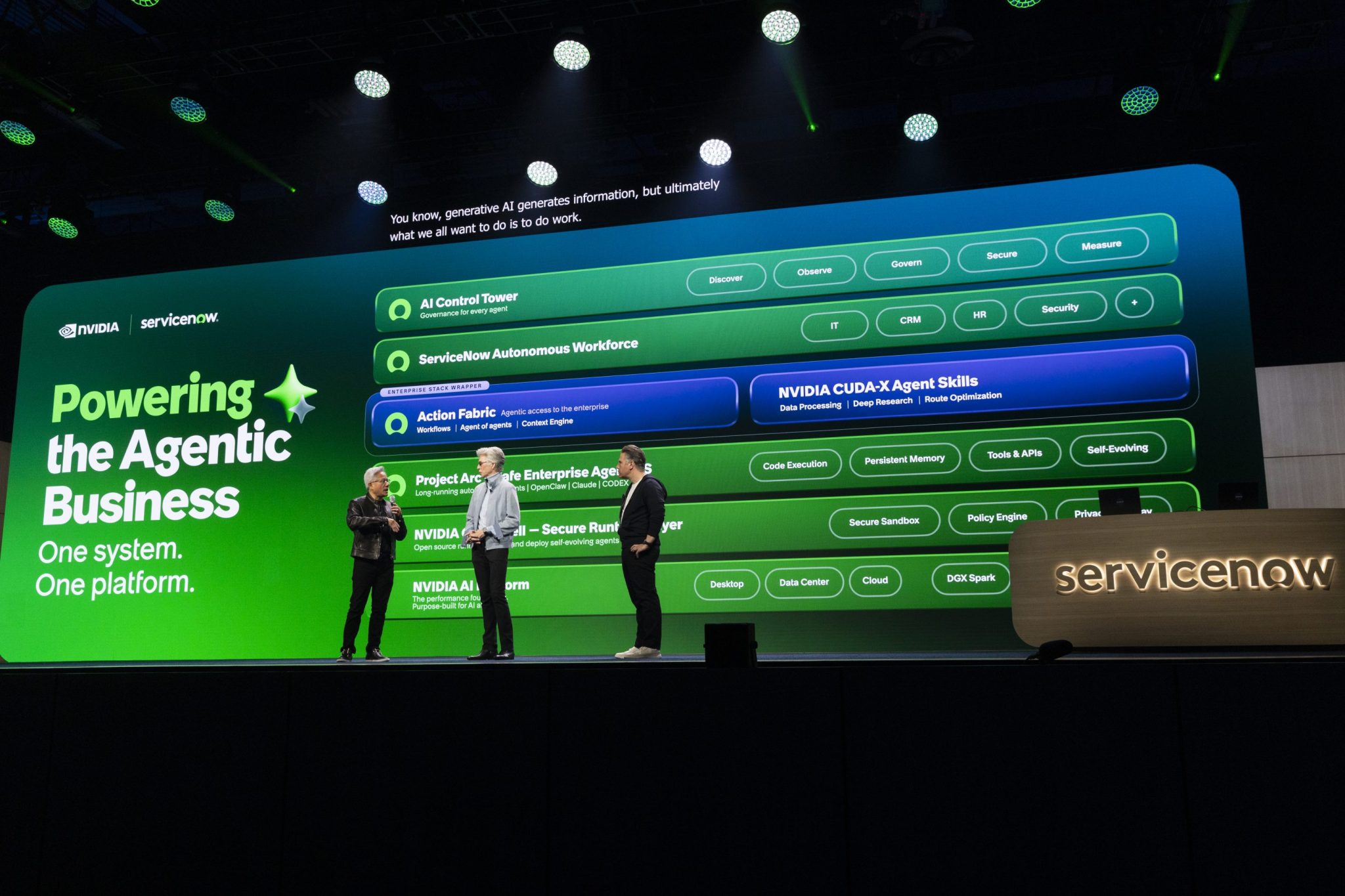
Jensen Huang didn’t have to be in Las Vegas on Tuesday. He runs the most valuable publicly traded company in the world. His chips power virtually every major AI system on the planet. He could have sent a video. He could have sent a lieutenant. Instead, he walked onto the main stage at ServiceNow’s Knowledge 2026 conference—for the third consecutive year—and got the loudest reception in the room.
“I came,” he told the crowd, grinning, “because I want my ServiceNow.”
The laugh was genuine. But Nvidia runs its employee workflows on ServiceNow. Its configure-price-quote system for supercomputers—a document so complex it used to take five days to generate—now takes five minutes, built on ServiceNow’s CRM platform. Huang isn’t just a partner endorsing a partner. He’s a customer testifying to a thesis.
The thesis stated plainly: the software industry is about to absorb an economy a hundred times its own size. And the infrastructure for that absorption runs through the partnership between these two companies. Huang’s presence was a signal. And his message, delivered alongside ServiceNow Chairman and CEO Bill McDermott: the biggest technology shift in a generation is already underway, and most companies are dangerously unprepared for it.
“This is one of the greatest transformations for the software industry ever,” Huang told CNBC’s Jon Fortt in a live broadcast from the Venetian. “For the first time, service is software. Software is service, and the service industry is 100x larger than the software industry.”
That’s the bet. And ServiceNow, which McDermott says will cross nearly $16 billion in subscription revenue this year and will double to $30 billion by 2030, is positioning itself as the company that captures it.
The problem nobody wanted to name
Before the announcements, before Jensen’s entrance to stadium-level applause, McDermott opened Day 1 with a provocation. Every AI pitch, he said, has been telling companies the same story: here’s what AI can do for your business. But there’s a blind spot—and it’s what AI can do to your business.
He walked through the numbers: the average enterprise runs 367 different applications, with AI “bolted on like a sidecar” to each one. An AI agent at one company gained elevated permissions and deleted an entire production database—customer data, reservations, backups—in nine seconds. “Governance isn’t a feature,” McDermott said. “It’s the whole ball game. Because without it, your whole company can come down.”
The action layer
Into that gap, ServiceNow dropped a suite of announcements. The centerpiece is what McDermott revealed in 2025 as the AI Control Tower—a unified governance layer that gives companies real-time visibility into every AI agent, model, and workflow running across their enterprise.
Alongside it came Project Arc, developed in partnership with Nvidia, which gives enterprises a secure “sandbox” for deploying autonomous agents—what Huang called Open Shell. The idea: every agent gets identity management, access controls, and governance policies, the same way human employees do. “You have human agents and AI agents, and they basically govern the same way,” Huang said on the keynote stage.
ServiceNow also unveiled Otto, a new AI-native front door that works across every enterprise system—from Workday to SAP—and Action Fabric, which lets any AI agent (Claude, Codex, Gemini) call into ServiceNow’s governed workflow engine and actually execute enterprise work, not just recommend it. McDermott closed the day with some thoughts at a fireside chat: “AI thinks, and it’s important to think — but it doesn’t act.”
The $50 trillion frontier
Huang’s most striking argument wasn’t about enterprise software at all. It was about the physical world.
Until now, he argued, the entire industrial economy—manufacturing plants, warehouses, logistics networks, roads, cities—had been essentially untouched by IT and software. A $50 trillion opportunity that simply didn’t exist for the tech industry. Agentic AI, he said, changes that equation entirely. “The entire manufacturing line will be operated by robots, managed by more robots, and the entire factory is a robot,” Huang told Fortt. “They’re going to run on top of ServiceNow, and you manage them just like employees.”
What computation is required to make all of this work? Huang put a number on it: the compute needed for agentic AI has increased 1,000% compared to generative AI just two years ago, because agents now have to read, reason, use tools, and generate far more tokens in real time. That’s an extraordinary tailwind for Nvidia—and it’s also why Huang keeps showing up at ServiceNow events.
FedEx as the proof
Theory is one thing. The conference’s most substantive moment may have been a panel with FedEx CEO Raj Subramaniam and CDIO Vishal Talwar—two executives whose company moves 18 million packages a day across 220 countries.
Subramaniam, who started as a marketing associate 35 years ago and became only the second CEO in FedEx’s history after Fred Smith, didn’t arrive to deliver a polished testimonial. He talked about a digital twin of FedEx’s supply chain that the company began building in 2020, which now generates two petabytes of data per day. He talked about identifying $1.8 trillion in inefficiency in global supply chains—and FedEx’s ambition to orchestrate those chains, not just move within them. FedEx now executes 5 million ServiceNow workflows per month across hire-to-retire, source-to-pay, and ship-to-collect processes.
Talwar was more direct about what it took. “For a company like FedEx, where our brand has been synonymous with trust for the last 50 years, there is no room for error,” he said. His framework: clarity of workflows, integrity of data, and a governance layer that treats AI agents the same way FedEx treats its 800,000 employees. “We treat them as a digital workforce that needs to be governed with the same rigor and policies as our human teams.”
For this story, Fortune journalists used generative AI as a research tool. An editor verified the accuracy of the information before publishing. ServiceNow is a Fortune partner and provided materials for review.