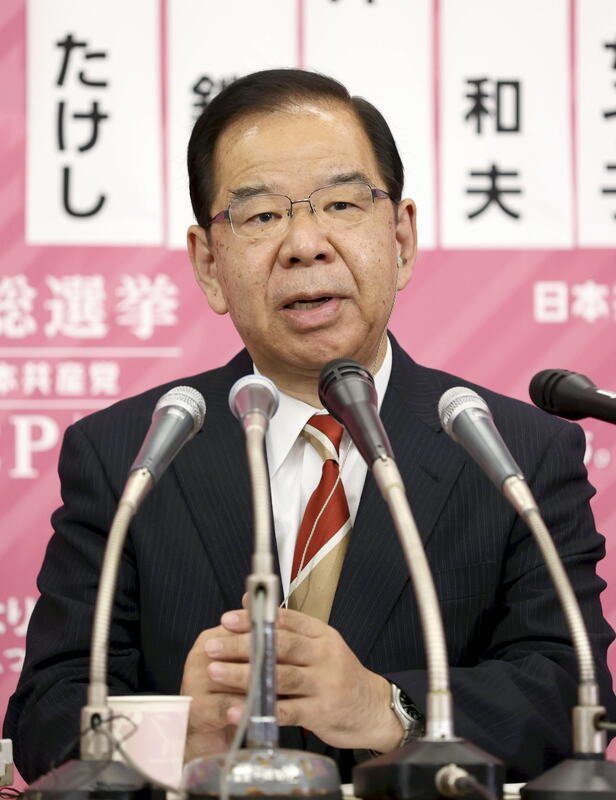
Sunday's election for the House of Representatives left the Japanese Communist Party with fewer seats than the 12 it secured in the previous race, as the JCP held on to Okinawa Constituency No. 1, its only seat among the single-seat constituencies, but failed to attract as many votes as it had expected in regional blocs under the proportional representation system.
"We haven't talked about how we'll tackle the House of Councillors election [slated for next year]," JCP leader Kazuo Shii said at a press conference held before dawn on Monday. "But we want to move forward on a path of joint struggle." Shii was referring to a possible election partnership with other opposition parties, including the Constitutional Democratic Party of Japan, in the future.
To cooperate with the CDPJ in the Sunday election, the JCP backed out of fielding its own candidates in 22 out of the about 70 single-seat constituencies where it would have competed with the CDPJ.
Making a great concession to the CDPJ, the No. 1 opposition party, in single-seat constituencies, the JCP positioned the lower house race as "an election in which we take part, for the first time in our party's 99-year history, under an agreement to support a government led by another party."
But JCP-backed candidates struggled in constituencies where they ran with the joint support of five opposition parties, including the CDPJ.
"Our party played a sacrificial role in the united front presented by opposition parties," Akira Koike, head of the JCP's Secretariat, said at a Sunday press conference. He stressed that the JCP, more often than not, threw its support behind candidates backed by the CDPJ.
In addition to the shared policies based on an accord that the JCP, CDPJ, Social Democratic Party and Reiwa Shinsengum made with a civil society organization, the JCP's campaign platform argued for what it called "four changes" designed to alter politics with regards to people's livelihoods, climate change issues, gender equality, and peace-oriented diplomacy.
Included in the platform was the provision of "benefits to support livelihoods," through which households whose income dropped due to the impact of the novel coronavirus would in principle be given 100,000 yen per member. The JCP also called for lowering the consumption tax rate to 5%.
Read more from The Japan News at https://japannews.yomiuri.co.jp/