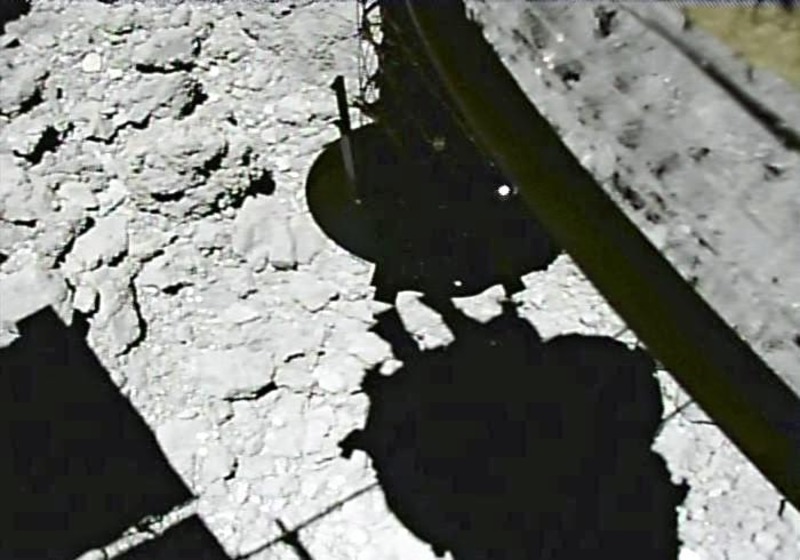
The Japan Aerospace Exploration Agency (JAXA) has released photographs and video showing its space probe Hayabusa2 touching down on the asteroid Ryugu.
The images, released Tuesday, show sand and rocks flying up after the probe fired a bullet into the asteroid to collect samples. The probe is scheduled to make the first-ever attempt to create a crater on the surface of an asteroid in early April, then make a second landing near the crater in May or later.
Hayabusa2 landed on the surface of Ryugu for several seconds on Feb. 22. A camera attached to the side of the probe showed a cylindrical sample-collection device making contact with the ground.
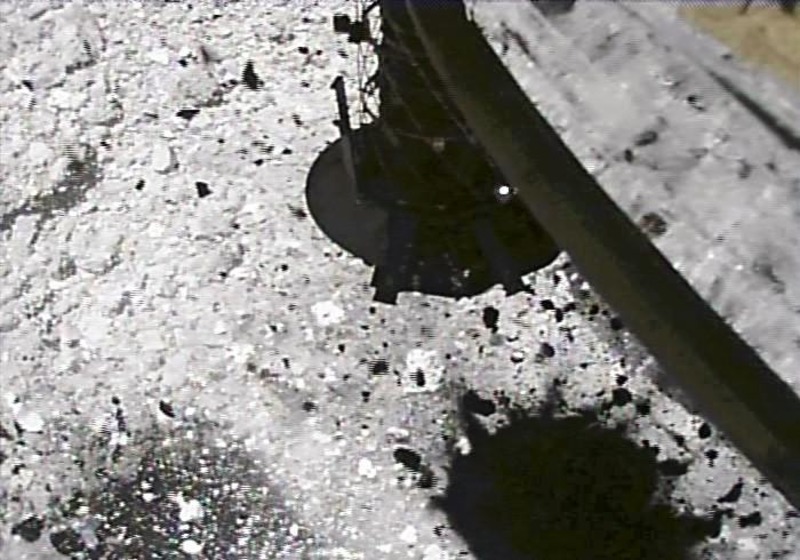
Sand and rocks ranging from several millimeters to tens of centimeters in size were sent flying by the bullet's impact and the firing of the probe's engine. Due to the asteroid's slight gravity, these are seen hovering in space for a long time.
The geology of Ryugu's surface "appears to be rough like pumice and quite fragile. Fine, confetti-like material was also kicked up, which we believe to be part of the stratiform structure," Hayabusa2 Project Scientist and Nagoya University Prof. Seiichiro Watanabe said at a press conference.
The camera was developed using about 12 million yen donated from everyday citizens.
"These wonderful images were possible because of your donations. We are truly grateful," JAXA Project Manager Yuichi Tsuda said.
The landing site has been nicknamed "tamatebako," after the mysterious box that appears in the "Urashima Taro" folktale, according to the project team.
JAXA also indicated that the original plan to perform three landings would be reduced to two, mostly because the sample size obtained in the February landing was sufficient.
After the crater is made and more samples are collected in the second landing, a third will probably not be necessary, the agency has determined.
Read more from The Japan News at https://japannews.yomiuri.co.jp/