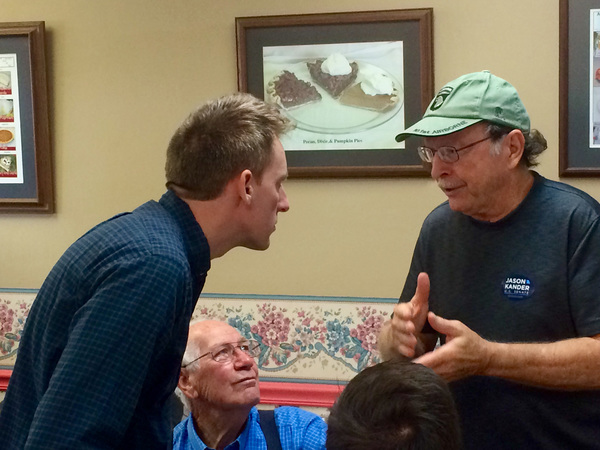
WASHINGTON _ A crowd of at least 100 students, many of them self-professed progressives intent on changing the world, came to American University recently to hear Jason Kander.
How, one asks the former Missouri secretary of state and failed 2016 Senate candidate, do we start?
"There is no code to crack, no specific way to do this," Kander says.
He answers questions about how to correspond with people on Facebook you disagree with (Talk about something that happened to you that makes you think the way you do, he says: "Show them your math."); why it's futile to hope that Donald Trump won't last four years as president (If you do that, "every morning you wake up and he is still the president, it feels like Nov. 9, 2016, all over again. Don't do that to yourself"); and how social media forever changed politics ("It is 2018 _ you can't go say one thing to one group and another thing to another, and not have them know about it.")
One question he isn't asked:
What is Jason Kander up to?
Jason Kander looks like a man on a long run toward the presidency in a world with an attention span no longer than the time between presidential tweets.
Some think the 38-year-old Kander would be a suitable millennial vice presidential candidate to balance an older presidential aspirant on a Democratic ticket in 2020.
Critics say he's a man in a hurry running too fast from his roots.
That he is operating largely outside the official Democratic Party, and outside the single-barreled aim of the New York and Washington big-media markets, says as much about the world we live in as it does about one man's ambitions.
It is a world of divergent but targeted media, calibrated to activist audiences and to the calendars of early presidential nominating states. In this world, political parties largely are institutional afterthoughts. It's also a world in which Kander is comfortable calling himself a politician and criticizing politicians who say they aren't.
In a late January interview after his appearance at American University, from which he graduated in 2002, Kander said he is likely to run for public office again someday, but is not specific on the when and where.
In a party that has few nationally recognizable figures under 70 years old, he has time.
Some think he may run for president in two years, when he will be four years younger than Theodore Roosevelt was when he entered the office.
"A lot of my friends like to say he is going to run for president in 2020," said first-year American University student Julia Wunning-Zimmer, who sat in the third row at Kander's appearance. She added that she thinks "he is way too young."
Wunning-Zimmer, who as a high schooler worked for Missouri Democratic State Rep. Deb Lavender, said she sees Kander running for another statewide office first. "He came so close" against Republican Sen. Roy Blunt in 2016, she said.
Kander's campaign-like activity, in 34 states and counting, is done through his organization, Let America Vote, which resists what Kander says is Republican suppression of voting.
Kander, along with adviser Abe Rakov, formed Let America Vote a year ago this month. Through it, he has traveled the country, appearing on virtually every media platform available, including a profile-raising gig on CNN.
Kander's "Majority 54" podcast _ named for the percentage of Americans who didn't vote for Trump in 2016 _ had had more than 1.8 million total "listens." Edison Research reported last year that 67 million Americans listen to podcasts monthly.
Several American University students told Kander they were regular Majority 54 listeners.
The podcast, Kander said, aims at "how we in the majority can better talk about our beliefs to those we have yet to convince."
Kander's guests have included his translator in Afghanistan, where Kander was an Army intelligence officer after Sept. 11, 2001, and Cecile Richards, who just stepped down as the head of Planned Parenthood, the women's health group that Republicans have been trying to defund under Trump.
The podcast also features Kander bantering with his wife, Diana, one of his advisers in what past associates describe as a very tight circle around him.
"His wife really kind of steals the show," Iowa Democratic County Commissioner Stacey Walker said in December on an Iowa podcast popular with millennials called "Political Party."
"Totally agree," Kander responded.
In one broadcast, Diana Kander said that she had just bought tickets to take their son, True, 4, to a Monster Truck event.
"The so-called coastal elites listening to this right now said, 'Of course you did,'" Kander responded.
Kander later says it was a sarcastic remark about what critics say about his party and his home.
From Hillary Clinton's "deplorables" to the shellacking that Democrats took in middle-America in 2016, the rap is that national Democrats are largely coastal elites who view the rest of America as an alien outpost, something to be won over rather than lived in.
Describing himself as a "progressive from a red state," Kander advised an American University student from Arizona to "go home" after graduation and try to make a difference in the community in which she grew up, rather than stay inside the Beltway, which Trump has famously labeled swampland.
"We have got to zero in on the fact that all of us, no matter where you live, want our kids' lives to be an upgrade over our own and we would really like it if our kids could come back and live where we raised them," Kander said later. "So, yeah, there is an important element of making people understand that we want communities all over the country � Midwest, the South, East � to be a place that people want to come home to."
Kansas City is still home to Kander, but his life since his loss to Blunt is one shared mostly by truckers, airline crews, rock bands and presidential candidates.
Let America Vote has offices in five states, including presidential campaign battlegrounds such as Iowa and New Hampshire. The group's board of directors includes former Obama White House press secretary Josh Earnest, a native of Kansas City. He was Obama's campaign press secretary in Iowa in the 2008 campaign and has connections with many top Democratic Party officials, including former Gov. Terry McAuliffe of Virginia and 2004 presidential candidate Howard Dean.
Let America Vote has raised $3.2 million to keep Kander on the road. Kander's paid staff and volunteers knocked on 194,000 doors in Virginia for Ralph Northam, who was elected governor handily in what was seen as a big harbinger of resistance to Trump.
Kander's organization claimed victory when Trump's national voter fraud commission disbanded in the face of widespread resistance.
But in that role, Kander also has been called a carpetbagging meddler _ a "smirking menace," in the words of New Hampshire Republican activist Patrick Hynes.
"The former Missouri secretary of state wants to come to New Hampshire, cast aspersions on our election, and use his 'wokeness' as a springboard to bigger things," Hynes wrote in a scathing commentary, appropriating liberals' term for a new social justice movement.
After Kander told a New Hampshire journalist, "I'm really focused on making sure we still have elections," _ an often used line �� Hynes shot back: "We should laugh him out of the state for this insult to our competency and our pride."
"I think I am more of a smiling menace," Kander said of Hynes' comments.
Only in 21st century America would a good-effort prize be seen as a springboard to higher office. Kander lost by fewer than 3 percentage points to Blunt, in a state Trump won by almost 19. Six months later, Politico headlined a profile: "How Jason Kander Won By Losing."
Days before leaving office, former President Barack Obama told the liberal "Pod Save America" podcast that Kander was one of his five rising Democratic stars.
The designation says as much about Democrats as it does about Kander. It also touches on the power of ideological and insurgent media, the detours politicians now routinely take around parties and distinct periods in the presidential calendars of Iowa and New Hampshire.
Although Kander said he will campaign for Sen. Claire McCaskill, D-Mo., this fall, almost all of his focus since his loss to Blunt has been outside Missouri. He's gotten a lot of attention by simply being the youngest Democrat in a given spotlight.
The Democrats mentioned most as possible presidential candidates are either in their late 60s or early 70s. Democratic House Leader Nancy Pelosi will be 78 next month.
Dante Scala, a political scientist at the University of New Hampshire, said that by spending so much time in New Hampshire, ostensibly on voters' rights issues, Kander "is taking advantage of a particular window in the New Hampshire primary cycle" that comes while activists are starting to show themselves before any bigger names show up.
It's how Democrats like Jimmy Carter and Howard Dean got early momentum.
"For the Democrats, it is basically wide open at this point," Scala said. "So you have this informal arrangement, where the state and the local Democrats are seeking outside Democrats from different states and regions to come here, headline events, speak at dinners, that sort of thing.
"That is what Kander has been up to, and it is a good way to get to know who (you need to know) up here."
Virtually every hand in the American University room goes up when Kander asks who had seen "the ad."
He is referring, of course, to the commercial he ran in his race against Blunt showing a blindfolded Kander breaking down and reassembling a military assault rifle. It was his way, he tells the students, of pushing back on the NRA, which had given him an "F" rating _ of showing that while not everyone would agree with his position on gun control, at least they knew his beliefs came from hands-on experience.
"Voters will forgive you for holding a position that they don't also hold, as long they know you genuinely believe what you are saying and that you believe it because you care about them," Kander tells the students. "That is it. I could stop the speech right now. That is all of politics. By the way, that is also kind of life, just kind of being a good person."
Subtly, Kander takes a swipe at interest-group politics, criticizing Democrats for running ads showing guns and "talking about how much you like hunting, and then basically pretending that you are a Republican."
Later, in an interview, he said: "Look, I think that one of the things that Democrats, in particular, need to recognize is that the way we have sometimes thought about issues as just affecting a particular group of people is not necessarily right.
"In Missouri, no matter where I was in the state ... I would ask (voters) if their lives were personally affected by student loans of somebody in their family. Three quarters of the room would raise their hands."
Rather than a millennial issue, he said, "it is affecting people across the generations."
Kander maintained that he has spent virtually no time thinking about how his life would be different if he, and not Blunt, were in the Senate.
But where are all these steps leading?
Kander flatly out denies that Let America Vote is a stalking horse for national office, but he said he will run for something again.
"Look, I am a politician," he said. "I don't shy away from that.
"I am a person who cares deeply about what is happening in the country and for me, in most ways since getting out of the service at least, politics has been the way in which I see myself best serving and trying to make things better."