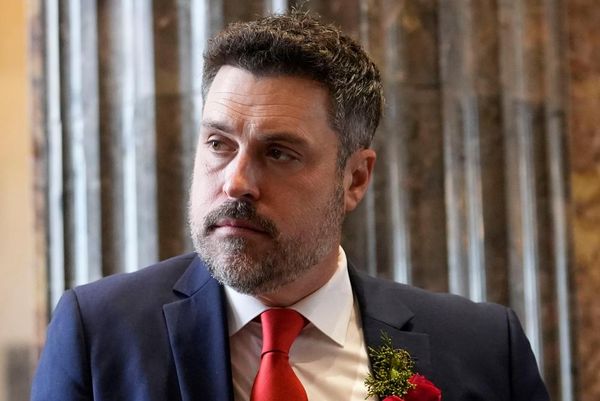
KANSAS CITY, Mo. _ Jason Kander, citing depression and post-traumatic stress disorder, is dropping out of the Kansas City mayor's race.
Kander posted a message on his campaign website and Facebook page saying that in the 11 years since leaving Afghanistan as an Army intelligence officer, he has experienced depression, nightmares and suicidal thoughts.
"Instead of dealing with these issues, I've always tried to find a way around them," Kander said. "Most recently, I thought that if I could come home and work for the city I love so much as its mayor, I could finally solve my problems. I thought if I focused exclusively on service to my neighbors in my hometown, that I could fill the hole inside of me. But it's just getting worse."
Kander's exit from the campaign to succeed Mayor Sly James upends the crowded race as much as his entrance did in June.
"It certainly comes as a surprise," said Quinton Lucas, a Kansas City Council member who is running for mayor. "My heart goes out to him. Jason has been a friend for years. I hope it's an example other veterans can follow to seek help."
Kander is also stepping back from day-to-day involvement with Let America Vote, a voting rights advocacy organization he founded last year.
His decision to abandon the mayor's race appears to have coalesced last week.
"Last Tuesday, I found out that we were going to raise more money than any Kansas City mayoral campaign ever has in a single quarter," Kander's announcement said. "But instead of celebrating that accomplishment, I found myself on the phone with the (Veterans Affairs) Veterans Crisis Line, tearfully conceding that, yes, I have had suicidal thoughts. And it wasn't the first time."
Kander said he first contacted the VA for help about four months ago.
Kander was seen as the runaway favorite to win the mayor's race next April. His entrance into the race caused Jolie Justus, a Kansas City Council member and former Missouri state senator, to pull out of the mayor's race and focus on re-election to her 4th District council seat.
"He made what I'm sure was a difficult decision, but it was also a very courageous," Justus said in a tweet. "I'm going to take some time to let this settle in and talk to my wife and my friends about what's next for me, but in the meantime I'm also going to support Jason."
The immediate repercussions from Kander's withdrawal on the race were not clear on Tuesday.
"It will work itself out," Lucas said. "For today, I'm thinking of Jason."
Filing for the mayor's race opens in December and closes in January, giving plenty of time for aspirants to get back into the race.
"I feel like if someone has a personal issue, they need to attend to it," said Scott Wagner, a Kansas City Council member running for mayor. "If the reason given was true, it shows once again the importance of mental health in dealing with our veterans. I think it takes courage for him to do this."
Kander's service in the military has been part of his political profile. After one term as Missouri secretary of state, Kander ran in 2016 for U.S. Senate as the Democratic nominee against Republican incumbent Roy Blunt.
Kander's campaign famously featured a television advertisement in which he assembles a military rifle blindfolded.
Kander joined the Army National Guard in 2003 when he was a law student at Georgetown University, and volunteered for combat duty after graduation. According to his military service record, Kander was stationed at Camp Eggers, Afghanistan, from Oct. 2, 2006, to Jan. 1, 2007.
At the time, he was a second lieutenant, an intelligence officer responsible for "the collection of political intelligence and the development of timely strategic and operational assessments on issues and personalities within the government of Afghanistan," his service record said.
Kander told The Star in 2016 that he was never involved in firefights nor came under mortar or rocket fire. But his military records say his work "resulted in arresting enemies and saving lives" and he was "one of the only officers to volunteer for force protecting duty."
That meant manning a gun on missions, which put him at risk at a time when the Pentagon was stretched for personnel and materiel because it was fighting wars in both Afghanistan and Iraq.
"They (politicians) had made our maneuvers more dangerous," he told supporters at the opening of his Kansas City campaign office when he ran for senate in 2016. "And that's why I came back and started running for office."
In Kander's autobiography, "Outside the Wire," he draws on the emotions of his time in Afghanistan, describing his first trip on a Humvee in Afghanistan.
"I felt fearful, way beyond anything I'd ever felt before," he wrote. "This was, for the first time in my life, the raw, physical fear of being killed."
James, who cannot run again due to term limits, applauded Kander for sharing his story and taking care of his health.
"His track record of outstanding service and tireless work ethic have raised the bar for many who aspire to serve in elected office," James, who served in the Marines, said in a statement. "I applaud his bravery, and will do all I can to help him through his healing process."
Kander in his message did not rule out the possibility of a future in public life.
"I'll close by saying this isn't goodbye," Kander said. "Once I work through my mental health challenges, I fully intend to be working shoulder to shoulder with all of you again. But I'm passing my oar to you for a bit. I hope you'll grab it and fight like hell to make this country the place we know it can be."