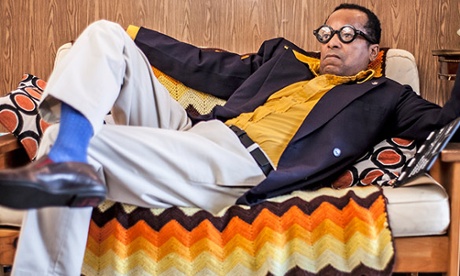
On the afternoon of Friday 9 June 1967, a select group was ushered into a fourth-floor screening room at the Museum of Modern Art in New York to view the latest film by Shirley Clarke, the Oscar-winning director and longtime participant in the downtown scene. The guestlist included Andy Warhol, filmmakers Elia Kazan and DA Pennebaker, Tennessee Williams, Allen Ginsberg and jazz critic Nat Hentoff.
Clarke must have particularly relished inviting Warhol, since the star of her project, Jason Holliday, was someone he had been trying to film. Disdainful of Warhol’s presence on the scene (he tried to move into the Chelsea Hotel, but couldn’t hack it, Clarke would scornfully tell people), she screened a film that afternoon which in fact bore comparison to 1965’s Screen Test No 2 – Warhol’s notorious film featuring superstar Mario Montez being cruelly interviewed off-screen by his lover, Ron Tavel.
Both Screen Test No 2 and Clarke’s Portrait of Jason have courted enduring controversy for the manner in which their white directors treat their subjects. The Puerto Rican Montez and African American Holliday were queer, gender-nonconforming men of colour who were both celebrated and travestied on the mostly white downtown scene of the 60s. Holliday became a superstar in his own right through Clarke’s film, but, like Montez, eventually disappeared from the New York scene.
Holliday (born Aaron Payne in Montgomery, Alabama in 1924) was a particularly mercurial persona. Beyond his filmed portrait by Clarke, and a comedy album he recorded in 1967 that went unreleased until almost a decade after his death in 1998, there is little evidence left in the archive of his performative brilliance.
Fortunately, what is there is definitive: minutes into Clarke’s film – in which Holliday is the only person on screen the entire time – one is assured of being in the presence of a marvel, as he discusses his life as a street hustler and aspirations to be a cabaret star in what Ingmar Bergman described as “the most extraordinary movie I’ve seen in my life”.
And yet, while Ginsberg praised Holliday for reaching “brilliant moments in a total run-down of his soul history” over the course of Clarke’s feature, and while the French philosopher Gilles Deleuze took time in his treatise Cinéma II: L’Image-temps (1985) to elaborate on Holliday’s particular style of fabulation, even Clarke herself was disturbed enough by the film she screened at MoMA to recut it before releasing the version most people have henceforth seen.
Clarke apparently removed an ugly confrontation at the end between Holliday and an off-screen Carl Lee. In the version that survives, Lee, a film star and Clarke’s former lover, is heard lighting into Holliday for spreading lies about him, bringing the formerly ebullient Holliday to wretched weeping, which Lee and Clarke scornfully reject as crocodile tears. Having exposed the charming Holliday as a liar and snake, Clarke calls it a wrap. It is an astonishing and disturbing denouement.
Seven minutes of this “lost confrontation” are a DVD extra in the restored version of her film released by Milestone Film & Video. But the antagonism between Holliday and Clarke – Holliday threatened legal action over the film – endured, and shapes the reception of a powerful new film by Stephen Winter that reimagines the production of Portrait of Jason.
When Winter’s Jason and Shirley (2015) screens at MoMA next month, it will add another chapter to a saga that began almost a half century ago. The film is based on footage taken from an improvised re-creation of Clarke’s original 12-hour film shoot in her Chelsea Hotel apartment, and stars Jack Waters (playing Holliday) and Sarah Schulman (playing Clarke). Legends of the downtown in their own right, they are the right interpreters of this difficult story.
Shot in pixelated color video, Jason and Shirley looks nothing like the black-and-white original, nor is it a shot-for-shot remake. It is rather an attempt to dig a little deeper into the dynamic of attraction and repulsion between the auteur and her star, and offers one plausible answer to the question that has bedeviled viewers of the confrontation.
Clarke felt Holliday had stolen her man from her, or had been spreading rumors that Lee had had sex with him. Luring him to her apartment to receive the celluloid star billing he longed for must have struck her as a particularly apt revenge, at once putting him in his place and confirming her own virtuosity as cinematographer of the Manhattan demimonde.
Something went wrong with her plan, however. In the long weeks in the editing bay, Clarke reports that she came unexpectedly to “love” Holliday. Such a love also clearly animates Water’s improvised performance. His Holliday is a mess, but he is not wretched; he has dreams and ambitions that will not be tamed by liquor, drugs or Clarke and Lee’s psychodrama.
Commenting on the re-release of the original in 2013, the critic Armond White shared Clarke’s own judgment of her subject as a man who longed to be in front of a camera, but had not learned to hide himself from it. Such Warholian “not-acting” shines through Waters’ reinvention of Holliday and Schulman’s no-nonsense interpretation of Clarke.
Although the burnishers of Clarke’s legacy have regrettably chosen to see things otherwise, Jason and Shirley is the best possible thing that could happen to Portrait of Jason. For generations of queer men of color who have been horrified by Holliday’s on-screen fate, Jason and Shirley offers a reinvention of a historical moment that sought to consign them to the roles of mascots and scapegoats. Once disposable, in Winter’s able hands Holliday returns, available for reinvention.
“I would like to say in passing, before I go,” Holliday says on his spoken word album, “I’m not ashamed of being a star, but I got a little uptight about how I became one. There were so many beautiful things that I could have done. But I just wasn’t given the opportunity.”
Jason and Shirley cannot redeem Holliday’s lost opportunity, of course. But it can remind us of what might have been.