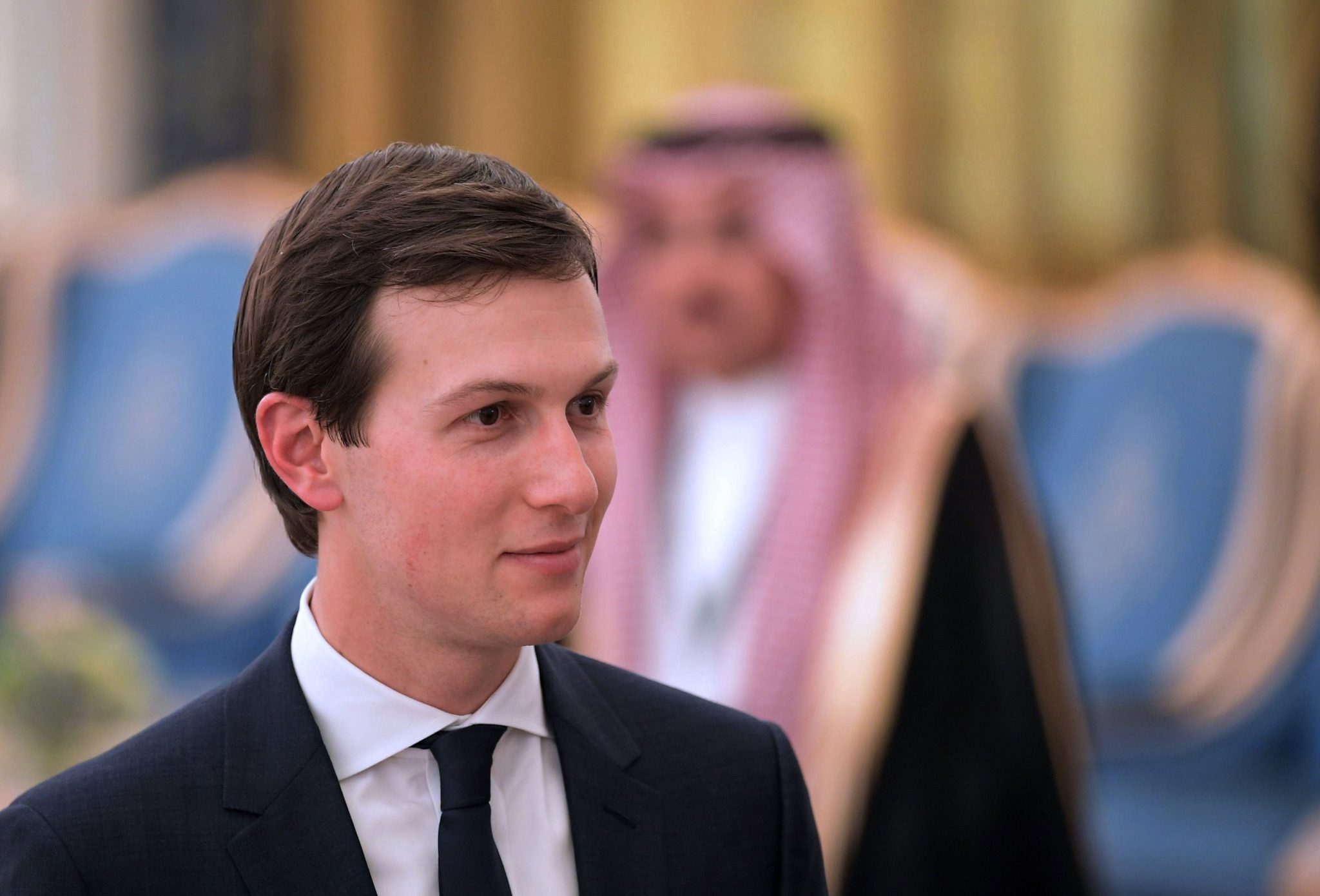
Jared Kushner has quietly reemerged as a player in one of the biggest takeover fights in modern Hollywood. Paramount’s audacious, all-cash $108 billion hostile bid for Warner Bros. Discovery, announced Monday, names Kushner’s fully owned private equity firm, Affinity Partners, as one of four outside financing partners backing the offer, alongside the sovereign wealth funds of Saudi Arabia, Abu Dhabi, and Qatar.
Axios first reported the involvement of Saudi and Gulf investment.
The detail is buried in Paramount’s tender offer, with Paramount listing “the Public Investment Fund (Kingdom of Saudi Arabia), L’imad Holding Company PJSC (Abu Dhabi), Qatar Investment Authority (Qatar), and Affinity Partners (Jared Kushner)” as investors who would, under a successful deal scenario, hold nonvoting equity and forgo governance rights, including board seats.
The filing also states that because these investors are structured without such rights, “the Transaction will not be within CFIUS’s jurisdiction,” referring to the Committee on Foreign Investment in the United States. Reports have suggested that WBD’s board opted for Netflix’s deal as it lacked any foreign financing components and therefore faced no issues with CFIUS, a notably opaque and powerful antitrust tool that the government can employ to block controversial mergers.
Both Paramount and Netflix are likely to increase their offers. Paramount CEO David Ellison said on CNBC that he told the CEO of Warner Bros., David Zaslav, that $30 per share wasn’t the company’s best and final offer.
Kushner’s Middle Eastern ties
Kushner’s inclusion reflects a broader fact pattern: Since leaving government, his firm has raised several billion dollars from Gulf investors and has participated in large private transactions involving capital from the same region. In September, his firm joined Silver Lake and Saudi Arabia’s Public Investment Fund in the $55 billion agreement to take Electronic Arts private, the largest private-equity buyout in history.
Wall Street Journal reporting shows Kushner helped connect Silver Lake with PIF leadership earlier in the year as discussions around an EA buyout accelerated. Affinity Partners ultimately took a roughly 5% stake in the transaction, alongside Silver Lake and PIF, which financed the majority of the equity. The EA deal marked the first time Kushner’s fund appeared in a major global technology buyout of that scale, and it involved the same Gulf investors who now appear in Paramount’s financing package.
Kushner has also remained active in Middle East political diplomacy, not just financial. He played a meaningful role in the administration’s recent Israel-Gaza peace effort, brought in because of his involvement in negotiating the Abraham Accords during Trump’s first term, which established diplomatic ties between Israel and several Gulf states including Saudi Arabia. The Gulf state is increasingly opening up, especially with regard to Western businesses, as highlighted by Barclays’ confirmation in late October at the Fortune Global Forum in Riyadh that it was relocating its regional headquarters there. Separately at the forum, Saudi Investment Minister Khalid A. Al-Falih described the breakthroughs occurring under Vision 2030, the kingdom’s economic transformation plan that is roughly nine years old. He said he saw 2025 as a “pivotal moment,” when “the very foundations of global business are being shaken, in a way, and being rewritten before our own eyes.”
The deal took on new political dimensions over the weekend, with President Donald Trump publicly weighing in on Netflix’s agreement to acquire WBD’s studio and streaming assets. Speaking to reporters on Sunday, Trump said the Netflix–WBD deal “could be a problem” because of the combined businesses’ market share, and noted that he expects to be involved in the review process. He also confirmed meeting with Netflix co-CEO Ted Sarandos in the Oval Office shortly before the deal was announced by Netflix, saying Sarandos had made “no guarantees” about the transaction.
Trump did not confirm the scoop by Bloomberg’s Lucas Shaw, who wrote in his influential entertainment newsletter that Sarandos has been wooing Trump since late November, when he visited Mar-a-Lago. Trump did indicate, however, that he has a good relationship with the Netflix leader, calling Sarandos a “fantastic man” who had played a major role in building Netflix into a great company. Netflix executives expressed confidence in regulatory approval on Friday’s call with analysts about their deal, worth $72 billion in equity and about $83 billion including the assumption of debt.
The political plot thickens
The political overtones of the wrangling here are at least worth noting. Paramount was recently acquired by David Ellison, son of longtime Republican donor Larry Ellison, whom Trump named as one of several U.S. billionaires to take control of the U.S. assets of TikTok. (Bloomberg’s Shaw reported that Sarandos was interested in the Paramount studio before Ellison acquired it.) Meanwhile, Sarandos is married to Nicole Avant, who was ambassador to the Bahamas during the Obama administration. Netflix cofounder Reed Hastings is a prominent and longtime Democratic donor, although Hastings is now nonexecutive chairman at Netflix and has been focused on his Powder Mountain resort in Utah, acquired shortly after Fortune’s article about the resort in 2023.
Paramount explicitly argued that its own proposal carries fewer regulatory risks than Netflix’s. In its filing, the company contends that the Netflix agreement faces significant antitrust hurdles, including a long potential review timeline. Paramount also emphasizes that its outside financing—because it is nonvoting—does not trigger CFIUS review, eliminating one additional hurdle of national-security scrutiny.
Trump’s posture toward Paramount, however, has been mixed. Roughly 20 minutes after Paramount launched its hostile offer, Trump explicitly criticized Paramount management over a 60 Minutes segment featuring Rep. Marjorie Taylor Greene, writing on Truth Social that it was “NO BETTER THAN THE OLD OWNERSHIP.” Trump added: “Since they [Paramount] bought it, 60 Minutes has actually gotten WORSE!” CBS News and 60 Minutes, as is customary with news organizations, maintain that they have editorial independence from their ownership. Paramount settled a lawsuit brought by Trump over a certain 60 Minutes episode during the 2024 election, paying $16 million in July 2025, shortly before Ellison’s takeover won regulatory approval.
Separately on Monday, Larry Ellison told CNBC that he has had “great conversations” with Trump about the WBD bid, without elaborating.
Nidhi Hegde, executive director of the American Economic Liberties Project, wrote on X in response to Ellison’s remarks that “the correct option is neither Paramount nor Netflix buy Warner.
“The president inserting himself in the deal is obviously problematic, regardless of the parties involved,” said Hegde.
Disclosure: One of the authors worked at Netflix from June 2024 through July 2025.