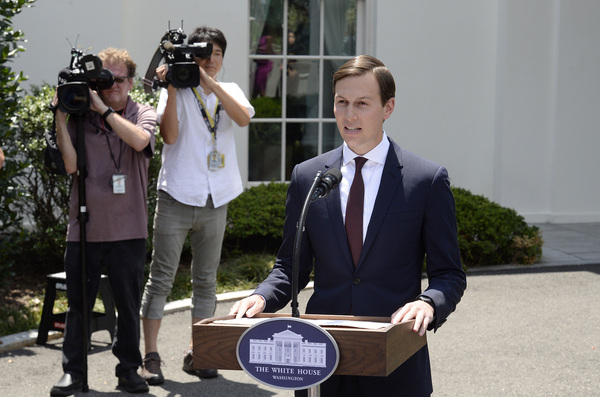
WASHINGTON _ Jared Kushner, who has spent months divesting pieces of his vast business empire to serve in the White House, was slapped with a fine by the Office of Government Ethics for late reporting of a financial transaction, according to a newly released document.
Another 17 White House staffers, including some of President Donald Trump's top aides, filed their required personal financial disclosure statements late, according to data compiled by American Bridge 21st Century, a Democratic opposition research group, and confirmed by McClatchy.
Reince Priebus, who served as chief of staff until recently, was four days late. Press secretary Sarah Huckabee Sanders was 23 days late. And Omarosa Manigault, director of communications for the Office of Public Liaison, received a 32-day extension but still missed her deadline by eight days.
Government watchdog groups say that, taken together, the multiple instances of tardiness signal that Trump's administration hasn't made ethics a priority, despite his pledge to "drain the swamp" of business as usual.
"These people coming in to public service should have the attitude of bending over backwards to ensure ... that the public interest is first and foremost in their mind," said Meredith McGehee, chief of policy, programs and strategy at Issue One. "Confidence in government is largely based on this notion that you don't have a conflict."
Under federal law, when those who are required to file financial disclosure statements are more than 30 days late doing so they must pay a fine of $200, payable to the U.S. Treasury.
The late fee can be waived if the White House's ethics officer determines that the tardy filing was due to "extraordinary circumstances ... which made the delay reasonably necessary," including the agency's failure to notify a worker of the need to file the disclosure report.
Separately, periodic transaction reports _ notifications that an employee has bought or sold stocks or other assets _ are considered late if they're filed more than 45 days after a transaction; typically, a $200 fine is levied after a 30-day grace period.
Kushner's fine is a relatively rare occurrence. Late fees were assessed on 3.6 percent of the more than 12,000 periodic transaction reports filed by federal government employees in 2016, according to an OGE survey of all executive branch agencies.
"What I'm concerned about is that it's a culture," said Lawrence Noble, general counsel of the Campaign Legal Center, speaking of the lateness of the White House aides' filings. "They are not taking it seriously."
The White House released financial disclosure forms in March for roughly 200 employees who are required to file them, offering details for the first time on the enormous wealth of many of the staffers. The reporting requirement is triggered if employees are high-ranking officials or are paid more than $161,755 annually, according to a senior administration official with knowledge of the situation but not authorized to speak publicly.
"President Trump acts like the rules for the rest of us don't apply to him and now his entire administration is doing the same," said Harrell Kirstein, a spokesman for the Trump War Room at American Bridge 21st Century.
Kushner, who negotiated a divestiture plan to serve as a top adviser to his father-in-law, President Donald Trump, will pay the fine, according to a White House official knowledgeable about the situation but not authorized to speak publicly as a matter of practice.
The late report for which Kushner was fined appears to involve JCK Cadre LLC, a real estate investment company. The transactions occurred in February, according to Kushner's most recent filing with OGE in late July.
Kushner and his wife, Ivanka Trump, were beneficiaries of a series of real estate and business companies worth up to $740 million, according to documents released by the White House in March. Earlier, Kushner announced that he would resign from executive positions at more than 200 entities, divest some companies and transfer others to his mother and brother.
Thirteen other White House staffers have been issued certificates of divestiture by OGE, allowing them to defer capital gains taxes on assets they must sell to avoid a conflict of interest.
But there are no records indicating whether 10 of the 13 _ including Steve Bannon, assistant to the president and chief strategist, and Kellyanne Conway, counselor to the president _ have actually sold the assets in question.
The White House declined to comment on individual staffers, pointing out that a report filed as many as 75 days after an asset was sold might not be considered late, according to ethics rules, and that it would be possible to get extensions beyond that, as well.