Archive picture of kamikaze pilots preparing for their mission. Photo: EPA
Late last week saw the release of For Those We Love, a new ¥1.8 billion (£7.5m) Japanese war movie. A kamikaze film originally titled I Go to Die for You, it celebrates the bravery of the second world war suicide bomber pilots - and happens to be written and executive-produced by Shintaro Ishihara, Tokyo's extremely nationalist governor.
Ishihara, you may recall, came to international attention with his bill introducing compulsory singing of the national anthem in Japanese schools - and also for his charming belief, expressed in an interview with Shukan Josei, a national women's magazine, that "women who live after they have lost their reproductive function are useless".
Directed by Taku Shinjo, For Those We love is the latest in a recent trend of extremely militaristic Japanese blockbusters, aiming either to rewrite their second world war defeat in broadly heroic terms, or, like Junji Sakamoto's big-budget 2005 film Aegis (an Under Siege-style thriller set aboard a navy cruiser), to capture the sense of a dynamic, thriving Japanese military. This, despite the country being forbidden, under clause nine of its postwar constitution, from maintaining an army in the traditional sense. (Instead, Japan has "self-defence forces", who command only a fraction of the country's annual budget.)
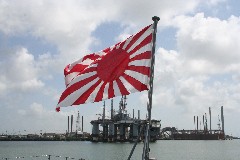
Sakamoto's film remains in many ways the perfection of the form. In it, the mutinous crew-members are inspired by a rightwing tract decrying their country's emasculation. They plot to launch a chemical weapon - American-made, naturally - into Tokyo. The film could hardly be accused of subtlety: at one point, we hear the polemic, "this country has been separated from its national essence!", while in the background, the flag of the Japanese Maritime Self-Defence Force - formerly the insignia of the Imperial Japanese Navy - flutters proudly in the breeze. Later, the hero, a dashing intelligence agent, complains of a "drifting Japan", too cautious and weak-willed to claim its rightful place on the world stage.
Ishihara-san would doubtless agree. This time, in For Those We Love, the setting is an airbase in Kagoshima, where hundreds of kamikaze pilots depart, their bellies filled with patriotic fire - and also a hearty last meal, courtesy of kindly local cook Tome Torihama, known to the doomed flyboys as "Kamikaze Mother".
There have been a number of such movies in the past five years. Ranging in tone from mildly conservative to rabidly rightwing, they provide a timely cinematic chorus to the growing calls for the country, in light of potential conflicts with a nuclear North Korea, to abandon the so-called "Peace Clause", and re-arm - a stance tacitly endorsed by former Japanese PM Junichiro Koizumi, and by Ishihara himself.
Most of the films have proved hugely successful in their home territory. Hearteningly, For Those We Love seems to have had the opposite effect: despite a strong opening weekend, in which it trailed only Spider-Man 3 and Kitaro, a local kiddie fantasy, it has not only provoked disquiet among both younger audience members and those who lived through the Japanese defeat, but has also drawn uncomfortable parallels between its heroes and the similarly unquestioning, ideology-driven suicide bombers of today.
Both director and screenwriter moved hurriedly into damage control. Shinjo rushed to assure journalists that he thought "the military leaders of the time were despicable".
Ishihara, though, was less conciliatory: the film was not at all pro-war, he said, and any claims to the contrary could mostly be attributed to a single factor: "foreigners".