To detect the inception of an outbreak of the novel coronavirus before the number of infected people further increases, eight universities are checking the amount of the virus in sewage.
The novel coronavirus can be found in the feces of infected people as well as in their saliva. In March, a Dutch team first detected the virus in sewage, and the United States, Australia and Italy also succeeded in finding it.
It is not known whether virus-contaminated sewage is contagious. The World Health Organization stated in April that the possibility of the virus being transmitted via feces is low.
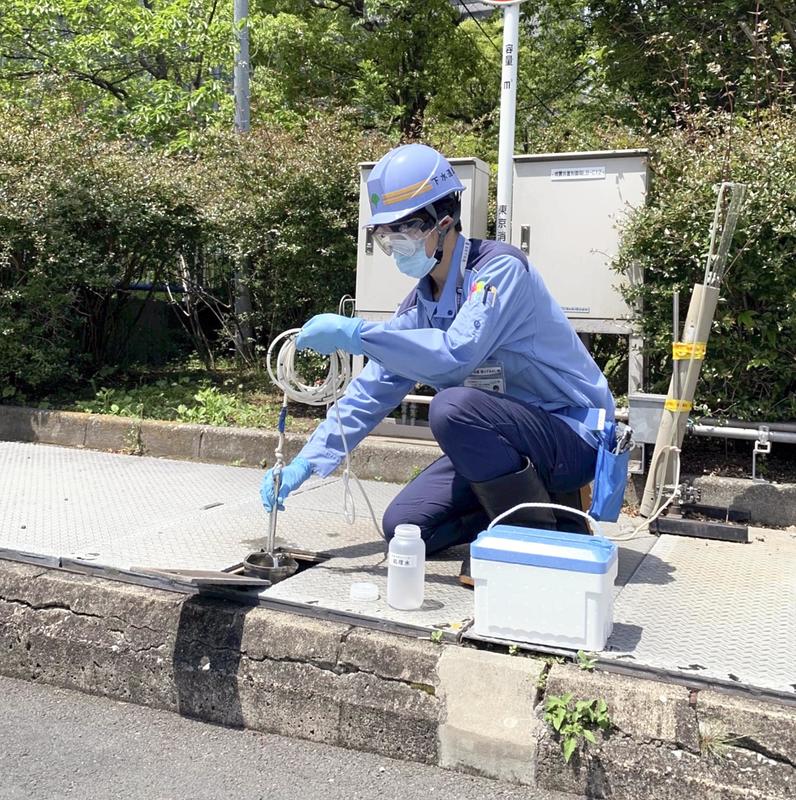
About 30 local governments, including Tokyo, Osaka Prefecture and Kitakyushu, have pledged to cooperate with the universities' research as the virus has been detected in sewage in some areas.
The next task is to improve the accuracy of virus detection. Researchers involved said they want to establish an accurate method by autumn in order to prepare for a second wave of infections.
It is difficult to detect an outbreak because some people infected with the novel coronavirus are asymptomatic. Once technology is in place to measure the amount of the virus from sewage, communities that manage sewage can monitor the condition to detect an outbreak before it becomes more prevalent.
The eight universities -- Hokkaido University, Yamagata University, Tohoku University, the University of Tokyo, University of Yamanashi, Kanazawa University, Toyama Prefectural University and Kyoto University -- began studying sewage this spring.
In May, the Japan Society on Water Environment, which comprises experts in environmental engineering, established a special task force, appointing Kanazawa University Associate Prof. Ryo Honda as secretary general, and called on local governments to provide sewage samples.
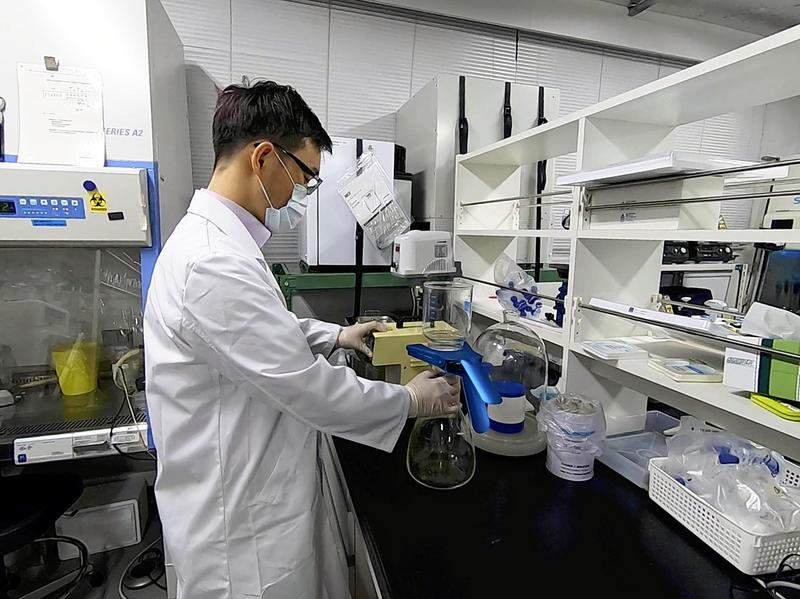
In the study, untreated sewage is sampled periodically, concentrated and then tested in PCR tests to check the amount of the virus. The volume is compared with the number of people infected with the virus in each local government, from which researchers try to derive a method to understand the situation of infections.
As the number of people infected with the virus is low, the researchers will analyze the data, including sewage sampled in the past that has been kept frozen.
"In order to detect epidemics, it is necessary to establish a concentration method that improves the accuracy of detection," said Hokkaido University Assistant Prof. Masaaki Kitajima in the Division of Environmental Engineering.
Hokkaido University, University of Yamanashi, Kanazawa University and Toyama Prefectural University have so far successfully detected the virus in sewage collected in such areas as Ishikawa and Yamanashi prefectures.
The Tokyo metropolitan government has been collecting sewage samples regularly since May, and the University of Tokyo has been analyzing it.
The Kitakyushu municipal government, in cooperation with the University of Tokyo and Hokkaido University, plans to get a sample once a week at the city's largest sewage plant that deals with waste produced by 340,000 people.
"If we can quickly detect the spread of the infection, it will be of great help to administrative and medical personnel," a city official said.
"If a unified method to estimate infection status from sewage is established, a nationwide monitoring system will be formed," said University of Tokyo Prof. Hiroaki Furumai, who analyzes sewage in Tokyo and Yokohama among other areas.
In the past, examples of surveys of sewage include that conducted by Israel amid a polio outbreak.
In Japan, monitoring sewage for the poliovirus has been carried out since fiscal 2013.
Read more from The Japan News at https://japannews.yomiuri.co.jp/